



A performance agency lost a $40k/month client because they recommended multi-touch attribution for a business that needed incrementality testing. The client's CFO questioned every number in their reports. The agency couldn't defend their approach, and the relationship collapsed in six weeks.
This wasn't about bad measurement. It was about applying the wrong framework to the wrong business context.
Most agencies pick measurement approaches based on comfort level, not what fits the client's actual situation. Teams run sophisticated data-driven attribution models for local service businesses with a dozen monthly conversions. Others force rule-based attribution onto complex B2B accounts with eight-month sales cycles and dozens of touchpoints.
The media mix decision framework isn't just picking between MMM, holdouts, or attribution models. It's matching measurement sophistication to business maturity, data availability, and decision-making needs.
Why measurement misalignment destroys agency-client relationships
Measurement mismatches create operational failures that compound over time.
Credibility erodes first. When a small ecommerce brand spending $15k monthly sees Marketing Mix Modeling outputs, they know something's off. They might not understand why a statistical model requiring multiple years of data doesn't work for their eight-month-old business, but they feel the disconnect. Every recommendation gets questioned afterward.
Resource waste follows. Agencies burn 40+ hours monthly maintaining measurement infrastructure that provides zero actionable insights. One team spent three months building a custom attribution model for a client whose entire spend went to Facebook and Google. The client needed basic creative testing insights, not channel attribution modeling.
The worst failure: decision paralysis. When measurement complexity exceeds client understanding, they stop trusting the data entirely. A regional healthcare network received 60-page MMM reports quarterly. Their marketing team couldn't translate any insights into tactical changes. They eventually returned to last-click Google Analytics because at least they understood it.
About 65% of measurement failures stem from framework misalignment, not technical problems.
The decision tree that actually works
The media mix decision framework starts with three qualifying questions:
Eliminate marketing chaos with streamlined campaign control.
Digmaly lets you plan, execute, and track every campaign effortlessly.
- Unified campaign management
- Real-time client reporting
- Collaborative team workflows
No credit card required
Data maturity assessment:
-
Under 500 conversions monthly → Rule-based attribution only
-
500-5,000 conversions monthly → Data-driven attribution possible
-
Over 5,000 conversions monthly → Advanced approaches viable
Budget threshold reality:
-
Under $50k monthly → Single-source attribution
-
$50k-$250k monthly → Multi-touch attribution or basic holdouts
-
Over $250k monthly → MMM becomes feasible
Business complexity factors:
-
Single channel dominant (>70% spend) → Simple attribution sufficient
-
2-4 active channels → Multi-touch attribution or geo-holdouts
-
5+ channels with TV/OOH → MMM consideration warranted
These thresholds are just entry points. The real decision branches based on operational constraints most agencies ignore.
A DTC supplement brand doing $3M annually might have volume for sophisticated attribution, but if their entire team is two people using Shopify reports, implementing a data warehouse and custom attribution creates more problems than it solves. A B2B software company with only 200 monthly conversions might need complex multi-touch modeling because their average deal size is $180k and involves multiple stakeholders.
Start: Monthly media spend level │ ├─ Under $30k/month │ └─ Rule-based (last-click or simple multi-touch) │ → Contract commitment: Weekly channel performance │ → Reporting cadence: Bi-weekly dashboard updates │ ├─ $30k-$100k/month │ ├─ High transaction volume (>2,000/month) │ │ └─ Data-driven attribution (GA4 or platform-specific) │ └─ Low transaction volume (<2,000/month) │ └─ Rule-based with quarterly holdout tests │ ├─ $100k-$500k/month │ ├─ Single dominant channel (>60% spend) │ │ └─ Platform attribution + geo-holdouts │ └─ Multi-channel spread │ ├─ B2C/short cycle → Data-driven attribution │ └─ B2B/long cycle → Custom multi-touch + incrementality │ └─ Over $500k/month ├─ Stable media mix → Quarterly MMM └─ Evolving media mix → Monthly incrementality + Annual MMM
Matching measurement to actual business operations
Technical possibility and operational feasibility are different things.
A fashion retailer spending $200k monthly across 8 channels technically qualifies for MMM. But if they're launching 50+ new SKUs monthly, running flash sales weekly, and pivoting creative themes based on TikTok trends, MMM's backward-looking insights arrive too late. They need real-time creative performance data and rapid incrementality tests, not quarterly mixed-media equations.
| Approach | Setup Time | Monthly Maintenance | Technical Skill Required | Client Understanding | Time to Insights |
|---|---|---|---|---|---|
| Rule-based Attribution | 2-4 hours | 1 hour | Basic analytics | Low | Immediate |
| Data-driven Attribution | ~1 week + 30-day learning | Few hours | Advanced analytics | Moderate | 30-45 days |
| Holdout Testing | ~20 hours per test | ~10 hours per test | Statistical analysis | Moderate-High | Test duration + analysis |
| Marketing Mix Modeling | Several months | ~20 hours quarterly | Data science expertise | High | 3-6 months initial |
Most agencies drastically underestimate maintenance burden. A mid-sized agency running data-driven attribution for 15 clients needs roughly 60-90 hours monthly just for maintenance, troubleshooting, and client education. That's before any optimization work.
Governance checkpoints that prevent measurement drift
Measurement approaches drift over time. The simple attribution model that worked at $50k monthly spend breaks at $200k. The MMM that provided clarity across 5 channels becomes noise across 12.
Quarterly measurement health review:
-
Every 90 days, assess
-
Has monthly spend increased significantly since last review?
-
Have we added multiple new channels?
-
Has conversion volume changed substantially?
-
Are stakeholder questions changing in complexity?
-
Is current measurement driving actual decisions?
Monthly data quality scorecard:
-
Track these operational metrics
-
Percentage of conversions properly attributed
Target >85%
-
Cross-platform data discrepancy rate
Target <15%
-
Time from data to decision
Target <5 business days
-
Client confidence score (simple 1-10 monthly survey)
Target >7
Automate the monthly data quality scorecard to catch issues before clients notice.
Escalation triggers that force measurement evolution:
-
When monthly spend exceeds $100k for consecutive months → Incrementality testing discussion required
-
When channel count exceeds 5 active platforms → Multi-touch attribution assessment required
-
When quarterly spend exceeds $1M → MMM feasibility review required
-
When attribution discrepancy issues exceed significant variance → Measurement approach review triggered
These are contractual obligations that protect both agency and client from measurement stagnation.
Contract language that sets proper expectations
Generic measurement language creates problems months later when clients expect insights your chosen approach can't deliver.
For rule-based attribution clients:
"Measurement Approach: Client's campaigns will be measured using last-click attribution with 30-day click and 1-day view windows as standard. This approach provides directional channel performance data suitable for budget allocation decisions under $50,000 monthly. Agency will deliver bi-weekly performance summaries showing channel-level ROAS and conversion metrics. This measurement approach does not provide: incrementality analysis, true multi-touch contribution, offline conversion impact, or brand lift metrics. Should Client's needs evolve beyond rule-based attribution capabilities, Agency will provide written recommendation for measurement approach upgrade with associated costs."
For data-driven attribution clients:
"Measurement Approach: Client's campaigns will utilize Google Analytics 4 data-driven attribution modeling, supplemented by platform-specific attribution where available. This approach requires minimum 500 monthly conversions for statistical reliability and 45-day model training period. Agency commits to: monthly attribution model health reports, quarterly cross-platform reconciliation, and bi-annual model performance reviews. Limitations include: iOS 14+ signal loss impact, cross-device attribution gaps, and offline conversion tracking requirements addressed separately. Transition to advanced measurement will be triggered by: significant increase in monthly spend, addition of offline media channels, or Client request for incrementality validation."
For MMM/Advanced measurement clients:
"Measurement Approach: Client's marketing effectiveness will be evaluated using quarterly Marketing Mix Modeling supplemented by ongoing incrementality testing. Initial model build requires 24 months historical data across all media channels, sales data, and external factors (seasonality, promotions, competition). Agency commits to: quarterly model updates, monthly incrementality test design and analysis, and executive-ready visualization of marketing contribution. Model limitations include: several week lag for new channel assessment, creative-level granularity not available, and competitive activity estimation based on observable data only. Governance: Quarterly model performance review with documented Mean Absolute Percentage Error (MAPE) targets of <10%."
When each approach actually fails
No measurement approach works everywhere.
Rule-based attribution fails when:
-
Multiple channels contribute equally to conversions
-
Customer journey exceeds 30 days regularly
-
Offline interactions matter (calls, store visits)
-
Budget exceeds $75k monthly across multiple channels
-
Stakeholders demand incrementality proof
A home services company spending $40k monthly on Google Ads might be perfectly served by last-click attribution if 95% of customers call within 24 hours. But the moment they add Facebook awareness campaigns, that same attribution model assigns zero value to top-funnel spend.
Data-driven attribution fails when:
-
Conversion volume drops below algorithm thresholds
-
New channels launch without historical data
-
Privacy changes eliminate signal (iOS updates)
-
Business model includes offline conversions
-
Long sales cycles exceed attribution windows
B2B SaaS companies faced this during 2021-2022. They relied on data-driven attribution while sales cycles stretched from 45 to over 120 days. The models kept attributing conversions to recent touchpoints while missing the webinars and content downloads from months earlier that actually drove pipeline.
Holdout testing fails when:
-
Geo-markets aren't comparable
-
Test duration is too short for statistical significance
-
Contamination between test/control groups
-
Budget doesn't support sustained holdouts
-
Multiple tests run simultaneously
A national restaurant chain tried running geo-holdouts across 6 markets simultaneously. Different regional competitors, varying demographics, and local promotion calendars made every test inconclusive. They burned significant test budget over six months without actionable insights.
MMM fails when:
-
Historical data quality is poor
-
Media mix changes faster than model updates
-
Investment levels don't vary enough
-
External factors dominate (pandemic, competitor actions)
-
Organization can't operationalize insights
The classic MMM failure: spending heavily on model development only to discover your client changes creative strategy every few weeks, runs unpredictable flash sales, and has three different teams buying media without coordination. Model outputs become academic exercises.
Building measurement evolution into agency operations
Measurement approaches aren't static selections. They're evolutionary paths built into operational infrastructure from day one.
Start with measurement maturity mapping during onboarding. Document where the client is today and where they need to be in 6, 12, and 24 months. A startup spending $20k monthly needs rule-based attribution now, but you should already be planning for data-driven attribution when they hit $75k monthly, and incrementality testing at $150k.
Create measurement migration playbooks that prevent disruption:
Phase 1 to Phase 2 transition ($30k → $75k monthly spend):
-
Month 1
Begin parallel tracking with new attribution model
-
Month 2
Run comparison reports showing both approaches
-
Month 3
Education sessions on new model insights
-
Month 4
Full transition with historical comparison available
Phase 2 to Phase 3 transition ($100k → $250k monthly spend):
-
Quarter 1
Design first holdout test while maintaining attribution
-
Quarter 2
Run test and analyze incrementality
-
Quarter 3
Integrate findings into attribution model
-
Quarter 4
Establish quarterly testing cadence
Your performance reporting strategy needs to anticipate these transitions. Don't wait until the client demands better measurement to start building infrastructure.
A real progression story
An online education platform started with $25k monthly spend entirely on Google Ads. Rule-based last-click attribution worked perfectly – simple, clear, actionable. Every dollar traced directly to a keyword.
At $60k monthly spend across Google and Facebook, attribution conflicts emerged. Facebook claimed 2.8x ROAS, Google showed 3.2x ROAS, but blended ROAS was only 2.1x. They transitioned to data-driven attribution, which took six weeks to stabilize but finally showed Facebook driving 40% of Google's branded search conversions.
By month 18, spending $180k across 6 channels including YouTube and podcasts, data-driven attribution hit its limits. They couldn't measure podcast impact, YouTube view-through value was questionable, and the CEO wanted proof that brand spending drove performance. They implemented quarterly geo-holdout tests supplemented by survey-based attribution for podcasts.
At $400k monthly spend in year three, they finally implemented MMM. But crucially, they maintained simpler attribution models for tactical decisions. MMM informed quarterly budget allocation, holdouts validated channel incrementality, and data-driven attribution guided daily optimization.
This progression took three years and substantial measurement infrastructure investment. But it matched measurement sophistication to business needs at each stage, avoiding both under-investment and over-engineering.
The coordination challenge agencies miss
The hardest part of evolving measurement approaches isn't technical implementation – it's organizational coordination.
When you transition from rule-based to data-driven attribution, you need:
-
Client education on why numbers will change
-
Historical data reprocessing for comparison
-
Stakeholder alignment on new success metrics
-
Platform configuration updates
-
Report template overhauls
-
Team training on interpretation
Most agencies budget for technical setup but ignore the coordination work. Then they wonder why clients resist the "obviously better" measurement approach.
Build coordination costs into your measurement evolution pricing. Rule-based to data-driven requires significant transition investment. Adding holdout testing means more substantial costs plus test budgets. Implementing MMM requires major year one investment, ongoing annually.
These aren't profit centers. They're investments in maintaining client trust through measurement transitions.
Making the framework operational with AI automation
The decision framework itself needs operational infrastructure. You can't manually assess every client's measurement readiness quarterly while managing actual campaigns.
Modern agencies build measurement assessment into their operational platforms. AI automation handles the qualifying data collection – pulling spend levels, conversion volumes, channel mix, and data quality metrics automatically. Instead of manual quarterly reviews, you get alerts when clients approach measurement transition thresholds.
For example: your operational software tracks that a client's spend has exceeded thresholds for consecutive months, conversion volume supports data-driven attribution, and they've added a third marketing channel. The system automatically generates a measurement evolution proposal with transition timeline, resource requirements, and contract amendments needed.
Sketch of the automation workflow:
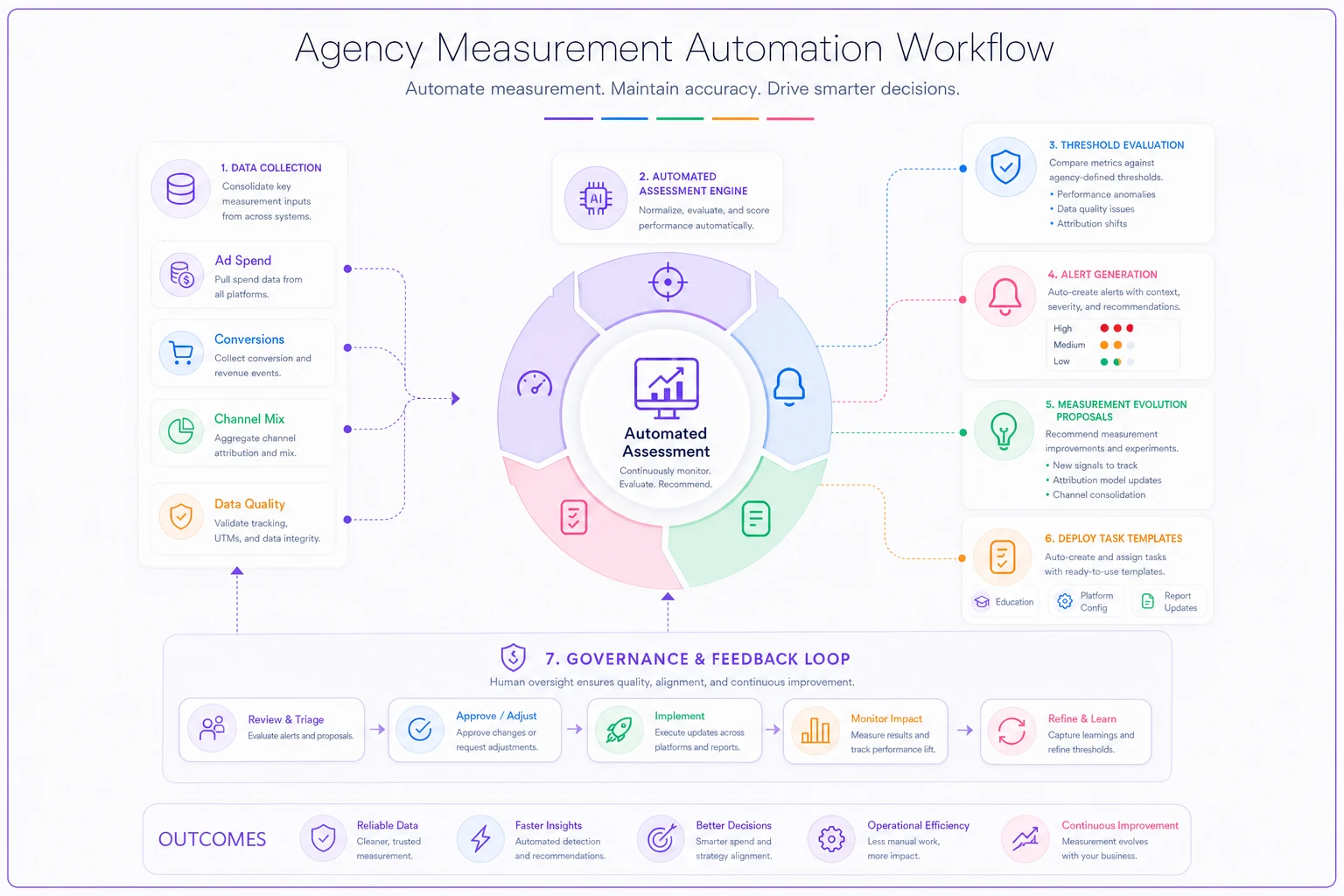
This same automation monitors data quality degradation. When attribution discrepancies exceed your thresholds or experiment sizing for A/B tests becomes statistically insufficient, you get alerts before client questions arrive.
The coordination overhead that kills measurement transitions also gets systematized. Task templates for stakeholder education, platform configuration, and report transitions deploy automatically when you approve a measurement upgrade. What took substantial project management becomes focused oversight.
The bottom line on measurement framework decisions
Your media mix decision framework isn't about choosing the most sophisticated measurement approach – it's about matching measurement complexity to operational reality.
Most agencies fail here by choosing measurement based on industry trends or technical capabilities rather than client operations. You end up with local dentists getting MMM proposals and enterprise retailers running on last-click attribution.
The framework that works starts with honest assessment of client data maturity, budget sustainability, and organizational readiness. Then it builds evolutionary pathways that prevent measurement approach obsolescence while avoiding premature sophistication.
The framework that works starts with honest assessment of client data maturity, budget sustainability, and organizational readiness. Then it builds evolutionary pathways that prevent measurement approach obsolescence while avoiding premature sophistication.
Ready to elevate your agency's performance?
Join 2,000+ agencies using Digmaly to save time, boost efficiency, and deliver superior client results.