


Attribution discrepancies aren't just annoying dashboard inconsistencies—they're operational cancer that spreads through every client relationship, every strategy meeting, and every renewal conversation. Working with agencies managing hundreds of accounts, I've watched this problem destroy more client trust than any other operational issue.
Most agencies treat attribution mismatches like they're inevitable. They slap a disclaimer on reports saying "platform numbers may vary" and hope clients don't dig deeper. But when your client's CFO asks why you're claiming credit for sales their internal system doesn't show, that disclaimer becomes your resignation letter.
The hidden cost of attribution chaos
Last month, an agency owner showed me their "reconciliation process"—basically a junior analyst manually copying numbers into Excel, highlighting differences in yellow, and adding a notes column that said things like "Facebook overcounts" or "Google's model changed." They were spending 14 hours per week on this busywork, and clients still didn't trust the numbers.
Time hemorrhaging: Account managers waste 3-5 hours per client monthly explaining why numbers don't match. That's pure overhead with zero strategic value.
Strategic paralysis: When you can't trust conversion data, you can't optimize campaigns. Teams end up making decisions based on gut feelings rather than data, which usually means overspending on underperforming channels.
Client erosion: Nothing destroys trust faster than conflicting success metrics. One agency lost a $45k/month retainer because they couldn't explain why their reported ROAS was double what the client's Shopify showed.
Team burnout: Your best people didn't join to become data janitors. When analysts spend more time reconciling numbers than analyzing performance, they start updating their LinkedIn profiles.
The real damage happens in compound effects. Attribution confusion leads to delayed decisions, which causes performance to drift, which creates more reporting complexity, which increases reconciliation time—a death spiral that ends with either the client or your best employees leaving.
Why platforms will never agree (and why that's actually fine)
Platforms don't just count differently—they exist in parallel universes with fundamentally incompatible physics.
Eliminate marketing chaos with streamlined campaign control.
Digmaly lets you plan, execute, and track every campaign effortlessly.
- Unified campaign management
- Real-time client reporting
- Collaborative team workflows
No credit card required
Facebook operates on a view-through attribution model that would make Google laugh. They'll claim credit for a conversion if someone saw your ad three weeks ago while scrolling at 2 AM, even if they later clicked a Google ad to actually purchase. Meanwhile, Google pretends view-throughs don't exist unless you specifically configure them, and even then applies different attribution windows.
GA4 adds another layer of chaos with its data sampling, session timeouts, and the delightful tendency to randomly decide certain conversions don't count because of "data thresholds." Then your client's internal systems—their CRM, their payment processor, their inventory management—each have their own version of truth based on when transactions clear, how returns are handled, and whether they count gross or net revenue.
The technical reasons are almost boring in their predictability:
-
Attribution windows Facebook's default 7-day click/1-day view versus Google's 30-day click-only versus GA4's whatever-you-configured-last-Tuesday
-
Cross-device tracking iOS 14.5+ turned Facebook's cross-device tracking into educated guesswork while Google maintains slightly better visibility through Chrome dominance
-
Conversion definitions That "purchase" event might fire at cart completion, payment processing, or order confirmation—each platform catching different signals
-
Time zone confusion Facebook reports in Pacific time, Google in your account timezone, GA4 in your property timezone, and your client's Shopify in Eastern
But here's what most agencies miss: Perfect reconciliation is impossible and unnecessary. Your goal isn't to make numbers match—it's to understand why they don't and build operational workflows that account for these differences.
Root-cause identification checklist
Technical implementation failures
Start here because these are fixable and often explain massive discrepancies:
-
Conversion pixels firing multiple times (check for duplicate event IDs)
-
Missing or broken UTM parameters causing traffic misclassification
-
Server-side tracking events not matching client-side pixels
-
iOS 14.5+ privacy features blocking conversion signals
-
Ad blockers preventing pixel fires (typically 15-30% of users)
-
Consent management platforms delaying or blocking tracking
Attribution model conflicts
These create systematic differences you can predict and explain:
-
Last-click versus first-touch versus data-driven attribution
-
View-through attribution enabled on some platforms but not others
-
Different conversion windows creating temporal misalignment
-
Post-view/post-click attribution hierarchies
-
Cross-device journey tracking capabilities
Data processing variations
The boring technical stuff that causes 10-20% variations:
-
Sampling thresholds in GA4 (kicks in above 10M events)
-
Time zone misalignments between platforms
-
Currency conversion timing differences
-
Return/refund handling delays
-
Batch processing schedules
Business logic mismatches
Where platform definitions don't match business reality:
-
What counts as a "conversion" (signup vs. trial vs. paid)
-
Revenue recognition timing (order vs. payment vs. fulfillment)
-
Customer deduplication methods
-
Multi-channel purchase credit distribution
Where platform definitions don't match business reality:
The stepwise reconciliation process
This is the actual process we've refined across hundreds of agency implementations. Not theory—this is what works when you need answers by tomorrow's client call.
Step 1: Establish source hierarchy
Pick your single source of truth. This isn't about which platform is "right"—it's about operational consistency.
For e-commerce: Client's payment processor or Shopify/WooCommerce backend For SaaS: Stripe or internal billing system For lead gen: CRM with qualified lead status
Everything else gets reconciled against this source. No exceptions, no debates.
Step 2: Create conversion ID mapping
Every conversion needs a unique identifier that travels across platforms. Without this, you're reconciling in the dark.
-
Generate UUIDs at conversion time and pass them through
-
Enhanced conversions to Google
-
Conversions API to Facebook
-
Custom dimensions in GA4
-
CRM custom fields
This takes maybe three hours to implement properly and saves hundreds of hours of reconciliation guesswork.
Step 3: Build time-boxed comparison windows
Stop comparing real-time data. Platforms process at different speeds.
-
T+3 days for initial reconciliation
-
T+7 days for weekly reporting
-
T+30 days for monthly performance reviews
Never reconcile same-day data. You're comparing incomplete datasets and creating unnecessary panic.
Here's a visual workflow of the stepwise reconciliation process.
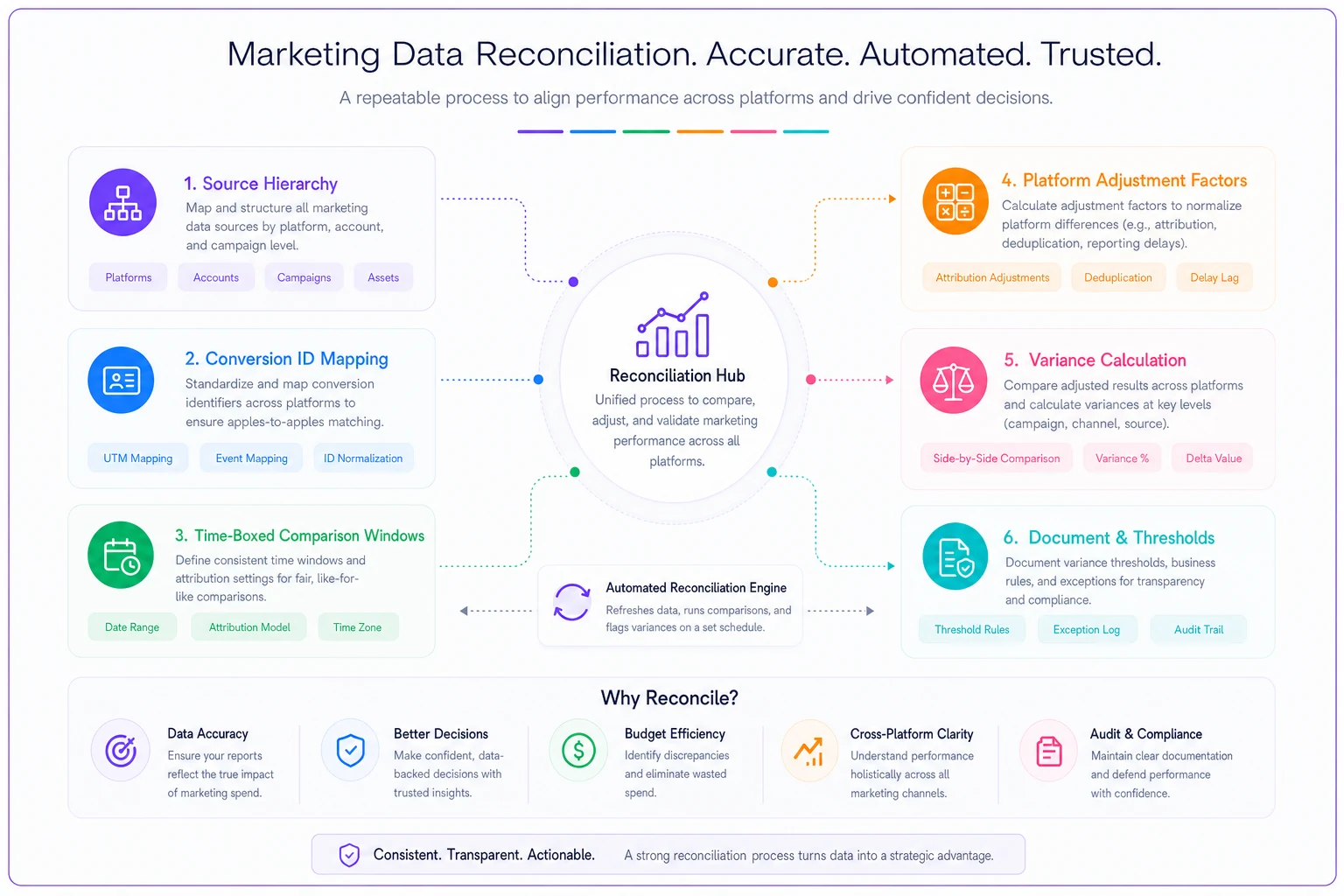
Step 4: Calculate platform adjustment factors
Every platform has predictable overcount/undercount patterns. Map them.
-
Track rolling 90-day averages
-
Facebook typically overcounts by 20-35% versus last-click
-
Google Search aligns within 5-10% of source truth
-
Google Display overcounts by 15-25% with view-through enabled
-
TikTok can be off by 40-60% (still figuring out their attribution)
Use these factors to set expectations, not to "correct" numbers. You're explaining variance, not eliminating it.
Step 5: Document variance thresholds
Not every discrepancy needs investigation. Set operational thresholds:
-
Under 10% variance
Note and continue
-
10-25% variance
Flag for weekly review
-
25-50% variance
Investigate within 48 hours
-
Over 50% variance
Immediate investigation
This prevents alert fatigue while catching real problems quickly.
Recommended reconciliation cadence
The rhythm matters as much as the process. Too frequent and you're chasing noise. Too rare and problems compound.
Daily spot checks (5 minutes):
-
Conversion volume directional alignment
-
Major platform outages or tracking breaks
-
Spend versus conversion rough ratio
Don't reconcile—just ensure nothing's completely broken.
Weekly tactical reconciliation (2 hours):
-
Platform adjustment factors still holding
-
New campaigns tracking properly
-
Conversion ID pass-through rates
-
Major variance investigations
This is where you catch problems before they become client conversations.
Monthly strategic analysis (4 hours):
-
Full platform-to-source reconciliation
-
Attribution model impact analysis
-
Adjustment factor recalibration
-
Client-ready variance explanations
Quarterly deep dive (8 hours):
-
Complete technical audit
-
Attribution model testing
-
Cross-client pattern analysis
-
Process optimization opportunities
The rhythm matters as much as the process. Too frequent and you're chasing noise. Too rare and problems compound.
Sample reconciliation worksheet
Here's a working template that actually gets used, not the 47-tab monstrosity that lives unopened in your Google Drive.
Basic Conversion Tracking
| Metric | Source Truth | Google Ads | GA4 | Variance % | |
|---|---|---|---|---|---|
| Total Conversions | 847 | 782 | 1,124 | 689 | -7.7% / +32.7% / -18.6% |
| Revenue | $42,350 | $39,100 | $51,200 | $38,900 | -7.7% / +20.9% / -8.1% |
| AOV | $50 | $50 | $45.55 | $56.45 | 0% / -8.9% / +12.9% |
| New Customers | 523 | 478 | 698 | 445 | -8.6% / +33.5% / -14.9% |
Attribution Window Analysis
| Platform | Same-Day | 1-Day | 7-Day | 30-Day |
|---|---|---|---|---|
| Google Ads | 45% | 72% | 94% | 100% |
| 23% | 51% | 89% | 100% | |
| GA4 | 67% | 84% | 97% | 100% |
Variance Investigation Log
| Date | Platform | Variance | Root Cause | Action Taken |
|---|---|---|---|---|
| 10/15 | +47% | View-through window enabled accidentally | Disabled VT, documented | |
| 10/18 | GA4 | -31% | Consent mode blocking EU traffic | Added server-side backup |
| 10/22 | -15% | Weekend batch processing delay | Adjusted comparison window |
Platform Adjustment Factors (90-day rolling)
-
Facebook to Source
× 0.74 (overcount by 35%)
-
Google to Source
× 1.03 (undercount by 3%)
-
GA4 to Source
× 1.09 (undercount by 8%)
Keep it simple. The moment your worksheet needs documentation to understand, it's too complex.
Building client trust through transparency
The agencies that thrive with attribution discrepancies don't hide them—they weaponize them as trust-building tools.
Start every client QBR with your variance report. Show them you're actively monitoring discrepancies, understand why they exist, and have processes to reconcile them. This transforms you from "vendor who might be lying about results" to "partner who ensures data accuracy."
Create standard explanation templates for common variances:
"Facebook shows 35% higher conversions than your payment system because it includes view-through attribution—people who saw an ad but purchased through another channel. This helps us understand Facebook's influence on the purchase journey, even when it's not the last click."
"Google Ads shows 8% fewer conversions than your CRM because of the 3-day processing delay in our integration. Week-over-week trends remain accurate, which is what we optimize against."
Never say "the numbers are different but trust us." Always explain why, show your work, and demonstrate your reconciliation process.
When to actually panic about discrepancies
Not all variances are created equal. These situations require immediate investigation:
Directional misalignment: If Google shows conversions increasing while your source truth shows them decreasing, you have a serious problem. Trends should always align even if absolute numbers don't.
Sudden variance changes: Your Facebook overcount jumping from 30% to 70% overnight means something broke. Usually iOS updates, pixel modifications, or attribution setting changes.
Channel-specific anomalies: If only Google Shopping shows weird numbers while Search stays normal, investigate immediately. Channel-specific issues often indicate feed problems or technical breaks.
Progressive drift: Variances that grow weekly indicate systematic issues—duplicate pixels, missing deduplication, or attribution window creep.
Client-reported mismatches: When clients say their numbers don't match yours, treat it as a red alert. They're comparing to something specific, and you need to understand what.
The software solution nobody talks about
Most agencies try to solve attribution discrepancies with more spreadsheets, more complex formulas, more manual processes. But reconciling attribution data is fundamentally an operational workflow problem that spreadsheets make worse, not better.
The agencies succeeding with attribution management have moved beyond manual reconciliation to automated operational platforms. Instead of analysts copying numbers between tabs, AI-powered operational software automatically pulls data from all platforms, applies your adjustment factors, flags variances outside thresholds, and generates reconciliation reports.
This isn't about replacing human judgment—it's about eliminating the 80% of reconciliation work that's pure data shuffling. Your team still investigates variances, adjusts models, and explains results to clients. But they're not wasting time on copy-paste reconciliation that AI automation handles in seconds.
The transformation happens in stages. First, you automate data collection across platforms. Then you build in your variance thresholds and adjustment factors. Finally, you create automated workflows that trigger investigations when discrepancies exceed limits. What took 14 hours weekly becomes a 30-minute review of pre-reconciled reports.
Operational software also maintains the audit trail agencies desperately need. Every variance, every adjustment, every investigation gets logged automatically. When clients ask why last month's numbers changed, you have the complete history instantly available.
Moving beyond reconciliation theater
The dirty secret about attribution reconciliation is that most agencies are just performing theater—elaborate displays of spreadsheet manipulation that create an illusion of control without actually solving anything.
Real reconciliation isn't about making numbers match. It's about building operational systems that acknowledge platform differences, establish clear hierarchies of truth, automate the mechanical work, and free your team to focus on what matters: improving campaign performance.
The agencies still drowning in manual reconciliation will keep losing clients to "trust issues" that are really operational failures. The ones who build proper reconciliation workflows—whether through disciplined processes or automated platforms—will keep clients longer, operate more efficiently, and actually have time to optimize campaigns instead of just reporting on them.
Your choice is simple: keep playing spreadsheet theater and hope clients don't notice, or build real operational workflows that turn attribution chaos into competitive advantage. The clients are already asking harder questions. The only question is whether you'll have better answers.
Ready to elevate your agency's performance?
Join 2,000+ agencies using Digmaly to save time, boost efficiency, and deliver superior client results.