



Running a campaign across six markets usually means six versions of the same ad diverging in ways nobody tracks. The German team shortens the headline because their legal reviewer flagged a superlative. The Brazilian team swaps the hero image because the original tested flat. The US team keeps the creative but changes the CTA color. Three months later someone asks a simple question — "which version of this concept actually performed best, and why?" — and nobody can answer it, because the versions were never connected to each other in the first place.
That's the real problem with multi-market creative. Not translation. Translation is the easy part. The hard part is that every localization decision creates a fork, and most agencies have no way to roll those forks back into a single learning. You end up with twelve winning ads and zero transferable insight.
The fix isn't a bigger spreadsheet. It's treating localization as a pipeline with rules — metadata that travels with each asset, versioning that preserves lineage, QA gates that catch drift before launch, and a mapping layer that lets you aggregate performance across markets even when the creative diverges. That's what a real creative localization workflow for an agency looks like, and most teams are missing three or four of those pieces.
Why cross-market learning leaks out of the process
The leak almost always starts at the same place: the moment a master asset gets handed to a local team, it stops being connected to its origin.
In practice, here's how it goes. A concept gets built centrally — call it "Q3 Value Prop, Variant B." It goes into a shared drive folder. The French team pulls it, makes a copy, renames it something like Q3FRfinalv2USE_THIS, and from that moment the asset has no idea it's a child of Variant B. There's no field anywhere that says "this is a localized derivative of the central concept, with these specific changes." The parent-child relationship exists only in someone's head, and that someone is going on vacation.
Multiply that by eight markets and three concepts and you get a folder of 40-plus assets that all look related but can't be grouped by anything meaningful. When reporting rolls up, it rolls up by ad account or campaign name — never by creative concept — so the thing you actually want to learn (does the "limited time" angle beat the "social proof" angle across cultures?) gets buried.
The second leak is the QA gate that doesn't exist. Local teams make changes under deadline pressure, and some of those changes are fine — translating copy, adjusting image crops — while others silently break whatever was being tested. If the central test was "short headline vs long headline," and the German team rewrites the headline to a completely different message because of character limits, you're now comparing apples to a different fruit entirely. The aggregated data still treats them as the same test.
These two leaks compound. No lineage plus no gate means you not only lose the learning, you can't even tell that you lost it. The numbers still look complete. They're just meaningless.
The metadata and versioning rules that actually hold
The foundation of a localization pipeline that preserves learning is a metadata schema that travels with the asset and never gets stripped during handoff. This is closely tied to how you structure your broader asset library — if you haven't already set that up, the mechanics in creative asset library governance are the prerequisite for everything below.
Eliminate marketing chaos with streamlined campaign control.
Digmaly lets you plan, execute, and track every campaign effortlessly.
- Unified campaign management
- Real-time client reporting
- Collaborative team workflows
No credit card required
For localization specifically, every derivative asset needs a few fields the master doesn't carry on its own:
-
Parent concept ID — the central concept this descends from, so performance can roll back up regardless of filename
-
Market — the specific locale, not just "EU"
-
Localization type — translation only, transcreation, full re-shoot, or partial swap (image, copy, CTA)
-
What changed and why — a structured note
"headline rewritten for 30-char limit," not "updated"
-
Test variable status — whether this derivative preserves the original test variable or alters it
-
Baseline reference — which market baseline its performance should be judged against
That last field matters more than people expect. Comparing a Japanese ad's CTR to a US ad's CTR as if they're the same scale is a mistake. Markets have different baseline performance, different auction dynamics, different creative norms. You judge a localized asset against its own market baseline first, then compare the relative lift across markets. A concept that beats its local baseline by 18% in three different countries is a real, transferable insight. Raw CTR comparison tells you almost nothing.
Versioning rules that keep lineage intact
-
A master concept gets a stable ID that never changes, no matter how many markets touch it.
-
Every localized derivative inherits that ID plus a market suffix and its own version counter.
-
When a derivative changes a test variable, it gets flagged as a variant branch, not a localization — because it's now a different experiment, not the same one in a new language.
-
Superseded versions are archived, never deleted, so you can trace why a market diverged.
Archive superseded versions rather than deleting them so you can always trace how and why a market diverged.
The versioning discipline sounds heavy until you've lived through the alternative — which usually looks like the intake-to-delivery mess the creative production SOP is designed to prevent. Lineage is just that same versioning rigor extended across markets instead of across revisions.
QA gates: catching drift before it poisons the data
A localization QA gate has one job that regular creative QA doesn't: it has to protect the integrity of the cross-market comparison. Normal QA asks "is this ad correct and on-brand?" Localization QA also asks "does this ad still belong in the same test group it claims to?"
The distinction matters. A gate that only checks correctness will happily approve a German ad where the headline was fully rewritten — because the rewrite is accurate German. But that approval just broke the experiment. The gate needs a second check: did any change alter a tracked test variable, and if so, has it been re-classified as a branch?
A workable gate structure looks like this:
| Gate | What it checks | What fails it |
|---|---|---|
| Linguistic | Translation accuracy, tone, legal/claims compliance per market | Mistranslation, non-compliant claim, wrong register |
| Variable integrity | Whether the test variable survived localization | Headline-length test broken by a full rewrite |
| Metadata completeness | Parent ID, market, change notes, baseline all present | Any required field blank |
| Technical | Specs, aspect ratios, character limits per platform | Truncated copy, wrong dimensions |
| Reuse eligibility | Whether this asset can feed reusable components | One-off exceptions flagged so they don't pollute the library |
The variable-integrity gate is the one almost nobody runs, and it's the single most valuable one for preserving learning. Without it, your "the short headline won" conclusion is built on data from a market where the headline wasn't actually short.
A useful rule: if a local team has to change a test variable — character limits force it, say — that's allowed, but the asset gets reclassified as a branch and reported separately. You don't lose the ad. You just stop pretending it answers the original question.
Market baselines and the reuse rules that save production time
Two things make a localization pipeline efficient instead of just rigorous: market baselines and reuse rules.
Baselines give you a fair yardstick per market so you're measuring lift rather than raw numbers. Set a rolling baseline per market and per format — the typical CTR, CVR, and CPA for that locale over a trailing window. New localized assets get scored against that baseline, which is what lets you compare a concept's relative performance across wildly different markets without getting distracted by the raw numbers.
Reuse rules decide what travels and what gets rebuilt. The pattern that works is a three-tier split:
-
Travels as-is
structural elements, layout logic, the core test variable, the measurement setup. These should never be rebuilt per market.
-
Travels with adaptation
copy, imagery, cultural references, CTA phrasing — localized but mapped back to the parent so the change is tracked.
-
Rebuilt per market
anything legally or culturally incompatible, re-shoots, market-specific offers.
The mistake agencies make is treating everything as tier three — rebuilding from scratch per market — which multiplies production cost and severs lineage every single time. A clear reuse tier means your localized assets stay connected to their parent by default, and only break that connection deliberately, with a reason on record.
Automated mapping for aggregated reporting
This is where the whole thing pays off. If every derivative carries a parent concept ID and a baseline reference, you can build a mapping layer that aggregates performance by concept across markets instead of by ad account.
The workflow in plain terms: pull performance from each platform, join it to the asset metadata on the parent concept ID, normalize each asset's numbers against its market baseline to get a lift score, then roll those lift scores up to the concept level. Now a single line in your report reads: "Social-proof angle: +14% median lift across 6 markets, strongest in BR/MX, flat in DE." That's a transferable learning — the kind you could never produce from a folder of disconnected files.
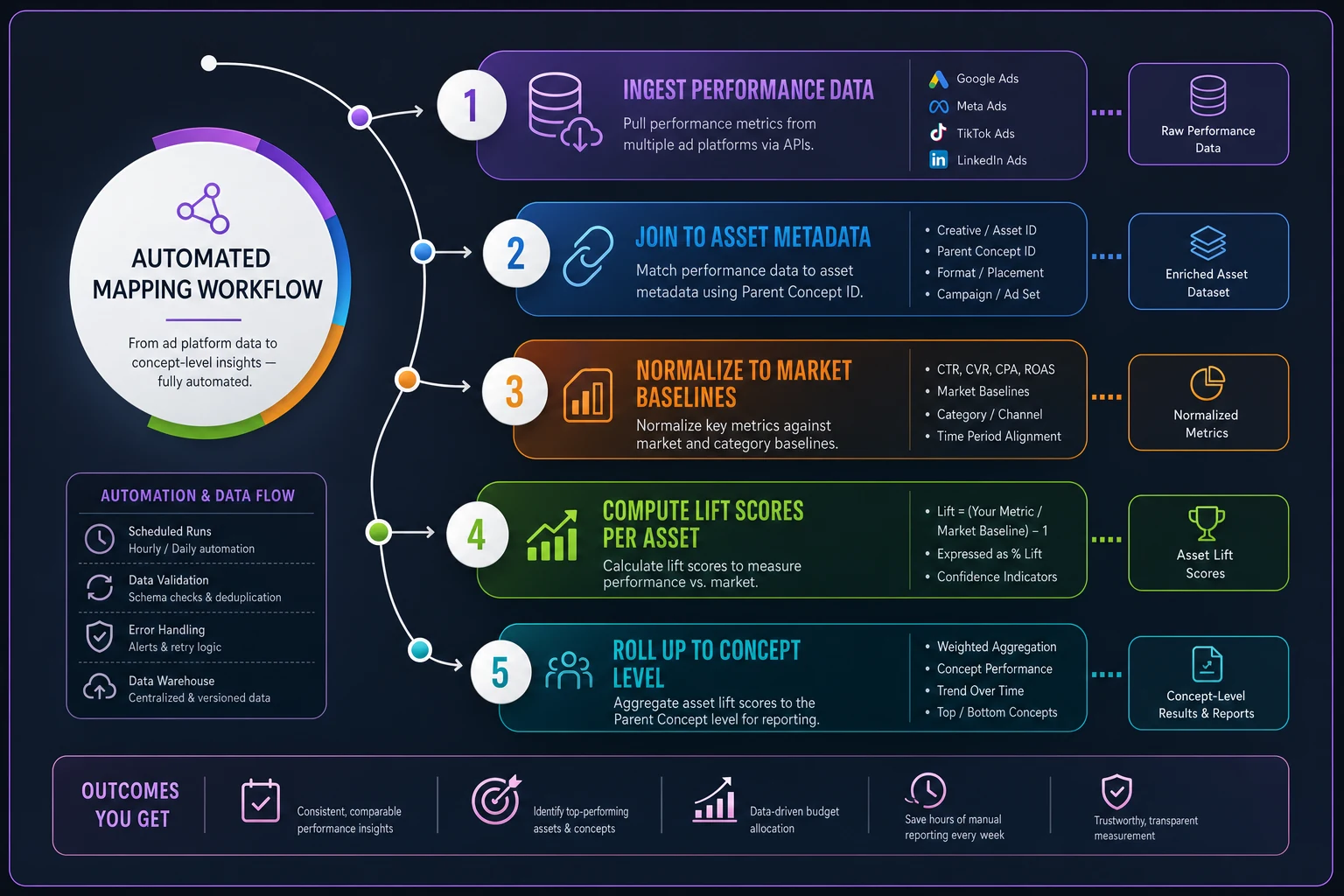
Automating the mapping matters because manual roll-up doesn't survive contact with real deadlines. The join between performance data and lineage metadata is exactly the kind of repetitive, rules-based work worth handing to automation — the mapping runs the same way every reporting cycle, flags assets with missing metadata, and separates true localizations from branches automatically. The point isn't automation for its own sake; it's that cross-market learning only accumulates if the roll-up happens reliably every time, not when someone remembers to do it.
One honest caveat: the mapping is only as good as the metadata discipline upstream. If the QA gate lets blank parent IDs through, the automated roll-up produces confident garbage. The pipeline is a chain — baseline, metadata, gate, mapping — and the weakest link sets the ceiling.
A real scenario
A mid-size performance agency was running a product-launch campaign across five markets — US, UK, Germany, Brazil, Mexico — for a DTC client. Three central concepts, localized by regional freelancers, roughly 35 live assets at peak.
Before any of this was in place, reporting rolled up by ad account. The client's monthly review was a wall of per-market CTRs with no cross-market story. When the client asked which creative angle to scale globally, the answer was essentially a guess. Production was also rebuilding most assets per market, so each new market added close to a week of lead time and real freelancer cost.
They implemented parent concept IDs, a market-baseline layer, a variable-integrity QA gate, and an automated concept-level roll-up. The first useful result showed up in the second reporting cycle: one of the three concepts was quietly outperforming its market baseline by 12–20% in four of five markets and was essentially flat in Germany — where the QA log showed the headline had been fully rewritten for length. The German case wasn't a failure of the concept; it was a broken test, now correctly flagged as a branch.
The client scaled the winning angle globally with evidence instead of instinct. Production lead time per new market dropped by roughly a third once reuse tiers were enforced, because structural elements stopped getting rebuilt from scratch. The bigger win was subtler: for the first time, the agency could say with data why a concept won — and carry that reasoning into the next quarter instead of relearning it from zero.
When this level of structure makes sense — and when it doesn't
This pipeline is overkill for a single-market advertiser or a client running one or two markets with occasional translation. The overhead of lineage tracking and baselines isn't worth it when there's nothing meaningful to compare across.
It starts paying off at roughly three-plus markets with shared concepts, repeated launch cycles, and a client who asks "what should we scale?" The more markets and the more frequent the launches, the faster the structure pays back — because the alternative is relearning the same lessons every campaign.
Teams that haven't got basic asset metadata and versioning working in a single market yet shouldn't rush into this. Localization lineage is the advanced layer on top of a functioning library. Bolt it onto chaos and you just get organized chaos. Fix the foundation first, then extend it across markets.
Worth naming one more thing: if your creative tends to decay faster in some markets than others, the localization pipeline pairs naturally with the kind of monitoring covered in automated creative fatigue alerts, because concept-level lineage lets you see fatigue at the concept level — not just per individual ad.
The thing most teams get wrong
Most agencies treat localization as a downstream production task — translate it, ship it, done. The learning problem stays invisible until a client asks a cross-market question nobody can answer, and by then the data to answer it was never captured.
The shift is small but it changes everything: treat every localized asset as a tracked derivative of a central concept, judge it against its own market's baseline, gate the changes that would break the comparison, and roll performance back up by concept. Do that, and five markets stop being five disconnected campaigns and start being one experiment running five times — which is the only way what you learned in Brazil ever helps you in Germany.
The shift is small but it changes everything: treat every localized asset as a tracked derivative of a central concept, judge it against its own market's baseline, gate the changes that would break the comparison, and roll performance back up by concept. Do that, and five markets stop being five disconnected campaigns and start being one experiment running five times — which is the only way what you learned in Brazil ever helps you in Germany.
Ready to elevate your agency's performance?
Join 2,000+ agencies using Digmaly to save time, boost efficiency, and deliver superior client results.