


The gap between what your sales conversations promise and what your delivery team can realistically ship is where most agencies quietly bleed margin. Not in dramatic ways. It shows up as the account manager who's suddenly running four accounts instead of two, the SLA credit you paid last quarter because a launch slipped, the senior strategist who quit because every quarter felt like triage.
Most agencies treat the proposal and the delivery plan as two separate universes. Sales closes the deal, throws it over the wall, and ops figures out how to make it work. That handoff — or the lack of one — is probably the single most expensive coordination failure in the agency model. And it gets worse as you grow, because the number of in-flight commitments multiplies while the mechanism connecting "what we sold" to "what we can staff" stays the same informal Slack thread it always was.
A real commercial operations alignment framework for an agency isn't a document. It's a set of connected triggers: win probability feeds capacity planning, service-tier commitments feed SLA obligations, and capacity impact feeds pricing and hiring decisions before the contract gets signed — not after the fire starts.
Why the proposal-to-delivery gap exists in almost every agency
The root cause is that sales and delivery optimize for different things and rarely share a scoreboard.
Sales is measured on closed revenue. So the incentive is to say yes — yes to the aggressive timeline, yes to the extra deliverable, yes to the SLA the prospect asked for because a competitor offered it. None of that costs sales anything at the moment of the promise. The cost lands on delivery three weeks later, and by then it's someone else's problem.
Delivery, meanwhile, has almost no visibility into the pipeline. They find out about a big new retainer when onboarding kicks off, which means capacity planning is always reactive. You can't hire ahead of demand you can't see. So you're perpetually either overstaffed (margin drag) or scrambling (quality drag, burnout, missed SLAs).
This isn't a personality problem or a "sales overpromises" problem. It's a missing feedback loop. There's no shared object that both teams look at that says: this deal, if it closes, consumes X hours of senior time, Y hours of specialist time, and commits us to these SLAs — and here's whether we can absorb that.
Without that object, everyone's guessing. And guessing scales badly.
What actually breaks as you grow
At five clients, informal coordination works. The founder knows every account, every commitment, every team member's load. The "system" is a shared brain.
Eliminate marketing chaos with streamlined campaign control.
Digmaly lets you plan, execute, and track every campaign effortlessly.
- Unified campaign management
- Real-time client reporting
- Collaborative team workflows
No credit card required
Somewhere between roughly 12 and 20 clients, that brain runs out of RAM. Here's the sequence that plays out repeatedly:
-
Capacity becomes invisible. Nobody can answer "can we take on this account next month?" with confidence, so the answer defaults to yes.
-
SLAs stop being uniform. Every deal gets slightly custom terms because sales negotiated them individually. Now delivery is tracking 14 different response-time promises with no central record.
-
Pricing drifts from cost. The price on the proposal reflects what the market will bear, not what the work actually consumes. Some accounts are wildly profitable, some are underwater, and nobody knows which is which until year-end.
-
Hiring is always late. You hire when someone's already drowning, which means the new person onboards into chaos and takes months to become useful.
The connective tissue here matters more than any single fix. This is the same argument behind why capacity formulas, hiring scorecards and profitability triggers should drive your agency operational playbook — the individual pieces only work when they feed each other.
The core idea: a decision matrix that connects the pipeline to capacity
The framework here is essentially one table that lives at the intersection of sales and ops. Every deal in late-stage pipeline gets scored across a few dimensions, and the combination of those scores triggers a specific action — pricing adjustment, hiring flag, or a "don't sell this as-is" warning.
Here's the shape of it:
| Win probability | Service-tier committed | Capacity impact | Triggered action |
|---|---|---|---|
| High (>70%) | Standard tier | Fits current slack | Proceed at list price |
| High (>70%) | Premium tier | Consumes >60% of a senior's remaining hours | Flag hiring review + confirm SLA staffing before signature |
| Medium (40–70%) | Premium tier | Over capacity | Price in a ramp premium OR push start date past next hire |
| High (>70%) | Custom SLA | Requires dedicated coverage | Route to ops for SLA feasibility sign-off before quote goes out |
| Low (<40%) | Any | Any | No capacity action; keep in pipeline forecast only |
The point isn't the exact thresholds — you'll tune those to your own numbers. The point is that win probability determines how seriously you treat the capacity impact. A 30% deal doesn't move your hiring plan. An 80% deal that would blow past a senior's availability absolutely should, and it should trigger that conversation while there's still time to price it in or delay the start.
This is the mechanism that's missing in most shops. The proposal isn't just a price document — it's the first place capacity and SLA reality should get stress-tested.
How the workflow actually runs
A deal hits 60%+ probability. The account executive fills in the two things sales already knows — the tier being discussed and the target start date. That auto-generates an estimated capacity draw based on your standard hours-per-tier model. Ops sees it in their weekly capacity review alongside every other late-stage deal.
If the combined draw of all high-probability deals exceeds available hours in the target month, the review surfaces it. Now there's a decision to make before anyone signs: adjust the price to fund a hire, push the start date, or decline the SLA the prospect wanted. That decision gets recorded against the deal, so when it closes, delivery already knows the terms and the staffing plan.
Compare that to the default: deal closes, onboarding email goes out, delivery discovers three weeks in that they're 40 hours short for the month.
The diagram below shows the flow from pipeline scoring to capacity review and triggered actions.
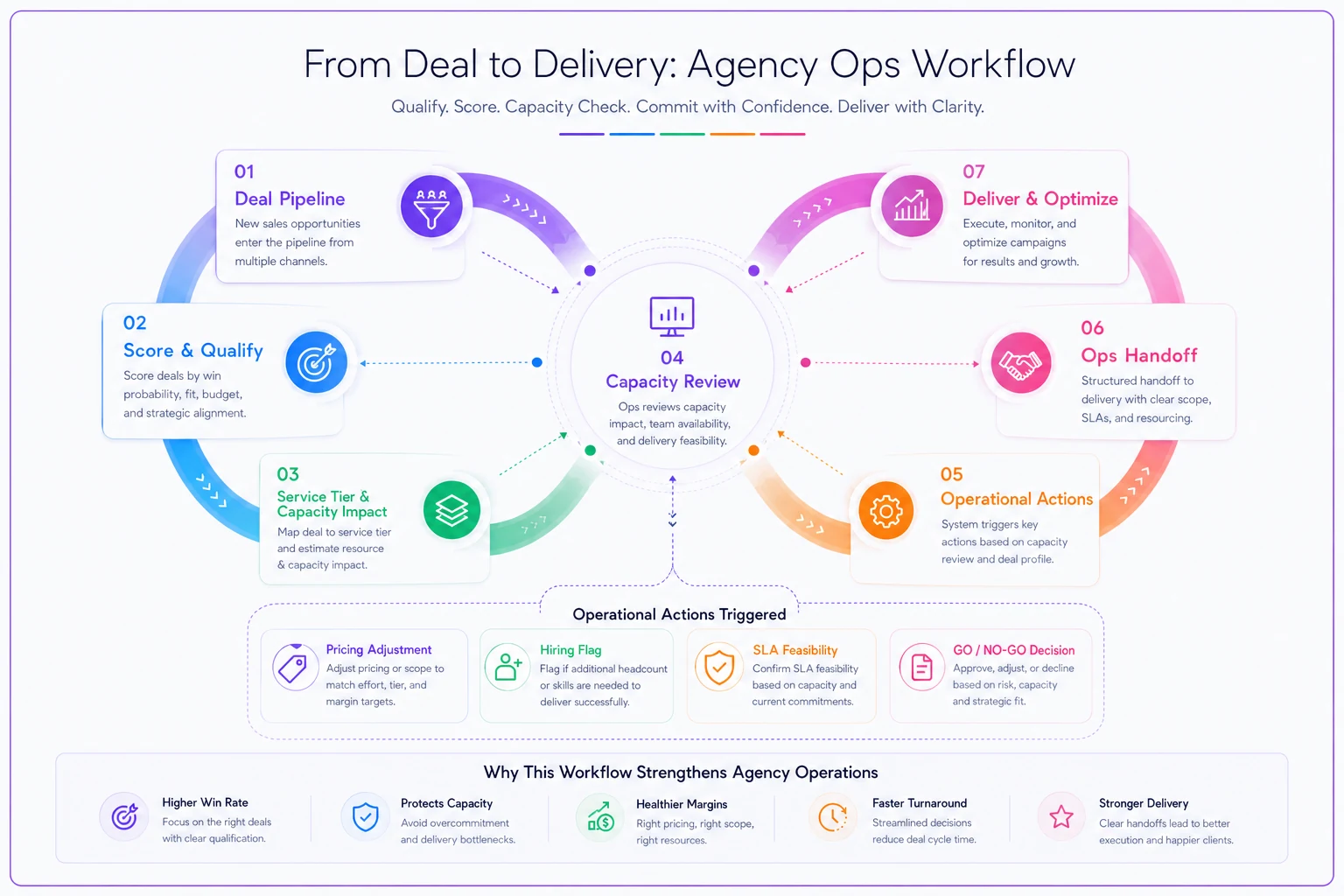
This visual maps the scoring steps to the operational triggers described above.
Turning tier commitments into contract-ready SLA clauses
The other half of alignment is making sure the SLAs you promise are the SLAs you can enforce and, when you miss, the ones you can afford to credit.
Custom SLAs negotiated deal-by-deal are a slow-motion disaster. The fix is a small library of pre-approved, tier-linked clauses that sales can attach without inventing new terms. Ops writes these once with delivery reality baked in.
A few clause patterns worth having ready:
Response-time clause (tier-scaled): > "Agency will acknowledge priority requests within [4 business hours for Premium / 1 business day for Standard]. Acknowledgment constitutes confirmed receipt and assignment, not resolution." That last sentence saves you constantly. Clients conflate "you replied" with "you fixed it."
Capacity-change amendment clause: > "Additions to scope exceeding [X hours/month] require a written amendment. Agency will provide a capacity and timeline assessment within [3 business days]; new work commences upon signed amendment and confirmed staffing availability." This is the clause that stops scope creep from silently consuming the margin you priced in.
SLA credit cap clause: > "Service credits for a given month shall not exceed [15%] of that month's fees and constitute Client's sole remedy for the applicable service level miss." Without a cap, one bad month can wipe out a full quarter of profit on an account. The mechanics of calculating and enforcing those credits deserve their own workflow, but the contract language is where you set the ceiling.
Align SLA credit caps with your fee structure so a single bad month can't erase a quarter's profit.
The connection back to packaging matters here — if your tiers themselves aren't built around defensible service levels, no clause library will save you. That's the argument in agency service packaging that doesn't scale: the SLA is only as safe as the tier structure underneath it.
The proposal → ops handoff template
The handoff is where alignment either happens or evaporates. A verbal "hey, we closed the Acme deal" is not a handoff. Here's a template that carries the commercial context into delivery without requiring a meeting:
-
Deal summary — client, tier, contract value, term length, start date.
-
Committed SLAs — pulled directly from the clause library, not re-typed. If a custom term was negotiated, it's flagged in red with the ops sign-off attached.
-
Capacity allocation — the estimated hours by role, and which team members are assigned. This should already exist from the pipeline scoring, not get invented now.
-
Pricing rationale — was this priced at list, or was a ramp premium or discount applied? Delivery needs to know if the account is running thin so they don't gold-plate it.
-
Known risks and promises — anything sales said in the room that isn't in the contract. This is the single most valuable field and the one always left blank.
-
Onboarding owner + first-week plan — who runs kickoff, and what the first deliverables are.
That fifth item — the verbal promises — is worth dwelling on. The most damaging commitments never make it into the contract. "We'll have that dashboard live in week one." "Sure, we can support the German market too." Delivery inherits these blind. A structured handoff forces them into daylight while there's still time to reset expectations. If you want the mechanics of a clean onboarding start once the handoff lands, the paid media onboarding checklist covers the delivery side of that first week.
A real scenario
A performance agency running around 18 retainers kept missing its own margin targets despite growing top-line revenue — roughly $190k/month in billings. The pattern: senior strategists were consistently over-allocated, two premium accounts were quietly running at a loss, and they'd paid out SLA credits three times in six months on custom terms sales had negotiated without ops review.
The change wasn't dramatic. They started scoring every deal above 50% probability against a simple hours-per-tier model, and they replaced custom SLAs with a five-clause library. Any deal that would push a senior past roughly 85% utilization triggered a mandatory pricing-or-timing conversation before the quote went out.
Over the next two quarters, a few things shifted. They walked away from two deals that would've been unprofitable at the price the prospect wanted — deals they'd have taken blindly before. They repriced one renewal that had been underwater. SLA credits dropped to zero because there were no more one-off terms slipping through. Utilization on the senior team settled into a saner band, and the founder stopped getting the Friday-afternoon "we're underwater on Acme" messages. Revenue growth actually slowed slightly. Margin improved noticeably. That trade was worth it.
When this framework makes sense — and when it doesn't
When it's worth building: You're past roughly 10–12 clients, you've got more than one person selling, and you've felt the pain of a closed deal you couldn't staff. If your delivery team has ever found out about a commitment after it was signed, you need this.
When it's premature: If you're a three-person shop where the founder sells and delivers, this is overhead you don't need yet. The shared-brain model still works. Building formal scoring matrices before you have the volume to justify them is just process theater.
Who should not do this: Agencies whose service is genuinely bespoke every time — where no two engagements share a tier or a repeatable hours model. If you truly can't standardize the work, the matrix won't hold. Though in practice, most agencies that say they can't standardize actually can; they just haven't tried to define their tiers clearly enough.
Where the tooling fits
You can run all of this in a spreadsheet and a shared doc, and plenty of agencies do at first. It works until the number of in-flight deals and active SLAs outgrows what a person can reconcile by hand — usually around the same point where the shared brain broke.
The value of putting this into connected operational software isn't the software itself; it's that the pipeline score, the capacity model, the SLA library, and the handoff stop living in four disconnected places. When a deal's probability updates, the capacity forecast updates. When it closes, the handoff populates from data that already exists. That reduces the manual re-typing and the "wait, what did we promise them?" gaps that cause most of these failures in the first place.
The takeaway
Commercial-operations alignment isn't about slowing sales down or making delivery say no more often. It's about making the two teams look at the same reality before a signature happens instead of after. The proposal is the earliest — and cheapest — place to catch a commitment you can't keep.
Score the deals that are actually likely to close, tie your tiers to SLAs you can enforce, cap your downside in the contract, and carry the full commercial context into delivery through a handoff that doesn't rely on anyone's memory. Do that consistently and the quarterly triage that most agency owners have come to accept as normal simply stops being normal.
Commercial-operations alignment isn't about slowing sales down or making delivery say no more often. It's about making the two teams look at the same reality before a signature happens instead of after. The proposal is the earliest — and cheapest — place to catch a commitment you can't keep.
Score the deals that are actually likely to close, tie your tiers to SLAs you can enforce, cap your downside in the contract, and carry the full commercial context into delivery through a handoff that doesn't rely on anyone's memory. Do that consistently and the quarterly triage that most agency owners have come to accept as normal simply stops being normal.
Ready to elevate your agency's performance?
Join 2,000+ agencies using Digmaly to save time, boost efficiency, and deliver superior client results.