



Every agency hits the same wall around 8-12 clients. You're profitable enough to survive but stretched too thin to grow. New business means working weekends. Hiring feels risky because you're not sure if the work will stick around. And somewhere between juggling client calls and reviewing creative, you realize you're running a business without actually knowing the operational math that drives it.
The capacity planning mistake that kills agency margins
Most agencies track utilization wrong. They look at billable hours divided by available hours and call it a day. But what actually matters is effective capacity versus theoretical capacity.
An account manager handling 5 clients at 80% utilization looks fine on paper. Until you realize each client requires 12 hours of actual work per week but generates scattered 30-minute tasks throughout the day. Those context switches destroy another 8-10 hours weekly. Your "80% utilized" employee is actually operating at 120% real capacity.
-
Internal meetings that could be async updates
-
Client communication scattered across email, Slack, and calls
-
Rework from unclear briefs or changing requirements
-
Knowledge transfer when team members switch accounts
The fix isn't tracking hours more carefully. It's building capacity formulas that account for reality:
Real Capacity = (Available Hours × 0.75) - (Clients × Switch Cost) - (Team Size × Coordination Tax)
-
Available Hours assumes 6 productive hours per 8-hour day
-
Switch Cost runs 2-3 hours per client per week
-
Coordination Tax equals roughly 30 minutes per team member per week
Run these numbers for your agency. You'll probably discover you're operating 20-30% over sustainable capacity, which explains why everything feels like it's on fire.
Hiring scorecards that predict success (not just skills)
Every agency owner has hired that perfect-on-paper strategist who couldn't handle client politics. Or the brilliant designer who melted down when given feedback. Traditional hiring focuses on portfolio and experience, but agency work demands something different.
Eliminate marketing chaos with streamlined campaign control.
Digmaly lets you plan, execute, and track every campaign effortlessly.
- Unified campaign management
- Real-time client reporting
- Collaborative team workflows
No credit card required
The pattern becomes clear after watching dozens of agency hires succeed or fail. The best performers score high on three dimensions most interviews miss:
Client Pressure Resilience Can they handle a client calling the work "completely wrong" without taking it personally? Ask about their worst client feedback experience. Winners tell stories about finding solutions. Losers blame the client or get defensive.
Ambiguity Navigation Agency briefs are never complete. Test this by giving incomplete information during the interview process. Do they ask smart questions or make reasonable assumptions? Or do they freeze up waiting for perfect instructions?
Context Switching Ability Nobody manages one project at a time in agencies. During interviews, interrupt them mid-answer with a "quick question" about something else. Can they pivot smoothly and return to their original point? This mirrors daily agency reality.
Build your hiring scorecard around these dimensions:
| Dimension | Weight | Green Flags | Red Flags |
|---|---|---|---|
| Client Resilience | 30% | Stories of turning difficult clients around | "The client didn't know what they wanted" |
| Ambiguity Navigation | 25% | Asks clarifying questions, proposes frameworks | Needs everything defined before starting |
| Context Switching | 25% | Handles interruptions smoothly | Gets flustered when discussion jumps around |
| Technical Skills | 20% | Portfolio matches your needs | Perfect portfolio but can't explain process |
During interviews, use short simulated client scenarios to validate ambiguity navigation and pressure resilience in real time.
Notice technical skills are only 20%. In agencies, soft skills determine who survives the chaos.
The profitability trigger most agencies ignore until it's too late
Agencies track revenue per client but miss the metric that actually predicts profitability: Revenue Per Effort Hour (RPEH). This isn't billable rate. It's total client revenue divided by total team effort including:
-
Direct work
-
Internal discussions about the client
-
Rework and revisions
-
Client communication
-
Post-mortems and planning
Most agencies discover their highest-revenue clients actually have the lowest RPEH. That $15k/month retainer requiring weekly stakeholder meetings, constant revisions, and emergency requests? It's probably generating $45-60 per effort hour. Meanwhile, the $5k/month client who approves everything first round might hit $120+ per effort hour.
Profitability triggers become critical here. Set automatic flags when:
-
RPEH drops below $75 (danger zone)
-
Revision rounds exceed 3 per deliverable
-
Client communication exceeds 15% of project time
-
Scope creep hits 20% of original agreement
These triggers should prompt immediate action:
-
Scope conversation with client
-
Price adjustment for next contract period
-
Process changes to reduce effort
-
Team reallocation if nothing improves
Without these triggers, unprofitable clients slowly poison your entire operation. Your best people burn out on difficult accounts while profitable clients get junior attention.
Decision matrices that actually drive daily operations
The biggest operational gap in growing agencies isn't process documentation. It's decision-making clarity. When should a project manager escalate to the creative director? When does a scope change require client approval versus internal absorption? When should you staff overtime versus push deadlines?
-
Inconsistent client experience
-
Decision bottlenecks at senior levels
-
Team confusion about authority
Build decision matrices for your five most common scenarios:
Scope Change Matrix
-
Under 2 hours
PM approves internally
-
2-8 hours
Department head approval
-
8-20 hours
Client approval required
-
Over 20 hours
New statement of work
Timeline Adjustment Matrix
-
1-2 day delay
PM communicates to client
-
3-5 day delay
Account director involved
-
Week+ delay
Executive conversation with client
-
Impacts other clients
Full resource reallocation meeting
Quality Standards Matrix
-
Minor typos/formatting
Fix without discussion
-
Messaging concerns
Creative director review
-
Strategic misalignment
Account strategy meeting
-
Brand guideline violation
Immediate client flag
These matrices eliminate 70% of internal "should we..." conversations. Team members know exactly when they have authority and when to escalate.
Role templates that scale without breaking
The classic agency scaling mistake: hiring someone as "marketing manager" without defining what that means in your specific operation. Six months later, they're doing half account management, half project coordination, and nobody's happy.
Growing agencies need role templates that define:
Core (70%)
-
Manage 4-6 client relationships
-
Weekly status updates and monthly QBRs
-
Brief creation and approval management
-
Budget tracking and invoice approval
Growth (20%)
-
Identify upsell opportunities (target
2 per quarter)
-
Contribute to new business pitches
-
Develop junior team members
-
Process improvement suggestions
Flex (10%)
-
Cover for other AMs during absence
-
Special projects as needed
-
Company culture initiatives
This clarity serves multiple purposes:
-
Hiring
candidates understand actual expectations
-
Performance
clear evaluation criteria
-
Capacity
you know when someone's overloaded
-
Growth
defined pathway to promotion
This clarity serves multiple purposes:
The SOP trap that keeps agencies stuck
Everyone knows agencies need standard operating procedures. But most SOPs fail because they document ideal workflows instead of actual operations. Your beautiful 12-step client onboarding process means nothing if steps 4-7 get skipped when things get busy.
Effective SOPs start with reality. Document what actually happens, then gradually improve. A realistic client onboarding SOP might be:
-
Sales sends signed contract to operations
-
Reality check
30% of time, contract missing key details
-
Operations creates client folder structure
-
Reality check
Often done days later during first project
-
Kickoff call scheduled within 48 hours
-
Reality check
Usually takes a week due to calendar conflicts
By acknowledging these reality checks, you can build contingencies:
-
Automated contract review checklist for sales
-
Folder creation triggered by contract signature
-
Pre-blocked kickoff slots in team calendars
The goal isn't perfection. It's making the imperfect process 10% better each quarter.
Connecting the dots: from insight to operation
The difference between agencies that scale smoothly and those that don't isn't talent or client quality. It's whether their operational playbook connects all these elements.
Your capacity formulas inform hiring triggers. Those hiring scorecards ensure new team members can handle the ambiguity your decision matrices address. SOPs provide the framework while role templates clarify execution. Profitability triggers keep the whole system sustainable.
Most agencies try fixing these in isolation. They implement time tracking without addressing capacity planning. They hire without updating role definitions. They document SOPs without building decision authority.
The magic happens when you connect everything into one playbook:
Week 1-4: Foundation
-
Calculate real capacity for current team
-
Identify top 3 profitability drains
-
Document 5 most critical decision points
Week 5-8: Structure
-
Build hiring scorecards for next 3 hires
-
Create role templates for existing team
-
Define profitability triggers and responses
Week 9-12: Implementation
-
Roll out decision matrices to team
-
Start tracking RPEH weekly
-
Adjust capacity planning based on data
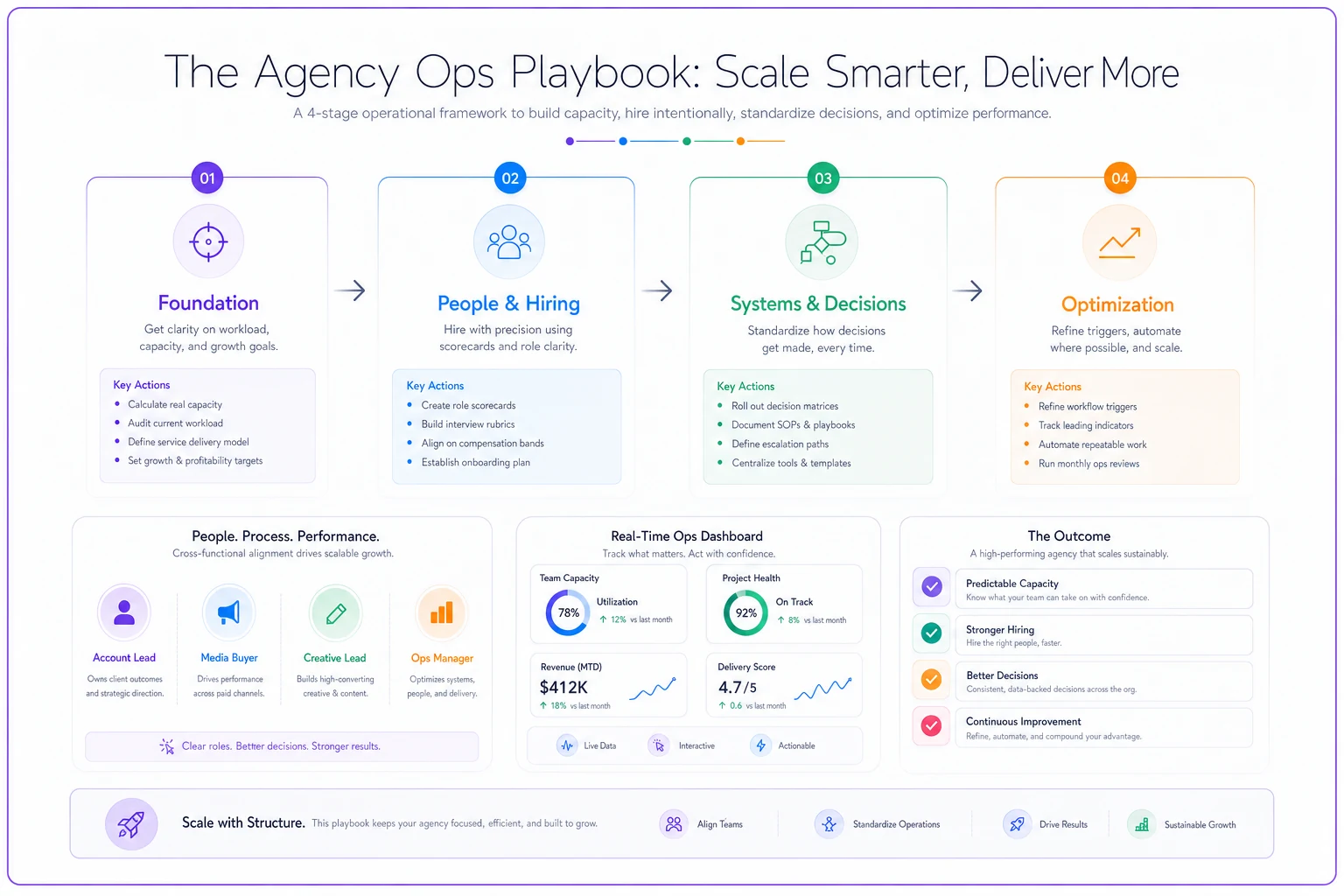
A simple visual helps teams see the sequence and who owns each stage.
Week 13+: Optimization
-
Refine triggers based on patterns
-
Update SOPs monthly based on reality
-
Quarterly playbook reviews with leadership
This isn't about building perfect systems. It's about creating frameworks that help your team make better decisions faster.
When the playbook actually works
A 15-person creative agency in Austin implemented this connected approach last year. Before, they were stuck at $180k monthly revenue, working 60-hour weeks, and losing money on their biggest clients.
Six months after building their operational playbook:
-
Revenue hit $240k/month
-
Average workweek dropped to 45 hours
-
They fired two unprofitable clients and replaced them with three profitable ones
-
Team satisfaction scores increased by 35%
The biggest change? They stopped making emotional decisions about capacity, hiring, and client relationships. The playbook gave them objective triggers and clear actions.
The AI-enhanced operations advantage
Modern agencies are discovering that AI-powered operational software can automate much of this tracking and decision-making. Instead of manually calculating RPEH or updating capacity formulas, operational platforms can monitor these metrics in real-time and flag issues before they become crises.
AI automation particularly helps with:
-
Tracking effort hours across scattered communication channels
-
Identifying profitability trends before they impact margins
-
Suggesting optimal team allocation based on capacity formulas
-
Flagging when decision matrices need updating based on outcomes
The best agencies aren't trying to automate creativity. They're automating operational intelligence so humans can focus on what they do best: solving client problems and creating great work.
Building your agency operational playbook
Don't try implementing everything at once. Start with the biggest pain point in your agency:
If you're overwhelmed: Begin with capacity formulas. Figure out your real availability before taking on more.
If you're hiring: Build scorecards first. Better hires solve many downstream problems.
If you're unprofitable: Start with RPEH tracking and profitability triggers.
If decisions bottleneck: Create decision matrices for your top 3 recurring issues.
The playbook isn't a one-time project. It's a living system that grows with your agency. Every new hire, client, or service offering should trigger a playbook review. What worked at $50k/month breaks at $200k/month.
The agencies that thrive don't have better strategies or cooler clients. They have operational playbooks that turn chaos into process, hunches into metrics, and growth from accident into intention.
Your agency's next phase isn't waiting for the perfect client or killer campaign. It's waiting for you to build the operational foundation that makes scaling inevitable instead of impossible.
Ready to elevate your agency's performance?
Join 2,000+ agencies using Digmaly to save time, boost efficiency, and deliver superior client results.