



There's a specific kind of pain that shows up around the 15-to-25 client mark. Revenue looks fine. New logos keep coming in. But somewhere in the account management team, people are drowning, and nobody can explain why. The retainers are the same size they've always been. The margins on paper look healthy. And yet delivery is slipping, senior people are firefighting instead of strategizing, and clients are starting to notice that the responsiveness they had at month two is gone by month nine.
Almost every time, the root cause traces back to how the agency packaged its services in the first place.
Most agency service packaging is built as a sales artifact, not an operational one. Someone put together a "Silver / Gold / Platinum" grid, wrote some nice bullet points, and slapped prices on it. The problem is that those bullet points — "dedicated account manager," "monthly reporting," "ongoing optimization" — don't map to anything measurable. There's no definition of how much work each line item actually consumes, no rule for what happens when a client demands more, and no connection between what you sold and what your team can deliver at capacity.
So the package looks scalable. The operations underneath it aren't.
The gap between what you sold and what you deliver
Every service tier is really a promise about capacity and response, and most agencies never define either one.
Take "dedicated account manager." What does that mean in hours? Is that person managing 4 accounts or 11? "Monthly reporting" — is that a templated dashboard pull, or a 90-minute custom narrative deck with strategic recommendations? "Ongoing optimization" is the worst offender. It's completely unbounded. One client interprets it as "check in on my campaigns weekly." Another interprets it as "I can Slack you at 9pm with a new idea and expect it built by Wednesday."
When the packaging is vague, client expectations fill the vacuum — and they almost always fill it upward.
What tends to happen is that the gap between sold and delivered doesn't show up as a single dramatic failure. It shows up as slow erosion. A senior strategist who was supposed to spend 20% of their time on a given account is now at 45% because there was no rule that said otherwise. Nobody logged it. Nobody flagged it. The account still "looks" like a Gold retainer on the billing side, but operationally it's consuming Platinum-level resources at a Gold price.
Multiply that across a dozen accounts and your effective margin quietly collapses while your P&L still looks okay for another quarter or two — until it doesn't.
Why this happens across nearly every agency
This isn't a discipline problem or a "your team needs to say no more" problem. It's a design problem baked into how the packages were built.
Eliminate marketing chaos with streamlined campaign control.
Digmaly lets you plan, execute, and track every campaign effortlessly.
- Unified campaign management
- Real-time client reporting
- Collaborative team workflows
No credit card required
A few structural reasons it repeats everywhere:
-
Packages are written in client language, not operational language. "We'll grow your revenue" is a great sales line and a useless operational spec. You can't staff against it.
-
There's no unit of work. Without a defined unit — a campaign build, a report, a strategy session, an ad-set refresh — you can't calculate how much any tier actually costs to deliver.
-
Scope creep has no friction. When there's no explicit boundary, saying "sure, we can do that" feels free in the moment. The cost is invisible until the account is unprofitable.
-
Nobody connects packaging to staffing math. Sales sells the tier. Ops staffs the account. These two functions rarely share the same model, so the numbers never reconcile.
The result is a business where the pricing structure and the delivery structure are two separate systems that were never designed to talk to each other. That disconnect is fine at 5 clients because everyone's close to the work. At 30 clients it's the reason your best people are burning out.
What actually breaks as you scale
At 5–10 clients: Founders and senior staff absorb the slack. Everything gets done because the people doing it are close enough to reprioritize on the fly. Packaging vagueness doesn't hurt yet — it's hidden by heroics.
At 10–20 clients: You hire mid-level people to take accounts off the founders. Now the tribal knowledge that made the vague packages work starts to leak. The new AM doesn't know that "ongoing optimization" was informally capped at "a few hours a week." So they either over-deliver (killing margin) or under-deliver (killing the relationship). Both happen simultaneously across different accounts.
At 20–40 clients: Coordination becomes the bottleneck. Nobody has a clear view of who's over capacity and who has room. Two things break at once: profitability, because some accounts are silently consuming 2x their allotted hours, and quality, because overloaded teams cut corners. This is usually when churn ticks up for reasons leadership can't quite name.
The uncomfortable pattern is that the tier a client is paying for and the tier they're actually receiving drift apart in both directions. Some clients pay for premium and get neglected because their AM is buried. Others pay mid-tier and get white-glove treatment because they're loud. Neither is a decision you made on purpose.
If you want the deeper version of the staffing math behind this, we've written about why capacity formulas, hiring scorecards and profitability triggers should drive your agency operational playbook — this article assumes you buy that premise and focuses on wiring it into how you package and price.
The core idea: package capabilities, not promises
The fix starts with a reframe. Stop thinking of a service tier as a list of features. Start thinking of it as a bundle of measurable capabilities, each with a defined level of service and a known capacity cost.
Every capability in a tier should answer four questions:
-
What is it? A specific, bounded deliverable — not "optimization" but "up to 3 ad-set restructures per month."
-
How fast? The service-level objective
response time, turnaround time, cadence.
-
What happens when it's exceeded? The escalation and remediation rule.
-
What does it cost us to deliver? The capacity load in hours or units.
When every line item answers those four questions, three things become possible: you can staff accurately, you can price for real margin, and you can hold a boundary with a client without it feeling personal — because the boundary was written down before the relationship started.
GRAPH: Service Tier Capability Mapping Flow A workflow diagram showing how a single capability moves through four sequential steps — What is it → How fast → What if exceeded → What does it cost — before being slotted into a tier, then feeding into both the service catalog and the staffing model. Each step should show inputs and decision points, and the output arrow should split into two paths: one to the catalog and one to the capacity calculation.
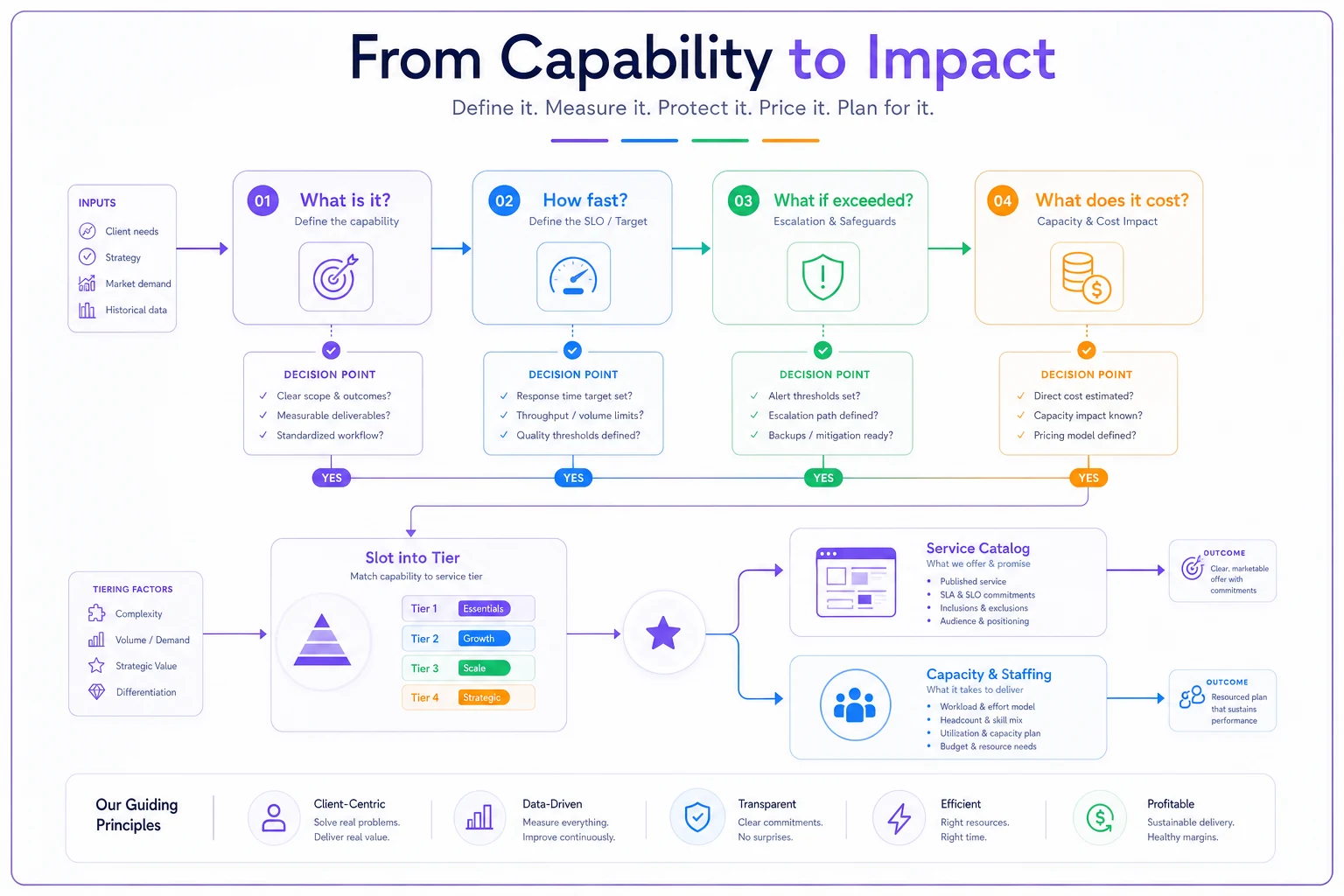
This flow ties the definition of a capability directly to both sales and operations, so what you promise is also what you can reliably staff.
Writing SLOs and SLAs that mean something
An SLO (service-level objective) is your internal target — the standard your operation aims to hit. An SLA (service-level agreement) is the external promise you make to the client, usually a slightly looser version of your SLO with defined consequences if you miss it.
The mistake most agencies make is either having neither, or having an SLA buried in the contract that nobody operationally tracks. A promise you don't measure is just a liability sitting in a PDF.
-
"First response to any client request within 1 business day."
-
"Standard creative revisions delivered within 3 business days of brief approval."
-
"Emergency campaign changes (spend pauses, compliance issues) actioned within 2 hours during business hours."
-
"Monthly performance review delivered by the 5th business day of the following month."
These are measurable. You can look at your ticketing or project system and know objectively whether you hit them. An SLO you can't measure is just a vibe.
Set client SLAs with a small buffer below your internal capability so the SLA is reliably achievable even in busy weeks.
One pattern worth stealing from technical operations: define your SLOs with a little headroom below your true capability. If your team can genuinely respond in 4 hours, set the client SLA at 1 business day. That gap is your buffer for the bad weeks, and it's the difference between an operation that occasionally disappoints and one that reliably over-delivers.
Escalation and remediation: the rules nobody writes until it's too late
This is the part almost everyone skips, and it's the part that saves relationships.
An escalation rule defines what happens when something is at risk of breaching an SLO — before it becomes a crisis. A remediation rule defines what you do when you've already missed one. Having both written down means your team doesn't have to improvise under pressure, and the client sees a mature process instead of a scramble.
-
Level 1 AM handles the request within standard SLO. No escalation.
-
Level 2 Request will breach SLO or exceeds tier scope → AM flags to team lead within 4 hours, and either reprioritizes or notifies the client with a revised timeline.
-
Level 3 Repeated breaches, at-risk account, or scope significantly beyond tier → account director involved, and a formal scope/renewal conversation is triggered.
Remediation is what you owe the client when you miss. Some agencies do service credits, some do a make-good deliverable, some have a defined communication protocol — acknowledge within X hours, root-cause within Y days. The specific remedy matters less than having any pre-agreed one. What kills trust isn't the miss. It's the silence and the improvisation that follows.
The escalation ladder only works if your team actually knows it exists. That sounds obvious, but a lot of agencies write this stuff into a handbook that nobody reads after onboarding. Build it into whatever project or account management system your team lives in day-to-day, so it's visible when it matters.
A reusable service-catalog template
Think of your service catalog as a single source of truth that both sales and ops work from — the same document that defines what's sellable also defines what's staffable.
| Capability | Tier | SLO (internal target) | SLA (client promise) | Capacity load | Escalation trigger |
|---|---|---|---|---|---|
| Account management | Growth | 4-hr response | 1 business day | ~6 hrs/mo | 2+ missed responses/mo |
| Campaign optimization | Growth | Weekly review | Weekly cadence | ~8 hrs/mo | >3 ad-set changes requested/wk |
| Reporting | Growth | Templated + summary | By 5th business day | ~3 hrs/mo | Custom report requested |
| Creative production | Growth | 3-day turnaround | 5 business days | ~10 hrs/mo | >4 assets/mo requested |
| Strategy sessions | Growth | Monthly, 60 min | 1 per month | ~2 hrs/mo | Additional sessions requested |
The magic of this table isn't the rows — it's the capacity load column. Once every capability has an hours estimate, you can sum a tier and know exactly what it costs to deliver. A Growth tier that loads to roughly 29 hours a month, at a blended cost of say $65/hour, costs around $1,900 to deliver. If you're selling it at $4,500, you know your delivery margin before anyone signs.
The escalation trigger column is what turns scope creep from an invisible leak into a visible, actionable event. That's the column most agencies never build — and it's the one that changes how conversations with clients actually go.
Tying packaging to capacity and billing
This is where the whole system either holds together or falls apart. The catalog above defines load per tier. Your team has a finite pool of hours. The connection between those two numbers is your real capacity limit — and most agencies fly completely blind on it.
Deliverable capacity = (total productive hours per person × number of delivery staff) − (reserve buffer for firefighting and internal work)
If you've got 6 delivery people at roughly 120 productive hours a month each, that's about 720 hours total, minus a 20% buffer, leaving around 576 deliverable hours. If the average account loads at ~30 hours, you can responsibly carry about 19 accounts — not the 25 someone in sales assumed. That gap between 19 and 25 is exactly where quality dies and burnout begins.
The billing side should be wired to the same model. When a client consistently trips their escalation triggers — requesting more than their tier allows, month after month — that's not a customer service problem to absorb. It's a pricing signal. Either they move up a tier, or you add an à la carte line, or you renegotiate. The escalation data tells you which accounts are underpriced before they quietly wreck your margin.
This is where an operational platform earns its place — not as a magic wand, but as the thing that keeps this model honest. When your project tracking, capacity model, and billing live in connected systems rather than three different spreadsheets and someone's memory, the escalation triggers can fire automatically. AI-assisted workflow tools can flag an account that's crossed its scope threshold, surface a capacity crunch before it becomes a crisis, and prompt the renewal or upsell conversation while there's still time to have it calmly. The point isn't automation for its own sake — it's that the signals you already care about stop getting lost in the day-to-day noise.
A real scenario
A performance agency with about 18 retained clients and a team of 7 was stuck around a 22% net margin despite growing revenue. On paper every account was profitable. When they mapped actual delivery hours against their tier definitions, they found four "mid-tier" accounts were each consuming close to 50 hours a month against a tier designed for 30. Those four accounts were effectively subsidized by the rest of the book.
They rebuilt their catalog with real capacity loads, added escalation triggers, and had honest scope conversations with those four clients. Two moved up a tier. One accepted an à la carte add-on. One churned — which, once they saw the real numbers, was fine, because that account had been unprofitable for over a year.
Six months later margin sat closer to 33–34%, and just as importantly, senior staff stopped getting pulled into constant firefights. Revenue didn't jump dramatically. The profitability and the sanity did.
When this makes sense — and when it doesn't
This makes sense when: you're past roughly 10 clients, you're hiring delivery staff you don't personally supervise every day, and you can't confidently answer "how many more accounts can we take before quality drops?" If that question makes you uncomfortable, you need this system.
This is probably overkill when: you're a 3-person shop with 6 hand-held clients and everyone's close to every account. Formalizing SLOs at that stage adds bureaucracy you don't need yet. Keep it lightweight — just start tracking rough hours per account so you have data when you do need to formalize.
Who should not do this: anyone hoping a service catalog will fix a positioning or sales problem. If you're winning clients purely on being the cheapest option, tightening your scope and SLAs will feel like friction they didn't sign up for. Fix your positioning first, then package for operations.
Where to go from here
Service packaging isn't a marketing exercise you do once and forget. It's the connective tissue between what you sell, what you staff, and what you bill — and when those three drift apart, everything downstream gets harder. The agencies that scale cleanly are usually the ones who treated their service catalog as a living operational document, not a sales one-pager.
The same discipline applies to how you report on all of this. Once your tiers and SLOs are defined, client reporting should reflect them — showing clients you're hitting the standards you promised rather than reacting to whatever fire came up that week. If that's the next gap you're feeling, our take on building an agency performance reporting strategy built on KPI governance and client narratives picks up right where this leaves off.
Start with one thing this week: pull your five biggest accounts and estimate the actual hours each one consumed last month. Compare that to what you sold. The gaps you find will tell you exactly where your packaging is quietly costing you money.
Ready to elevate your agency's performance?
Join 2,000+ agencies using Digmaly to save time, boost efficiency, and deliver superior client results.