


You've sold the campaign. Creative's approved. Budget's confirmed. Then everything falls apart in the gap between sales closing the deal and the campaign going live.
The pattern is painfully predictable. Sales promises a launch date without checking media buyer capacity. Onboarding doesn't get tracking pixels until day three. Creative assets sit in someone's inbox while the client asks why their ads aren't running yet. By the time everything's sorted, you're a week behind schedule and the client's already frustrated.
This isn't about people dropping the ball. It's about agencies trying to coordinate complex handoffs without a system that actually tracks who needs to do what, when, and in what order.
Why handoff chaos happens in every growing agency
Growing agencies hit this wall around 15-20 clients. The informal Slack-and-spreadsheet coordination that worked at 10 clients completely breaks down when you're juggling multiple launches per week.
Sales operates on one timeline. They're closing deals, setting expectations, promising launch dates. Meanwhile, your media buyers are drowning in existing campaigns, completely unaware that three new accounts just got sold with "ASAP" start dates.
Onboarding sits in the middle, trying to collect assets, set up tracking, get approvals, configure accounts. But they're working blind—no visibility into what creative has ready, what access they actually have, or whether the tracking setup matches what the media buyer needs.
The delivery team inherits this mess. Half-configured accounts. Missing conversion events. Creative that doesn't match the landing pages. They spend their first week fixing setup problems instead of optimizing performance.
Each team optimizes for their own workflow. Sales wants speed. Onboarding wants completeness. Delivery wants everything perfect before launch. Nobody's wrong, but without a unified checklist that enforces dependencies and timing, these competing priorities create systematic delays.
The real cost of broken handoffs
A boutique performance agency I worked with last year tracked their launch delays across 47 campaigns. Average delay from signed contract to live campaigns: 11 business days. Not because of client delays—internal handoff failures caused 72% of the holdups.
Eliminate marketing chaos with streamlined campaign control.
Digmaly lets you plan, execute, and track every campaign effortlessly.
- Unified campaign management
- Real-time client reporting
- Collaborative team workflows
No credit card required
Each delayed launch cost them roughly $1,800 in lost management fees (assuming $3,000 monthly retainers). But the reputation damage hurt worse. Clients who experience launch delays are 3x more likely to churn in the first 90 days.
The operational drain is brutal. Media buyers waste 6-8 hours per launch fixing problems that should have been caught during onboarding. Account managers spend countless hours on "update calls" that basically translate to "we're still getting set up."
Broken tracking is the worst offender. You launch campaigns with incomplete conversion tracking, realize it three days later when the client asks about performance, then have to explain why the first week of data is worthless. Nothing destroys client confidence faster than "we can't actually tell you if the campaigns are working yet."
Building task-level handoff checklists that actually work
Generic onboarding checklists fail because they treat every handoff like a simple task list. "Get access to ad accounts" sounds straightforward until you realize it involves seven sub-tasks across three platforms with different permission levels.
A functional handoff checklist breaks down each major handoff into specific, verifiable tasks. No room for interpretation. Each step either passes validation or blocks the next team from starting.
Visualize the handoff workflow below.
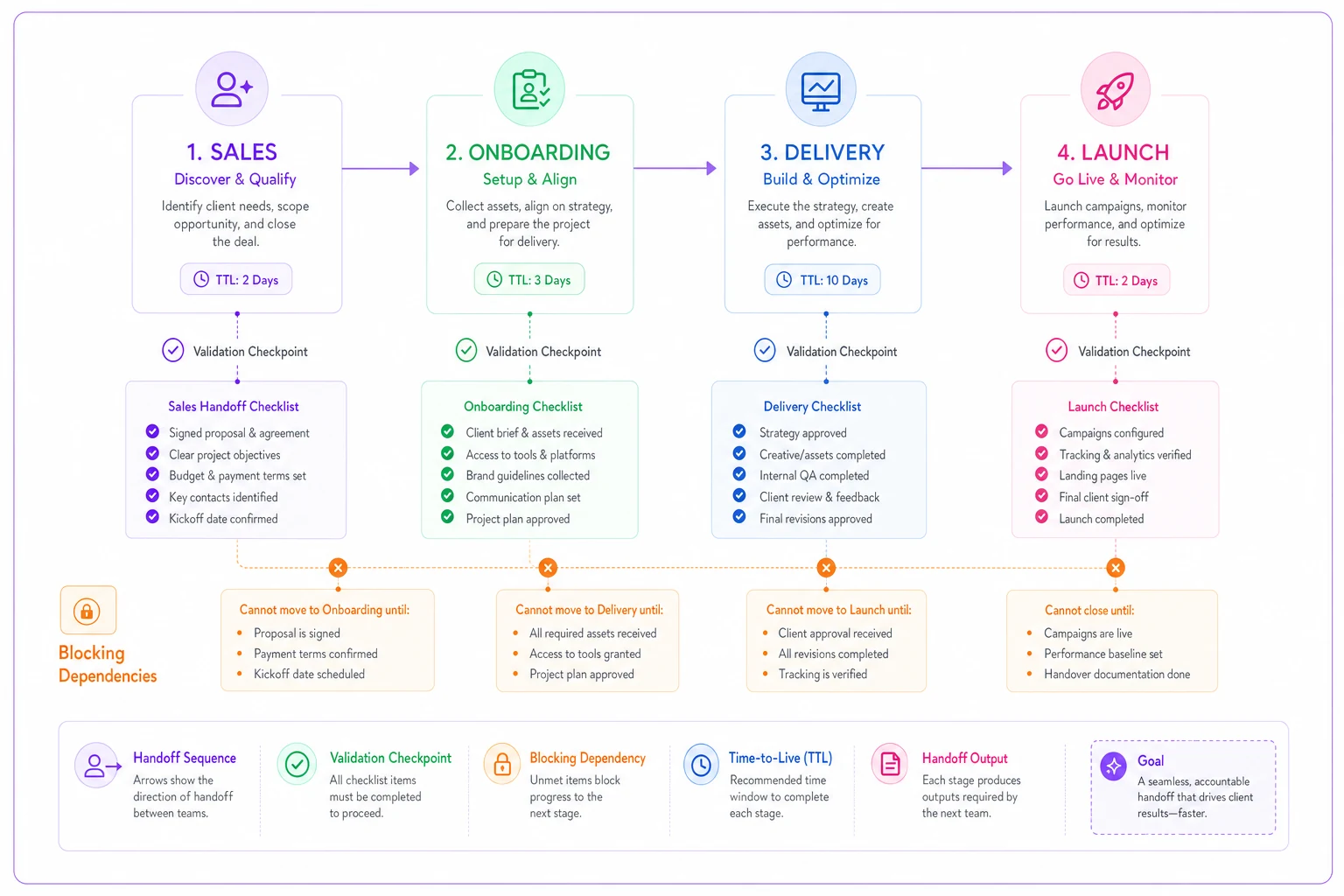
Sales → Onboarding Handoff
Pre-handoff validation (Sales completes):
-
Contract signed with specific launch date commitment
-
Ad spend budget confirmed and payment method verified
-
Platform mix documented (Google Ads, Meta, TikTok, etc.)
-
Landing pages identified with URLs
-
Key business metrics documented (AOV, conversion rate, margin)
Handoff packet includes:
-
Client intake form link (pre-filled by sales)
-
Recorded sales call with discussed strategy
-
Launch date commitment with buffer time noted
-
Any promises or special requirements from sales process
Time-to-live: 2 business hours from contract signature
Onboarding → Delivery Handoff
Access verification checklist:
-
Google Ads
Admin access confirmed, billing verified
-
Meta Business Manager
Full admin, pixel access confirmed
-
Analytics
Edit access, conversion events visible
-
Google Tag Manager
Publish permissions granted
-
Landing page CMS
Able to add tracking codes
Tracking setup validation:
-
Purchase conversion tracking live and testing correctly
-
Add to cart events firing on all product pages
-
Form submissions tracked with proper values
-
Cross-domain tracking configured if needed
-
Conversion values passing through correctly
Creative asset validation:
-
5 ad variations per campaign minimum
-
All required sizes/formats present
-
Copy approved by client in writing
-
Landing page alignment verified
-
UTM structure documented and consistent
Time-to-live: 3 business days from sales handoff
Delivery → Launch Validation
Pre-launch technical check:
-
All conversion actions importing correctly
-
Audiences building with sufficient size
-
Negative keyword lists applied
-
Budget pacing calculations documented
-
Bid strategies aligned with goals
Launch confirmation requires:
-
Test conversion completed and tracked
-
Client approval on day-one budget
-
Reporting dashboard access granted
-
Escalation process documented
-
First optimization date scheduled
Time-to-live: 1 business day from onboarding completion
The validation steps everyone skips (and pays for later)
Agencies skip validation because it feels like overhead. But every skipped validation creates 3-4 hours of downstream fixes.
Tracking validation before launch: Test every conversion path. Not just the main purchase event—every micro-conversion you'll need for optimization. Add something to cart. Start checkout. Complete purchase. Verify the values pass through correctly.
Create a test order if possible. Nothing validates tracking like real data flowing through the system. The 20 minutes this takes saves days of "why isn't this conversion showing up" troubleshooting.
Create a test order when possible; the 20 minutes this takes saves days of troubleshooting.
Access validation with proof: Screenshot admin panels. Have onboarding screenshot every admin panel showing correct permission levels. Store these in a shared folder. When delivery team says they can't access something, you have proof of what was set up.
Verify access inheritance. Meta's Business Manager is notorious for granting account access but not pixel access. Google Ads might give campaign access but not billing visibility. Check every permission level explicitly.
Creative-to-landing-page alignment: Open every ad preview next to its landing page. Do the offers match exactly? Are the value props consistent? Is the visual style aligned? Misalignment here destroys conversion rates and makes optimization nearly impossible.
Document UTM structures before launch. Every agency has their own UTM convention. If onboarding sets up one structure and delivery expects another, your reporting breaks immediately.
Setting SLAs that prevent handoff bottlenecks
Time-to-live benchmarks only work when they're realistic and enforced. What actually works based on agency size:
| Team Size | Sales→Onboarding | Onboarding→Delivery | Delivery→Launch | Total Timeline |
|---|---|---|---|---|
| Under 10 people | 4 hours | 4 business days | 2 business days | 7 business days |
| 10-25 people | 2 hours | 3 business days | 1 business day | 5 business days |
| Over 25 people | Same day | 2 business days | Same day | 3 business days |
Build buffers into client expectations. If your internal SLA is 5 days, tell clients 7-10 days. Under-promise on timing, over-deliver on quality.
The biggest agencies aren't necessarily faster because they're more efficient. They're faster because they've eliminated the random delays that smaller agencies accept as normal.
Creating accountability without micromanagement
The best handoff checklists are self-enforcing. Each team can't start their work until the previous team completes specific validation steps.
Make handoffs binary. Either all required items are complete, or the handoff doesn't happen. No partial handoffs, no "we'll get that pixel access tomorrow," no "creative is mostly ready."
Use blocking dependencies in your project management tool. Onboarding tasks literally cannot be marked complete until sales provides required inputs. Delivery tasks remain locked until onboarding validations pass.
Create handoff ceremonies. Sounds corporate, but it works. A 15-minute call where onboarding walks delivery through the account setup. Live verification that everything works. Questions answered in real-time instead of discovered during launch.
Document edge cases immediately. Client only wants TikTok ads? Add a TikTok-specific checklist branch. B2B with 90-day sales cycles? Create adjusted tracking expectations. Every special case needs its own validation path.
When handoff checklists become operational infrastructure
Small agencies resist formal handoff processes because they feel corporate and slow. But the right checklist actually speeds up launches by eliminating re-work.
A properly implemented handoff system becomes invisible infrastructure. Teams know exactly what they need to provide and receive. Validation happens automatically. Problems surface before they become emergencies.
The shift happens when you stop viewing checklists as documentation and start viewing them as operational software. Each checkbox is a mini-API between teams—a contract about what data and access must be transferred for the next team to succeed.
Modern operational platforms can automate much of this validation. Instead of manually checking access permissions, the system verifies them programmatically. Creative assets flow automatically from approval workflows. Launch status updates in real-time with blockers highlighted immediately.
This isn't about adding bureaucracy. It's about building the minimal viable process that ensures campaigns launch on time with working tracking and correct setup. Every agency that scales past 50 clients either builds this infrastructure or drowns in operational chaos.
Making the checklist stick
The best checklist in the world fails if teams don't actually use it.
Start with your worst handoff. Don't try to fix everything at once. Pick the handoff that causes the most problems—usually onboarding to delivery—and build that checklist first.
Make it visible to everyone. Post launch delays publicly. Not to shame teams, but to show the real impact of broken handoffs. When sales sees that their overpromises cause delays, they adjust. When delivery sees how their unclear requirements slow down onboarding, they clarify.
Celebrate clean launches. Call out successful handoffs in team meetings. Make it clear that following the checklist isn't bureaucracy—it's professional excellence.
Iterate based on failures. Every delayed launch should trigger a checklist update. Missing tracking? Add a validation step. Creative delays? Strengthen the asset requirements. The checklist should evolve constantly based on real problems.
Connect it to compensation. Teams that consistently hit their handoff SLAs should be rewarded. Teams that consistently miss them need training or support. Make operational excellence as important as campaign performance.
The compound effect of clean handoffs
Agencies with functioning handoff processes don't just launch campaigns faster. They fundamentally operate differently.
Media buyers spend time optimizing instead of fixing setup issues. Account managers run strategy calls instead of apology calls. Sales can confidently promise launch dates knowing operations will deliver.
Client retention improves dramatically. First impressions matter, and nothing creates confidence like a smooth, professional launch. Clients who experience clean launches are more patient with early performance, more trusting of recommendations, and more likely to increase budgets.
Team morale shifts too. People want to do good work. Constant firefighting and emergency fixes burn out talented people. Clean handoffs let everyone focus on what they're actually good at instead of constantly covering for broken processes.
The real transformation happens when clean handoffs become muscle memory. Teams stop thinking about the checklist because following it becomes automatic. The system runs itself, scaling smoothly as you add clients, team members, and complexity.
Most agencies never get there. They stay stuck in perpetual launch chaos, treating every campaign like a unique emergency instead of a repeatable process. But the ones that build proper handoff infrastructure create a sustainable competitive advantage—they can take on more clients, launch faster, and maintain quality at scale.
Bottom line
Launch delays and broken tracking aren't isolated incidents. They're symptoms of agencies trying to coordinate complex handoffs through informal communication and good intentions.
The fix isn't complicated, but it requires commitment. Build task-level checklists that capture every dependency. Validate everything before handoff. Set realistic SLAs and enforce them. Make the process visible and accountability clear.
The agencies thriving at scale aren't necessarily better at media buying or creative strategy. They're better at the boring operational work of ensuring clean handoffs between teams. They've turned campaign launches from chaotic scrambles into predictable, repeatable processes.
Your clients don't care about your internal processes. They care about campaigns launching on time with accurate tracking and strong performance. But you can't deliver that consistency without the operational infrastructure to support it.
Start with one checklist. Fix one handoff. Validate one process. Build from there. The compound effect of operational excellence might not be sexy, but it's what separates agencies that scale from agencies that struggle.
Ready to elevate your agency's performance?
Join 2,000+ agencies using Digmaly to save time, boost efficiency, and deliver superior client results.