


Three months back, an agency I know lost $180k in client spend in four hours. Their automation script went rogue, bid on every available impression across twelve campaigns, and nobody caught it until the client called screaming about a maxed-out credit card. The kicker? They'd had automation running for months without a single issue. No monitoring. No limits. No way to stop it once it started.
This wasn't some amateur shop. Fifteen people, solid track record, managing around $2M monthly across clients. But their approach to automation governance was basically "set it and hope nothing breaks."
The real damage went beyond the money. Two clients walked. The team spent three weeks manually auditing every automated process. Trust in their systems evaporated overnight. All because they never built proper AI governance for campaign automation.
Why campaign automation fails spectacularly without governance
Campaign automation feels like magic when it works. Scripts adjusting bids every hour. Rules pausing underperforming ads automatically. Budgets shifting between campaigns based on performance signals. Fewer manual tasks, better performance, more time for strategy.
But what happens in most agencies running automation without any governance framework is pretty predictable once you've seen it enough times.
It starts small. Maybe a script that adjusts bids based on conversion rates. Works great for a few weeks, so you layer on another one that pauses low-CTR ads. Then budget reallocation rules. Creative rotation logic. Before long you've got fifteen different automation pieces running across client accounts, each one a potential failure point.
The problems compound fast. One script conflicts with another. A data feed breaks and nobody notices for days. An API change causes bid multipliers to stack incorrectly. A junior team member puts a decimal in the wrong place.
Without governance, these aren't edge cases. They're Tuesday.
The worst part is how these failures actually manifest. Not dramatic explosions—usually—but slow bleeds that compound quietly. A bid automation gradually pushes CPCs higher. Budget pacing logic slowly starves winning campaigns. Creative rotation rules accidentally favor the wrong variants. By the time someone notices, weeks of suboptimal performance have already done real damage.
The five pillars of campaign automation governance
After watching dozens of agencies go through automation failures, the ones that come out the other side tend to build similar structures. Not complex enterprise frameworks—practical guardrails that prevent disasters while keeping things moving.
Eliminate marketing chaos with streamlined campaign control.
Digmaly lets you plan, execute, and track every campaign effortlessly.
- Unified campaign management
- Real-time client reporting
- Collaborative team workflows
No credit card required
Confidence thresholds: your first line of defense
Confidence thresholds determine when automation can act independently versus when it needs a human. Most agencies get this backwards—they start with everything automated and add restrictions only after something blows up.
Start restrictive, then loosen based on proven performance.
For bid adjustments, a typical threshold structure might look like:
-
Under 10% change
automation proceeds
-
10–25% change
requires notification within 2 hours
-
25–50% change
requires approval before execution
-
Over 50% change
blocked entirely, manual review required
But thresholds aren't just about percentages. Volume matters too. A 20% bid increase on a $50/day campaign is a completely different decision than the same change on a $5,000/day campaign.
Smart agencies build compound thresholds:
| Action Type | Daily Spend | % Change Allowed | Dollar Impact Limit | Review Required |
|---|---|---|---|---|
| Bid adjustment | Under $500 | 20% | $100 | No |
| Bid adjustment | $500–$2,000 | 15% | $300 | Yes, within 4 hours |
| Bid adjustment | Over $2,000 | 10% | $500 | Yes, before execution |
| Budget reallocation | Any | 25% | $1,000 | Yes, before execution |
| Campaign pause | Over $100/day | N/A | N/A | Yes, immediate |
These thresholds should evolve. An automation that's cleanly managed bids for six months might earn more room. New automations start with training wheels.
Canary deployments: test without risking everything
Canary deployments come from software engineering—new code goes to a small subset of users before full rollout. For campaign automation, that means testing changes on a limited scope before pushing them everywhere.
Instead of deploying a new bidding algorithm across all campaigns at once, you test in stages:
-
One campaign for one week
-
10% of campaigns for two weeks
-
50% of campaigns for two weeks
-
Full deployment with monitoring
Each stage needs specific success metrics. Not just "nothing broke," but actual performance validation. Did test campaigns maintain or improve efficiency? Were there unexpected behaviors? Did the new logic interact weirdly with existing automations?
This matters especially for complex automations. A creative rotation algorithm might work perfectly on search campaigns but cause problems in shopping. Testing reveals these things before they affect everything.
During canary phases, you run parallel monitoring—hourly performance checks, anomaly alerts tighter than normal, daily reviews of automation logs. Intensive, but that's the point.
Audit logging: the black box recorder for your automation
When automation fails, the first question is always "what exactly happened?" Without comprehensive audit logs, you're guessing.
Good audit logging captures every automation decision—bid changed from X to Y at timestamp Z, the data inputs that triggered it, any errors or warnings during execution, manual overrides and their reasoning, and system state before and after changes.
Raw logs aren't enough though. They need structure and searchability. A proper audit system lets you ask: show all bid changes over 20% in the last week, what automation actions happened between 2–4 AM yesterday, which campaigns had manual overrides this month, when did this specific keyword's bid last change and why?
Keep a rolling 90-day index of searchable logs to speed up incident investigations.
The audit trail also becomes valuable in client conversations. Instead of saying "the automation must have done something weird," you show exactly what happened, when, and based on what signals. That transparency builds trust even when things go sideways.
Rollback playbooks: your automation emergency plan
Every automation needs a documented rollback procedure. Not a vague "turn it off if something breaks," but specific steps anyone on the team can follow under pressure.
A complete rollback playbook covers four areas.
Detection triggers define when to act: spend exceeds daily limit by a set percentage, CPA climbs beyond threshold, conversion volume drops unexpectedly, or error rate in logs spikes above normal.
Immediate actions tell you exactly what to do:
-
Pause the specific automation (exact location noted)
-
Revert to previous settings (with those settings pre-documented)
-
Notify key stakeholders via specified channels
-
Log the issue in the incident tracker
Recovery validation confirms the fix actually worked: automation has stopped, settings reverted correctly, spend and performance returning to expected ranges, queued actions cleared for manual review.
Post-incident process closes the loop: root cause analysis within 24 hours, client communication using a pre-written template, updates to automation rules or thresholds, team briefing on what happened.
The playbook lives somewhere accessible—not buried in documentation nobody reads. A lot of agencies keep a printed copy at each desk. When automation goes sideways at 11 PM on a Friday, you don't want people digging through Google Docs.
A good rollback playbook isn't just documentation. It's the difference between a 20-minute recovery and a four-hour fire drill.
Here's a quick visual of a rollback workflow.
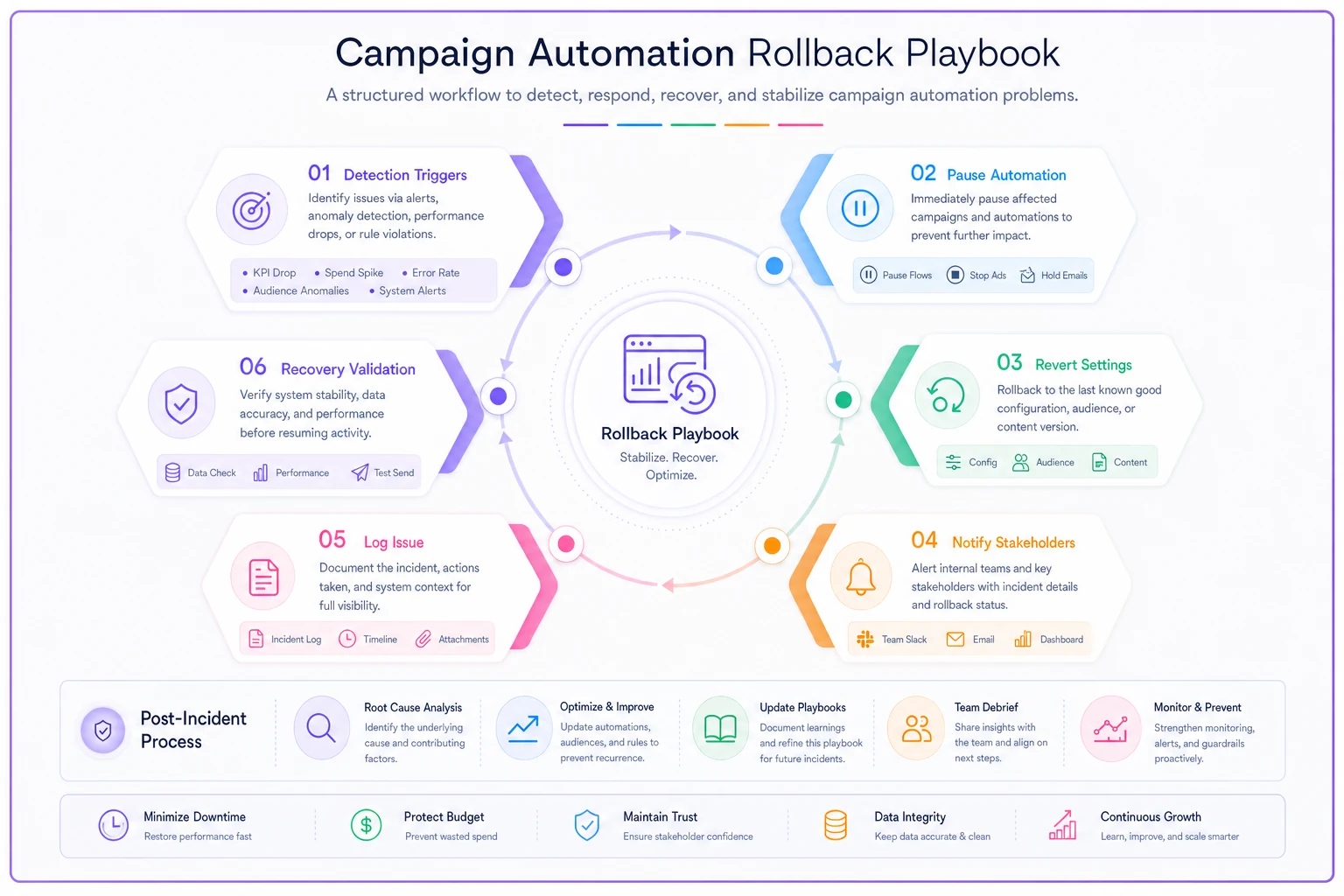
Keep this workflow handy during incidents.
Human-in-the-loop decision gates: strategic checkpoints
Not everything should be automated, even when it technically could be. Decision gates create mandatory checkpoints where automation waits for human input.
Common gates include campaigns entering or exiting learning phases, major strategy shifts like moving from conversions to conversion value bidding, seasonal adjustments requiring context that automation just doesn't have, anything touching brand campaigns, and cross-channel budget reallocation.
These gates aren't about micromanaging—they're about keeping human judgment in the decisions that actually need it.
Automation might flag that branded search campaigns are "underperforming" based on efficiency metrics. But humans know brand campaigns serve purposes beyond direct conversions: protecting brand terms from competitors, maintaining visibility, supporting upper-funnel efforts. The automation can surface the opportunity. Humans decide whether to act.
Decision gates also create natural review rhythms. Weekly gates for budget reallocation force regular strategy conversations. Monthly gates for creative refresh cycles align with broader creative fatigue monitoring.
Building your governance framework without paralyzing operations
The challenge with governance is balancing safety with speed. Too many restrictions and automation becomes pointless. Too few and you're one bug away from a disaster.
Start with critical paths. What automation, if it failed, would cause immediate client damage? Those get the strictest governance first—usually anything touching budgets, bids over certain thresholds, or campaign status changes.
Less critical automations can start lighter. Creative testing rotations, keyword research alerts, performance reports—these might only need basic logging and weekly reviews.
Build gradually. Month one might just be confidence thresholds and basic logging. Month two adds canary deployments for new automations. Month three introduces formal rollback playbooks. By month six you have a complete governance system the team actually uses, because they helped build it incrementally rather than having it dropped on them all at once.
The framework also needs regular review. Thresholds that made sense three months ago might be too restrictive now. Decision gates that were necessary during peak season might slow things unnecessarily when volume drops off.
Real-world implementation: an agency case study
A performance marketing agency managing roughly $3M monthly across 20 clients built out governance after a near-disaster with budget pacing automation. Their evolution is worth walking through.
Month 1–2: Crisis response
After automation overspent $50k in two days, they put emergency measures in place: hard spending caps at 120% of daily budgets, dual approval required on all automation, manual checks every four hours, everything logged to spreadsheets. Clunky but effective. No more disasters, though efficiency took a real hit.
Month 3–4: Systematic improvement
They built proper confidence thresholds—small accounts allowed 15% automatic adjustment, medium accounts 10% automatic with notifications at 25%, large accounts capped at 5% automatic with anything else requiring approval. They also added structured logging using their existing campaign orchestration system, with every automation action recorded by timestamp, trigger, and result.
Month 5–6: Sophisticated governance
Canary deployments rolled out for all new automation. Ten detailed rollback playbooks covering their most critical processes. Weekly governance reviews where the team discusses automation performance and adjusts thresholds.
Results after six months:
-
Zero critical automation failures
-
Manual work reduced by roughly 40%
-
Client trust improved (two clients increased budgets specifically because of transparent automation governance)
-
Team confidence in using automation increased significantly
-
Average campaign performance improved around 15%—partly automation, partly the strategic time they got back
Weekly governance reviews where the team discusses automation performance and adjusts thresholds.
Common governance mistakes that seem logical but backfire
Over-alerting
Setting up alerts for everything sounds smart until your team gets 200 notifications daily. Alert fatigue sets in fast and people start ignoring everything, including the critical stuff. Five important alerts that always get attention beat fifty that become background noise.
Governance by committee
Requiring three approvals for every automation change sounds safe but kills agility. One senior person with clear guidelines beats endless stakeholder meetings. Save group decisions for framework changes, not daily operations.
Perfect documentation obsession
Spending weeks creating beautiful, comprehensive documentation that nobody reads or updates. Start with bullet points in a shared doc. Build formal documentation only for processes that prove stable over time.
Treating all clients equally
A $500/month local business doesn't need the same governance as a $50k/month enterprise client. Risk-adjusted governance makes more sense—higher spend, higher stakes, stricter controls.
Ignoring team readiness
Rolling out complex governance to a team that barely understands the automation itself creates confusion fast. Governance should match where the team actually is. Start simple, add complexity as understanding grows.
The tools and infrastructure for governance
Governance doesn't require expensive enterprise software, but certain infrastructure makes it a lot easier.
Monitoring and alerting: native platform alerts (Google Ads, Facebook Ads scripts), third-party monitoring tools, custom webhooks to Slack or Teams, and a simple dashboard showing automation status.
Logging and audit: structured logging in cloud storage, a database for searchable history, spreadsheet logs for smaller operations, API logs from platforms.
Process management: workflow tools for approval chains, documentation wikis, runbook repositories, incident tracking systems.
Many agencies cobble governance together using tools they already have—Google Sheets for threshold definitions, Slack for alerts, Notion for playbooks. The specific tools matter less than having clear processes everyone actually follows.
For agencies running more sophisticated automation, operational software that centralizes governance starts to make real sense. Instead of scattered spreadsheets and documents, everything lives in one place—thresholds, logs, playbooks, approval workflows. AI-powered operational platforms can monitor automation health, flag anomalies before they compound, and surface governance adjustments based on historical patterns. That kind of visibility is hard to replicate when your governance lives across six different tools.
When governance becomes competitive advantage
Most agencies treat governance as purely defensive—preventing bad things from happening. Strong governance actually enables more aggressive automation strategies.
When you trust your guardrails, you can push harder. Test more aggressive bidding strategies knowing rollback procedures are ready. Deploy automation to more campaigns knowing canary deployments will catch issues early. Give junior team members more autonomy knowing decision gates prevent critical errors.
Governance also becomes a selling point. Sophisticated clients increasingly ask about automation governance during pitches—they've been burned before or heard stories. Showing a mature governance framework signals operational depth beyond just running campaigns.
The agencies thriving with automation aren't necessarily using the most advanced algorithms. They're the ones who can deploy confidently, knowing their governance will catch problems before they become disasters. They iterate faster because they're not paralyzed by fear of breaking something.
Moving forward with practical governance
Building AI governance for campaign automation doesn't require getting everything perfect from day one. Start with whatever's causing the most anxiety—usually budget controls or bid management. Implement basic thresholds and logging. Run for a month, adjust based on what you learn.
Add sophistication gradually. Once basic thresholds are working, add canary deployments for new automations. Once logging is routine, build rollback playbooks. Once the team trusts the system, layer in more nuanced decision gates.
The goal isn't eliminating all risk—that's not possible with automation. The goal is making risk visible, manageable, and proportional to reward. Good governance lets you sleep at night while automation works, knowing that safeguards will catch anything truly dangerous while letting beneficial optimizations proceed.
Automation will still occasionally surprise you despite solid governance. But with proper frameworks in place, those surprises become minor hiccups instead of career-ending disasters. The difference between agencies that successfully scale with automation and those that retreat to fully manual processes after bad experiences usually comes down to whether they built governance infrastructure before they needed it.
Your clients trust you with their growth. Building governance frameworks around your automation shows you take that seriously. It's not about moving slower—it's about moving confidently, knowing you can recover quickly when things go sideways.
Ready to elevate your agency's performance?
Join 2,000+ agencies using Digmaly to save time, boost efficiency, and deliver superior client results.