


Three weeks ago, I watched a 25-person agency implode over a Black Friday campaign. Not because they lacked talent or tools—they had both. The campaign involved paid social, Google Ads, email sequences, and influencer partnerships for an apparel brand. Everything looked good on paper. Creative was sharp. Strategy made sense. The media plan was solid. But the creative team built Instagram assets at 1:1 while media buyers needed 4:5. The compliance team flagged copy issues after ads were already trafficked. Email deployment got scheduled for 9 PM instead of 9 AM because someone misread the timezone. The influencer contracts specified posting times that conflicted with the paid media flight schedule. By Thursday night, the founder was personally rebuilding campaigns while the account team scrambled to adjust influencer briefs.
That's not a project management problem. It's an orchestration problem.
The difference between agencies that launch campaigns and agencies that orchestrate them at scale
Three weeks ago, I watched a 25-person agency implode over a Black Friday campaign. Not because they lacked talent or tools—they had both. The campaign involved paid social, Google Ads, email sequences, and influencer partnerships for an apparel brand. Everything looked good on paper. Creative was sharp. Strategy made sense. The media plan was solid. But the creative team built Instagram assets at 1:1 while media buyers needed 4:5. The compliance team flagged copy issues after ads were already trafficked. Email deployment got scheduled for 9 PM instead of 9 AM because someone misread the timezone. The influencer contracts specified posting times that conflicted with the paid media flight schedule. By Thursday night, the founder was personally rebuilding campaigns while the account team scrambled to adjust influencer briefs.
That's not a project management problem. It's an orchestration problem.
Campaign complexity compounds faster than agency resources
When agencies run five campaigns, coordination happens through memory and conversation. Team members know what's happening because they can literally see it happening around them. The creative director walks over to the media buyer's desk. The account manager catches the strategist at lunch. Information flows naturally because proximity enables it.
Eliminate marketing chaos with streamlined campaign control.
Digmaly lets you plan, execute, and track every campaign effortlessly.
- Unified campaign management
- Real-time client reporting
- Collaborative team workflows
No credit card required
At 15 concurrent campaigns, that proximity breaks. Now you need Slack threads and status meetings. Project management tools become necessary. The handoff complexity doesn't scale linearly though. Five campaigns might mean 25 handoffs per week. Fifteen campaigns means 150+ handoffs, but also introduces conflicting priorities, resource collisions, and cascading delays that didn't exist at smaller scale.
By the time an agency hits 30+ concurrent campaigns, traditional coordination completely fails. One agency I worked with discovered they were spending 11 hours weekly just on status meetings—not doing work, just talking about work. Their project manager maintained three different tracking systems because no single tool captured the full operational picture.
The breaking point varies by agency structure, but the pattern stays consistent. Somewhere between manageable and chaos, agencies cross an invisible threshold where human coordination can't keep pace with operational complexity.
Why handoffs determine everything
Campaigns don't fail at tasks—they fail between tasks. The strategist completes the brief. Creative starts concepting. But what exactly got handed off? Was budget allocation included? Were platform requirements specified? Did anyone mention the client's legal team needs five days for claim substantiation?
I analyzed campaign delays across multiple agencies and found that 73% traced back to incomplete handoffs. Not bad handoffs—incomplete ones. The brief technically got delivered, but it was missing the competitive audit creative needed. Assets got sent to media buyers, but without the UTM parameter structure. Campaigns got built in platforms, but nobody communicated the dayparting requirements.
The most dangerous handoffs appear complete. Creative sends a folder of assets. Media buying starts building campaigns. Two days later, they realize the assets don't include the required disclaimer text for California. Now creative has to rebuild 30+ assets while media buying waits, pushing the entire timeline back.
A handoff isn't just transferring work—it's transferring context, requirements, dependencies, and accountability. Miss any element and you've created a future delay that won't surface until it's too late to fix without impacting the timeline.
The governance layer nobody builds until it's too late
Most agencies think governance means approval chains. That's not governance—that's bureaucracy. Real governance means creating operational rules that prevent problems rather than managing them after they occur.
Take revision requests. Every agency struggles with late-stage revisions that cascade through the entire campaign. A client requests a "small" headline change three days before launch. That change requires new creative production, compliance review, asset regeneration, platform updates, and QA. What started as a five-minute request becomes a two-day timeline disruption.
Agencies typically handle this through negotiation—explaining to clients why changes are difficult, pushing back on timelines, or just accepting the chaos. But negotiation isn't governance. Governance means establishing systematic rules about how revisions impact timelines, then enforcing those rules consistently.
One agency established revision windows tied to campaign phases. Revisions during the strategy phase? No timeline impact. Revisions during creative development? May impact timeline by 1-2 days. Revisions after creative approval? Automatic 3-day timeline extension. The system calculates and communicates these impacts automatically. No negotiation needed.
Without governance, every campaign becomes a series of exceptions. With governance, exceptions become visible tradeoffs that stakeholders can evaluate objectively.
Building orchestration into existing operations
The biggest mistake agencies make is trying to implement a complete orchestration framework at once. They spend months designing the perfect system, then watch it collapse under real-world pressure because they didn't account for how their teams actually work.
Start with a single campaign type and one problematic handoff. Usually, it's the creative-to-media buying handoff for paid social campaigns. Map what currently happens—not what should happen, but what does happen. Creative drops files in a shared folder and posts in Slack. Media buying may or may not see the notification. They download assets and discover half don't meet platform specs. They message creative for revisions. Creative is already on the next project.
Here's a simple visual of that handoff workflow.
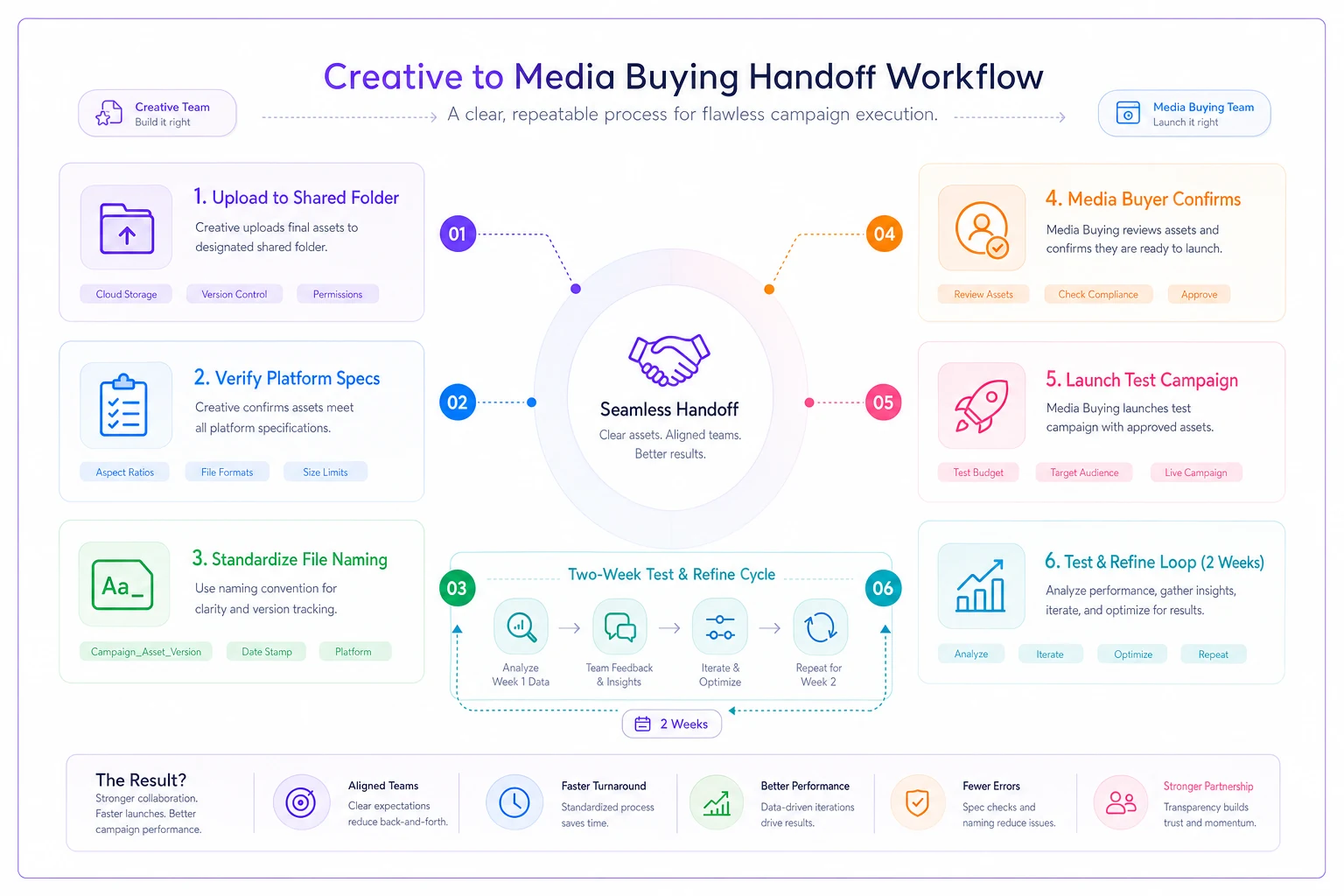
Now design a handoff protocol that addresses those specific failures. Not a universal template for all handoffs—just this one. The protocol might specify that creative must use a checklist confirming platform specs, include a standardized file naming convention, and get media buying confirmation before moving to the next project. Simple, specific, enforceable.
Test that single handoff protocol for two weeks. What breaks? What gets skipped under pressure? What additional information keeps getting requested? Refine based on actual usage, not theoretical perfection.
Start with the single most problematic handoff and iterate quickly.
Once one handoff works consistently, add the next most problematic one. Usually strategy-to-creative or media buying-to-launch. Build incrementally, letting each layer stabilize before adding complexity.
The RACI matrix that actually gets followed
RACI matrices fail because they exist as reference documents instead of operational infrastructure. Nobody checks the RACI matrix during a campaign—they just do what they did last time or what seems logical in the moment.
Functional RACI needs to be embedded in the workflow itself. When a campaign hits the creative development phase, the system should automatically know:
-
Creative Lead is Responsible for asset production
-
Creative Director is Accountable for quality and timeline
-
Account Manager is Consulted on client preferences
-
Media Buyers are Informed of progress
The system enforces these roles. The Creative Lead can't mark the phase complete without Creative Director approval. The Account Manager automatically gets notified when consultation is needed. Media Buyers receive updates without having to ask.
This isn't about creating bureaucracy. It's about eliminating the constant "who's handling this?" conversations that waste time and create confusion. When roles are clear and systematically enforced, teams stop spending energy on coordination and focus on execution.
Timeline architecture that assumes things will go wrong
Perfect timelines are fiction. Clients will request changes. Assets will fail platform specs. Compliance will identify issues. Key team members will get sick. Building timelines that assume perfect execution guarantees failure.
Smart timeline architecture builds in buffer zones and decision points. Instead of a linear 30-day timeline, you create phases with explicit dependencies and contingencies.
| Phase | Duration | Buffer | Trigger Points |
|---|---|---|---|
| Strategy | Days 30-25 | None | If not approved by Day 25, timeline extends |
| Creative Dev | 10 days | 2 days | Can overlap with strategy if brief is 80% complete |
| Platform Setup | 5 days | 1 day | Begins when initial assets ready, not final package |
| QA & Launch | 3 days | 1 day | Cannot be compressed without approval |
These aren't arbitrary buffers—they're calculated from actual campaign history. One agency tracked their last 50 campaigns and discovered creative revisions averaged 1.7 rounds, with each round taking 1-2 days. They built timelines assuming 2 rounds, which covered 85% of cases. For the 15% requiring more, the timeline explicitly adjusted rather than hoping to make up time later.
Making it sustainable without enterprise-level resources
Small agencies often think campaign orchestration requires expensive enterprise tools and dedicated project management staff. It doesn't. It requires systematic thinking about how work flows through your organization.
A 12-person agency implemented orchestration using nothing more sophisticated than shared spreadsheets and calendar automation. They created handoff templates as simple forms, used calendar events as timeline checkpoints, built escalation through automated email rules, and tracked everything in a central spreadsheet dashboard.
Was it as smooth as enterprise software? No. Did it transform their on-time delivery from around 60% to over 85%? Absolutely.
The tools matter less than the discipline of defining handoffs, establishing checkpoints, and enforcing governance. Modern AI-powered platforms can definitely accelerate implementation and reduce manual overhead. They automatically flag timeline risks, coordinate cross-functional teams, and prevent handoff failures before they impact deadlines. But the core orchestration principles work regardless of your tech stack.
Common orchestration patterns across agency types
Performance agencies face different orchestration challenges than creative agencies, but certain patterns appear everywhere.
The Hidden Stakeholder: Someone with veto power appears at the last minute. The CFO wants to review media spend. The legal team needs to approve health claims. Regional managers want input on geo-targeting. Orchestration frameworks must map all potential stakeholders during intake, not discover them during launch week.
The Scope Creep: What starts as a Facebook campaign becomes Facebook, Instagram, and TikTok because "they're all similar, right?" Except now asset requirements triple, compliance requirements change, and timeline needs adjustment. Orchestration means defining scope boundaries and making additions explicit timeline tradeoffs.
The Resource Collision: Multiple campaigns need the same specialized resource simultaneously. The motion graphics designer. The compliance reviewer. The senior media buyer who understands pharmaceutical regulations. Orchestration requires resource capacity planning, not just timeline planning.
The Integration Dependency: The campaign can't launch until the client's tech team implements tracking pixels. Or updates their product feed. Or provides API access. External dependencies kill more timelines than internal delays. Orchestration frameworks must identify and track external dependencies from day one.
Measuring whether your orchestration actually works
Orchestration metrics tell you whether your framework creates real improvement or just feels more organized.
-
Handoff Rework Rate
How often do downstream teams send work back upstream? If creative-to-media buying handoffs require rework more than 20% of the time, your handoff protocol has gaps.
-
Checkpoint Success Rate
What percentage of timeline checkpoints get hit on schedule? Below 70% means your timelines are unrealistic or your resource allocation is off.
-
Escalation Frequency
How often does the escalation protocol trigger? Too high means chronic problems. Too low might mean people are bypassing the system.
-
Timeline Adjustment Rate
What percentage of campaigns require timeline adjustments after kickoff? Some adjustment is normal, but over 30% suggests poor initial planning or missing requirements.
-
Cross-Team Wait Time
How long do teams wait for inputs from other teams? This hidden metric kills productivity. If media buyers average 3+ days waiting for creative assets, your handoff timing needs adjustment.
These metrics reveal operational health in ways that simple on-time delivery percentages can't capture.
The real cost of not having orchestration
Agencies without orchestration frameworks don't just miss deadlines. They burn out their best people, who end up being the human orchestration layer. The senior account manager who remembers everything. The creative director who personally ensures handoffs happen. The media buyer who builds campaigns at midnight because assets arrived at 6 PM.
These people become organizational single points of failure. When they take vacation, campaigns fall apart. When they leave, institutional knowledge disappears. One agency lost their "orchestration superhero" account manager and saw on-time delivery drop from 82% to 54% within a month.
Beyond burnout, lack of orchestration creates invisible costs. Teams sitting idle waiting for inputs. Campaigns launching with suboptimal assets because there wasn't time for revisions. Clients losing confidence and taking work elsewhere. Rush charges from vendors. Overtime hours that destroy margins.
An orchestration framework isn't about control or bureaucracy. It's about creating sustainable operations that don't depend on heroic effort. It's about teams knowing what's expected, when it's needed, and who's accountable. It's about turning campaign launches from high-stress scrambles into predictable, repeatable processes.
Starting your orchestration journey
Pick your most painful campaign type. The one that always runs late, requires constant coordination, or generates the most internal friction. Map the current workflow, including all the informal workarounds and shadow processes. Identify the three most problematic handoffs.
Build protocols for just those three handoffs. Not perfect protocols—functional ones that your team will actually follow under pressure. Test them for two weeks. Refine based on what breaks. Once those handoffs work consistently, add the next layer.
Campaign orchestration isn't a project you complete—it's an operational capability you build incrementally. Every improved handoff reduces chaos. Every checkpoint prevents surprises. Every governance rule eliminates a future crisis.
Your next campaign shouldn't launch on time because someone worked all weekend. It should launch on time because your orchestration framework made any other outcome impossible. That's the difference between managing campaigns and orchestrating them.
Your next campaign shouldn't launch on time because someone worked all weekend. It should launch on time because your orchestration framework made any other outcome impossible. That's the difference between managing campaigns and orchestrating them.
Ready to elevate your agency's performance?
Join 2,000+ agencies using Digmaly to save time, boost efficiency, and deliver superior client results.