


Most agencies didn't decide to adopt AI. It just leaked in. A media buyer started drafting ad copy in ChatGPT. A strategist began summarizing call transcripts. Someone in analytics built a janky script to reconcile spend data. Six months later, leadership realizes there are twelve different tools, nobody knows what data went where, and a client just asked a pointed question about how their campaign briefs are being generated.
That's the real starting point for most agencies. Not a blank slate — a mess of unofficial adoption that already happened. So the job isn't "should we use AI." It's how do you bring order to something that's already spreading, prove which parts actually create value, and turn the good ones into services you can charge for without inheriting a governance nightmare.
Why unstructured AI adoption breaks agencies specifically
Agencies have a structural problem other businesses don't. You're running dozens of client environments in parallel, each with different data access, compliance expectations, and contractual language around how work gets produced. When AI adoption is uncontrolled, every one of those environments becomes a separate risk surface.
A typical example: a mid-sized agency, maybe 40 people, lets teams experiment freely for a year. It feels productive. Then during a client security review, someone asks whether campaign performance data was ever fed into third-party AI tools. Nobody can answer with confidence. Now legal is involved, the account is frozen mid-renewal, and the "productivity gains" from the year are being spent on damage control.
The deeper issue is that unstructured adoption creates value you can't see and risk you can't measure. Some experiments genuinely save hours. Others quietly introduce errors — a hallucinated data point in a client deck, a mislabeled audience segment — that don't surface until much later. Without a system, you can't tell the two apart. You're carrying all the downside of moving fast with none of the discipline that makes speed safe.
And at scale, the informal approach simply collapses. What one clever strategist does in a spreadsheet doesn't transfer to the other eleven strategists. The knowledge lives in someone's head, disappears when they leave, and every team reinvents the same workflow slightly differently. You get inconsistency instead of leverage — which is the opposite of what adoption is supposed to buy you.
Phase structure: don't skip straight to scale
The most common mistake is trying to roll out AI across the whole agency at once because leadership got excited after a demo. The second most common is the opposite — endless "exploration" that never commits to anything. A phased model avoids both. Here's the shape of it before we get into each part.
Eliminate marketing chaos with streamlined campaign control.
Digmaly lets you plan, execute, and track every campaign effortlessly.
- Unified campaign management
- Real-time client reporting
- Collaborative team workflows
No credit card required
| Phase | Goal | Success looks like | Main risk |
|---|---|---|---|
| Pilot | Prove value in a contained setting | 2–3 workflows with measurable time or quality gains | Cherry-picking flattering results |
| Capability ownership | Assign accountability | Every active use has a named owner | Orphaned tools nobody maintains |
| Gated expansion | Controlled rollout | Clear criteria to widen or kill | Political pressure to skip gates |
| Skill uplift | Build internal competence | Teams operate without hand-holding | Training that's theory, not practice |
| Governance | Contain risk at scale | Auditable, reversible, documented | Governance that arrives too late |
| Commercialization | Turn IP into revenue | Packaged, repeatable services | Selling something you can't deliver consistently |
Here's a simple visual of how the phases interact as a repeating workflow.
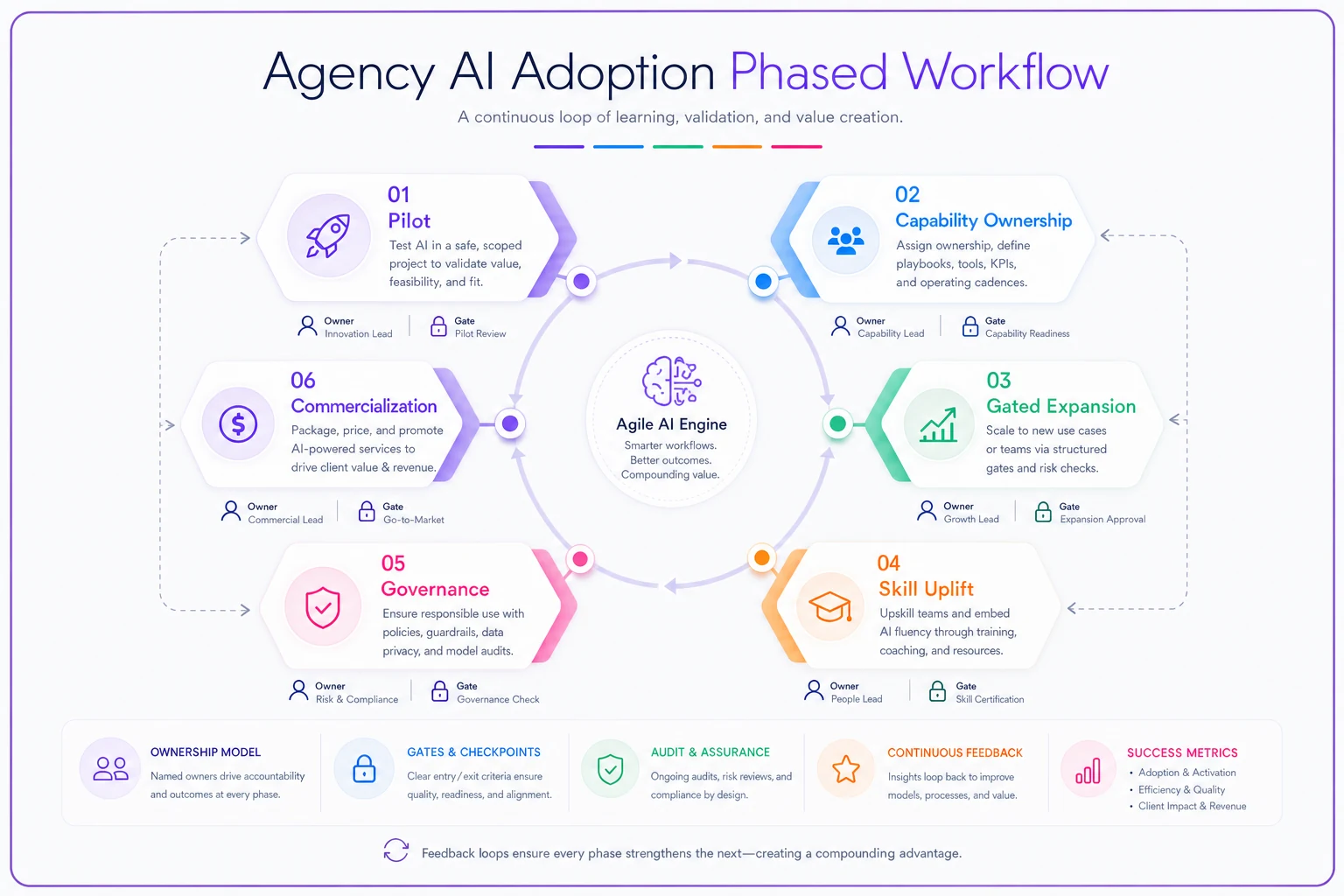
The phases overlap in practice. You don't finish one and start the next. But the ordering matters — commercializing before governance is how agencies end up selling AI services they get sued over.
Choosing what to pilot (and what to leave alone)
Pilot selection is where most roadmaps go wrong. Teams pick the flashy stuff — "AI that writes the whole strategy deck" — because it demos well. Those are almost always bad pilots. They're hard to evaluate, high-stakes if wrong, and dependent on judgment the tools don't reliably have yet.
Good pilots share a few traits. The workflow is repetitive and high-volume, so time savings compound. The output is checkable — you can tell quickly whether it's right or wrong. And a mistake is recoverable rather than a client-facing catastrophe. That combination lets you measure real value without betting an account on it.
A practical pilot scoring approach:
-
Volume — does this happen dozens of times a week, or occasionally?
-
Checkability — can a human verify the output in under a minute?
-
Blast radius — if it's wrong and slips through, how bad is it?
-
Baseline clarity — do we actually know how long this takes today?
-
Owner availability — is there someone who wants to own this, not just try it?
That last one gets ignored constantly. A pilot without a committed owner is a hobby. It'll produce a nice demo and then rot.
When a pilot actually makes sense
Reconciling data across ad platforms, drafting first-pass reporting narratives, categorizing inbound briefs, summarizing long client threads, generating creative variations for testing — these are strong candidates. High volume, checkable, contained. If something goes sideways, you catch it before it reaches a client.
When to leave it alone
Anything where being subtly wrong is invisible and expensive. Final budget allocation decisions. Compliance-sensitive copy in regulated verticals. Strategic recommendations where a plausible-but-wrong answer looks identical to a correct one. You can assist those workflows eventually, but they're terrible first pilots because you can't cheaply tell whether the AI is helping or quietly degrading your work.
Capability owners: the part everyone forgets
There's a pattern worth watching for: an agency runs six AI pilots, four show promise, and eight months later three of them have silently died. Not because they failed — because nobody owned them. The tool changed its pricing, or a workflow broke after a platform update, and there was no one whose job it was to notice.
Every active AI capability needs a named owner. Not a committee. A person. Their responsibilities are unglamorous and essential:
-
Maintain the workflow — fix it when upstream tools or data change.
-
Track the metric — keep the before/after baseline honest over time.
-
Own the quality bar — decide what "good enough output" means and audit against it.
-
Document the process — so it survives them leaving.
-
Flag drift — notice when results quietly get worse, which they do.
The owner doesn't need to be technical. Often the best owner is the person who felt the original pain most acutely — the analyst drowning in reconciliation work, the account lead buried in status updates. They care whether it keeps working because they're the one who suffers when it doesn't.
Make ownership explicit in capacity planning so it's visible in hiring and workload forecasts rather than an unpaid side task.
This connects directly to how you think about capacity and roles overall. If you've built out capacity formulas and hiring scorecards for your operational playbook, capability ownership slots right into that model — it's a real responsibility with a real time cost, not a favor someone does on the side.
Gating policies: how you decide to expand or kill
A gate is a checkpoint where a capability either earns the right to grow or gets shut down. Without gates, everything expands by default and nothing ever dies — which is how you accumulate tool sprawl.
The gate between pilot and wider rollout should be concrete. Something like: the workflow has run for at least six weeks, saved a measurable and consistent amount of time, produced an error rate below whatever threshold you've set for that workflow's risk level, and has documentation good enough that someone new could run it. Miss any of those, and it stays in pilot or gets cut.
The uncomfortable part of gating is killing things that work "fine." An agency will keep a tool that saves twenty minutes a week purely because someone likes it, ignoring that maintaining, securing, and governing it costs more than those twenty minutes. Gates force that math. A capability that isn't clearly worth its overhead should die, and someone senior needs the authority to make that call without a political fight.
Who should NOT own gating decisions: the person who built or championed the pilot. They're too invested. Gating needs someone who can look at an underperforming favorite and say "this goes," which is why it usually belongs with operations leadership rather than the enthusiast who started it.
Skill uplift: training that survives contact with real work
Most AI training at agencies is useless because it's abstract. A vendor runs a two-hour session, everyone nods, and nobody changes how they work on Monday. The skill uplift that actually sticks is built around your own workflows, run by your own capability owners, using your own real examples.
The sequence that works:
-
Start with the people who'll use one specific capability, not the whole agency.
-
Train on the actual workflow they'll run, with real (anonymized) client data.
-
Have them produce output that a human reviews, so they learn where the tool fails.
-
Build the "when to trust it / when to override it" judgment explicitly — this is the whole game.
-
Only then widen to the next team.
That last judgment piece matters more than tool mechanics. The dangerous employee isn't the one who can't use AI — it's the one who trusts it completely and stops checking. Your uplift program's real goal is calibrated skepticism: knowing exactly where the tool is reliable and where it quietly isn't.
There's an operational reason to invest here beyond the obvious. Skill level directly affects the metrics that predict whether you can scale. If you track leadership signals through something like an agency operational scorecard, you'll see the connection — teams that use AI well show up as higher throughput per head without a quality drop, while teams that use it badly show up as rework and client escalations. The scorecard tells you which is happening before it becomes a client problem.
Governance controls: the part that lets you sleep
Governance sounds like the boring compliance section, but for agencies it's the difference between AI being an asset and being a liability during your next client audit. And it has to be built early — retrofitting governance onto a sprawl of existing tools is brutal.
The core controls are simpler than people expect:
-
Data boundaries — a clear, enforced answer to "what client data can go into which tool." This is the one that gets you in trouble fastest.
-
Reversibility — every AI-assisted action a human can undo, and a documented way to do it.
-
Audit trail — a record of what was AI-generated versus human-made, so you can answer client questions honestly.
-
Human checkpoints — defined points where a person must review before output reaches a client.
-
Kill switches — the ability to shut off a capability fast if it starts misbehaving.
The pattern that burns agencies is treating governance as something you add after scaling. By then the risk is already distributed across every client environment and you're documenting exposure you can't remove. Governance-first isn't slower — it's what makes fast scaling survivable.
This is worth going deep on, because campaign automation specifically carries risks that are easy to underestimate. The mechanics of guardrails, audits, and rollback are covered thoroughly in the breakdown on AI governance for campaign automation, and it's the piece worth reading before letting any AI touch live campaign spend.
A real scenario
A performance agency, around 25 people, was drowning in reporting. Analysts were spending big chunks of every week pulling data, reconciling numbers across platforms, and writing the narrative sections of client decks by hand. Roughly two full days per analyst per week disappeared into it during reporting cycles.
They picked reporting narrative drafting and cross-platform reconciliation as pilots — high volume, checkable, contained. They assigned a senior analyst as capability owner, set a gate (six weeks, consistent time savings, error rate low enough that spot-checks rarely caught problems), and built a two-hour training session around their actual client accounts.
The reconciliation piece cut data-wrangling time by roughly half once it stabilized. Narrative drafting was messier — the first drafts needed real editing, and the team learned to treat AI output as a starting skeleton, not a finished section. Net effect over about a quarter: analysts got back close to a day a week each during reporting cycles, and — more importantly — the client-facing quality got more consistent, because the reconciliation errors that used to slip through by hand mostly stopped.
The part that made it work wasn't the tool. It was that someone owned it, the gate kept them honest, and the governance meant when a client asked how reports were produced, they had a clean answer.
Commercialization: turning internal wins into billable IP
This is where the roadmap pays off, and where most agencies fumble. Once a capability has survived piloting, gating, and governance, it's not just an efficiency gain — it's potential IP. The reconciliation workflow you built, the narrative framework, the way you structure creative variation testing — those are repeatable service models you can package.
A few honest paths to commercialize:
-
Efficiency captured as margin — you deliver the same service faster and keep the difference. Quiet, low-risk, easy to start.
-
New productized service — package the capability as a defined offering with its own scope and price. Higher upside, but it requires the capability to be genuinely repeatable.
-
Premium tier — offer AI-enhanced speed or depth as an upgrade on existing services.
-
Licensed methodology — the most ambitious
your documented, governed process becomes something you can license or sell, not just deliver.
The rule that keeps you out of trouble: never commercialize something you can't deliver consistently. A pilot that works when your best analyst runs it is not a product. It becomes a product only when the workflow is documented well enough that an average team member produces reliable output. That's why the ownership and skill-uplift phases aren't optional bureaucracy — they're what convert a clever trick into something you can actually sell.
Who should not commercialize yet
If your capability still depends on one person's judgment, if governance is informal, or if you can't clearly explain to a client how the work gets produced — you're not ready. Selling AI-enhanced services you can't reliably deliver or defend is how you turn a genuine advantage into a reputation problem. Finish the earlier phases first.
Bringing the phases together as one system
The reason to think of this as a roadmap rather than a checklist is that the phases feed each other. Pilots that pass gates need owners. Owners can't function without skill uplift. Skill uplift is dangerous without governance. And commercialization is only safe once all of that is in place. Skip a phase and the weakness shows up two phases later, usually in front of a client.
What separates agencies that get real leverage from AI versus the ones that just accumulate more tools is discipline about the boring middle — ownership, gates, governance. The exciting parts, piloting and commercializing, are the bookends everyone wants to jump between. The durable advantage lives in the connective tissue between them, and that's exactly the part most agencies skip.
Start narrow. Pick two or three checkable, high-volume workflows. Give each a real owner. Set honest gates. Build governance before you scale, not after. Then, and only then, package what survived into something you can sell. Done in that order, AI stops being a scattered set of experiments and becomes an operating capability — one you can defend in an audit and charge a premium for.
Ready to elevate your agency's performance?
Join 2,000+ agencies using Digmaly to save time, boost efficiency, and deliver superior client results.