


Most agencies treat privacy compliance like a legal problem that gets solved in a contract, then forgotten until something breaks. That's exactly why it breaks. The gap isn't in the policy documents — those usually read fine. The gap is between what the policy says and what the measurement team actually does when they set up a consent banner, wire a server-side event, or decide whether to backfill conversions after a client asks why last month's numbers dropped.
Nobody wrote the map from the policy language to the specific configuration choices. So the intern who sets up Consent Mode picks defaults. The analyst who builds the reporting layer assumes consent was handled upstream. The account lead promises the client "full-funnel attribution" without knowing half the events won't fire for EU visitors who declined. Three months later there's a discrepancy nobody can explain, a data subject deletion request touching five systems, and no evidence trail showing what the agency actually did.
This article is about closing that gap — building agency privacy compliance operations as a real system where consent capture points, retention and deletion SOPs, and measurement fallbacks are all tied directly to the measurement decisions your team makes. Not a policy binder. A working map with evidence artifacts and clean handoffs between the people who own each piece.
Where policy and practice actually diverge
The reason this falls apart isn't ignorance of the rules. Privacy policy lives in one language — legal, abstract, jurisdictional — and measurement work lives in another: pixels, event parameters, lookback windows, modeled conversions. Nobody is fluent in both, so translation errors pile up quietly.
-
Consent capture that records a choice but doesn't wire it to tag behavior
-
Retention rules that exist on paper but no system actually enforces (data just sits there indefinitely)
-
Deletion requests that get handled in the CRM but never touch the ad platforms, the warehouse, or the server-side layer
-
Measurement fallbacks — modeling, blended attribution, holdouts — chosen without anyone asking whether the fallback introduces its own privacy exposure
Each of these is a place where policy and process split. The framework's job is to bolt them back together.
Mapping consent capture points to measurement choices
Start with the thing that triggers everything else: the moment a user makes a consent choice. Most teams think about consent as a yes/no at the banner. In practice a single visitor generates several consent signals across a session, and each one should map to a specific measurement behavior.
Eliminate marketing chaos with streamlined campaign control.
Digmaly lets you plan, execute, and track every campaign effortlessly.
- Unified campaign management
- Real-time client reporting
- Collaborative team workflows
No credit card required
Here's the mapping that matters — not the legal categories, but the operational ones:
| Consent state | What measurement is allowed | What the fallback becomes | Evidence needed |
|---|---|---|---|
| Full opt-in | First-party + third-party tags, user-level IDs, remarketing | None needed | Timestamped consent record + tag-fired log |
| Analytics only | First-party analytics, aggregated reporting | Modeled/aggregated conversions for ads | Consent record showing granular choice |
| Denied / no response | Cookieless pings only, consent-mode modeling | Modeled conversions, MMM signal | Proof tags did NOT fire user-level data |
| Withdrawn later | Stop all, trigger deletion downstream | Backfill gap documented | Withdrawal timestamp + deletion ticket |
The column people skip is the last one — evidence. Configuring the behavior correctly isn't enough. When a regulator, a client's legal team, or a new agency taking over the account asks "prove that denied users weren't tracked," you need an artifact, not a verbal reassurance.
The insight that trips up most teams: your measurement fallback is a downstream consequence of your consent design, not a separate decision. When you decide that denied users get modeled conversions instead of tracked ones, you've made a measurement-accuracy tradeoff and a compliance decision simultaneously. Treating those as two separate conversations is how agencies end up with attribution that quietly overstates performance for privacy-conscious segments. This ties directly into the attribution reconciliation problem — a lot of ghost discrepancies across platforms trace back to inconsistent consent enforcement, which is worth digging into with the stepwise playbook to reconcile attribution discrepancies across platforms.
Retention and deletion SOPs that actually reach every system
Retention is where "we have a policy" and "we do the thing" diverge most dramatically. The policy says "personal data retained no longer than 14 months." Fine. Now name every place that data actually lives:
-
GA4 (has its own retention setting, often left at default)
-
Your BigQuery/warehouse export (retention setting there is completely separate)
-
The ad platforms' customer match and audience lists
-
Server-side event storage
-
Your reporting cache or BI layer
-
Any CRM or email tool feeding conversions back
A retention SOP that only adjusts the GA4 slider is the most common failure. The warehouse export keeps everything forever, and now your longest-lived copy of user data is the one nobody remembers to clean.
A workable retention SOP reads as a scheduled enforcement job with named owners, not a policy statement. In practice:
-
Every data destination gets logged in a system-of-record inventory (this is the same asset your data governance work produces — if you've built role matrices and data-lineage checks, you already have most of the inventory).
-
Each destination gets a retention value and a method of enforcement — automatic setting, scheduled query, or manual quarterly purge.
-
Someone owns the enforcement check on a calendar cadence, and the check produces a dated log.
-
Deletion requests trigger a fan-out checklist that hits every destination, not just the obvious one.
That deletion fan-out deserves its own checklist because it's where most agencies get exposed. When a data subject asks to be deleted:
-
[ ] Remove from CRM and suppress future collection
-
[ ] Delete or hash-remove from ad platform audience lists
-
[ ] Purge from warehouse tables (including historical partitions)
-
[ ] Clear from server-side event store
-
[ ] Confirm reporting cache doesn't re-surface stale rows
-
[ ] Log the request ID, systems touched, and completion timestamp
-
[ ] Send confirmation artifact to whoever owns the client relationship
"We deleted them" is not defensible. "Here's request #4471, deleted from six systems on March 14, signed off by the ops lead" is.
The deletion fan-out is only as good as the inventory behind it. If your data-destination list is incomplete, the checklist is incomplete. That's why the inventory isn't a one-time project — it needs to update whenever a new vendor gets added to the stack.
Measurement fallbacks: choosing them with privacy in the room
When consent rates drop, measurement gets harder, and teams reach for fallbacks — Consent Mode modeling, data-driven attribution, media mix modeling, geo holdouts. Each is a legitimate tool. The mistake is choosing one purely on measurement accuracy and never asking what it does to your privacy posture.
Modeling and aggregation are actually your friends here — they let you keep measuring denied-consent users without collecting their personal data. That's the point. But the choice has to be deliberate and documented, because "we're using modeled conversions" means "we are reporting numbers that were estimated, not observed," and the client deserves to know which parts of their reporting are which.
A pattern worth flagging: agencies sometimes blend modeled and observed conversions in a single reported number without labeling the split. Technically the measurement might be reasonable. Operationally it's a trust landmine — the day a client's own analyst reconciles the platform's raw numbers against your report and finds a 20% gap you never disclosed, the conversation isn't about methodology anymore. It's about whether they can trust anything you send. Building your reporting layer so modeled versus observed is a labeled, testable distinction is part of a healthy pipeline architecture, which connects to the agency-first measurement platform architecture with governance and CI-style tests.
When a fallback makes sense — and when it doesn't
Modeling makes sense when consent denial is high enough that observed data alone would misrepresent performance, and you can clearly separate modeled from observed in reporting.
A holdout or MMM approach makes sense when you need channel-level truth that doesn't depend on user-level tracking at all — genuinely privacy-durable measurement.
A fallback is a bad idea when you're using it to paper over a broken consent implementation. If tags aren't firing because of a configuration bug rather than a consent choice, modeling that gap just hides the bug and inflates the numbers. Fix the plumbing first.
Who should not lean on modeled fallbacks: small-volume accounts. Modeling needs data density to be trustworthy. On a client running a few hundred conversions a month, modeled numbers are guesses dressed as estimates, and you're better off reporting honestly on what you can observe.
Audit-ready evidence: the artifacts that make this real
The difference between an agency that says it's compliant and one that can prove it is a set of artifacts you can pull on demand. Not documents written once and filed away, but records the system generates as work happens.
The core evidence set:
-
Consent record log — per-user or session-level, timestamped, showing the granular choice
-
Tag-firing audit — proof that tags respected the consent state (the artifact almost nobody keeps, and the one regulators actually want)
-
Retention enforcement log — dated confirmations that each destination was purged on schedule
-
Deletion request register — request ID, systems touched, completion, sign-off
-
Fallback methodology record — which accounts use modeling, since when, how it's labeled in reports
-
Vendor and data-flow map — where data goes and under what consent basis
The thing that separates mature ops teams: these artifacts are produced automatically by the workflow, not assembled in a panic when someone asks. If your team has to spend two days reconstructing what happened for an audit, the evidence isn't real — it's archaeology.
Most of these records don't require fancy tooling. A dated log in a shared sheet, a scheduled query that writes a row on completion, a deletion register in your project management tool — the format matters less than whether it exists and whether it's current. Agencies that struggle with this usually don't have a tooling problem. They have a habit problem.
A real scenario
A mid-sized performance agency managing around $180k/month in combined ad spend across a handful of EU-facing ecommerce clients got a simple question from a client's legal team during contract renewal: "Show us that visitors who declined tracking weren't added to your remarketing audiences."
They couldn't. The consent banner was live, but nobody had ever verified that denied choices actually blocked audience membership. When they checked, roughly 15–20% of denied-consent users had been landing in customer match lists anyway — a server-side tag was bypassing the client-side consent gate. No malice. Just an untranslated policy.
Remediation took about three weeks: they mapped every consent state to tag behavior, rebuilt the server-side layer to read the consent signal, set retention enforcement as scheduled warehouse jobs instead of hopeful defaults, and built out a deletion fan-out checklist. The measurable outcome wasn't a revenue jump — the renewal closed, and the next quarterly review took a couple of hours to evidence instead of a scramble. The client's legal team signed off because there were now artifacts to sign off on.
The quieter win: their reporting got more honest. Once modeled conversions were labeled separately, one client's apparent "conversion drop" turned out to be a labeling artifact, not a performance problem — a much easier conversation than the one they'd been avoiding.
Operational handoffs: who owns what
A system with no clear owners defaults to "everyone assumed someone else did it," which is exactly how the server-side tag in that scenario slipped through. Map the handoffs explicitly:
-
Onboarding / setup owner configures consent capture and verifies enforcement, then hands a signed setup artifact to ops.
-
Ops / measurement owner runs retention enforcement, monitors that tag behavior stays correct after platform updates, and owns the deletion fan-out.
-
Account owner holds the client-facing evidence and knows which parts of reporting are modeled.
-
Whoever owns governance keeps the data-flow map current as vendors change.
The handoff that fails most often is between setup and ongoing ops. Something gets configured correctly at launch, then a platform update six months later silently changes the default, and nobody re-verifies. Consent enforcement isn't a one-time build — it needs a periodic check, the same way you'd re-verify tracking after any major platform change.
[Consent Choice Captured] ↓ [Tag Behavior Enforced → Consent Record Logged] ↓ [Ops Owner: Periodic Enforcement Check → Dated Log Produced] ↓ [Deletion Request Received → Fan-Out Checklist Triggered] ↓ [All Systems Purged → Request Register Updated → Account Owner Notified] ↓ [Evidence Set Available for Audit or Client Review]
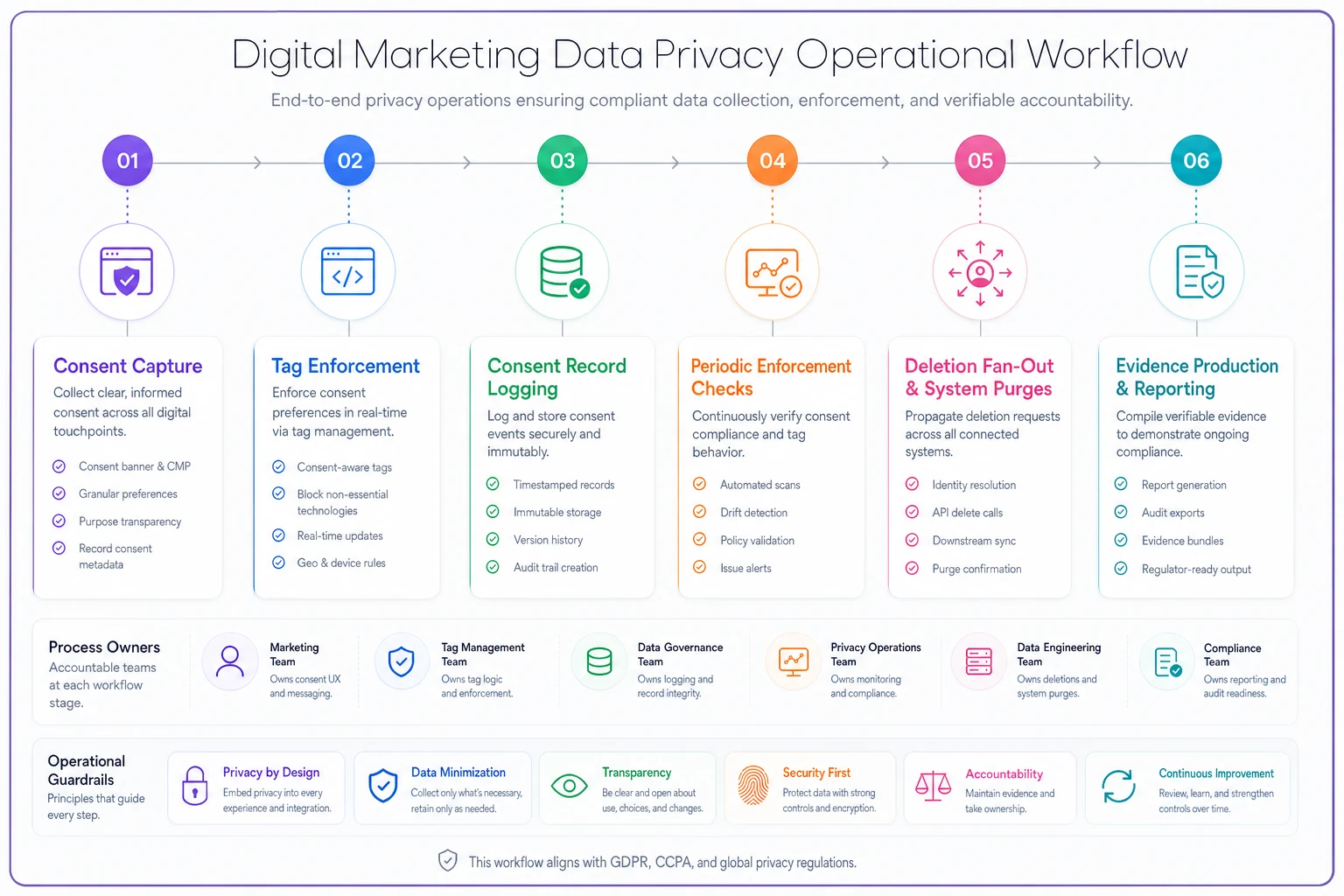
This workflow captures the handoffs and evidence steps above.
Each step has an owner, produces a record, and connects to the next. Nothing is assumed.
Bringing it together
Privacy work feels like a burden at most agencies because it's disconnected from the actual measurement job. Policy sits in a binder, configuration sits in GTM, and nobody maintains the map between them. Every gap in that map is a place where you're either under-measuring, over-reporting, or quietly non-compliant — and usually you don't find out until a client's legal team or a regulator forces the reconciliation.
The framework here isn't more policy. It's translating the policy you already have into specific consent-to-measurement mappings, retention enforcement jobs, deletion checklists, and evidence artifacts your team executes as normal work. Do that once, assign the handoffs, and privacy stops being the thing you dread during renewals. It becomes just another part of running measurement well — provable, maintainable, and boring in the best possible way.
Ready to elevate your agency's performance?
Join 2,000+ agencies using Digmaly to save time, boost efficiency, and deliver superior client results.