


The worst part of an ad account suspension isn't the suspension itself. It's the 45 minutes of scrambling that follow — three account managers arguing about who has login access, someone tearing through Slack looking for the last policy email, and the client sending a "hey why did our ads stop?" message that nobody's ready to answer yet.
That chaos is what actually costs you money. Not the suspension itself.
A proper ad account suspension runbook exists so nobody has to think creatively under pressure. When a Business Manager gets restricted at 9:14am, the first responder opens the doc, follows the steps, and the panic gets replaced by process. This post is that runbook — built for agency teams managing multiple client accounts across platforms.
First, understand what you're actually triaging
Not every suspension is the same emergency. Before you touch anything, you need to classify what hit you — because the wrong first move can permanently kill an appeal.
Suspensions generally fall into a few buckets, and the path forward forks hard depending on which one you're dealing with:
| Suspension type | Typical trigger | Appeal odds | First move |
|---|---|---|---|
| Asset-level (single ad or page) | Policy flag on creative or landing page | High | Pause/remove flagged asset, keep account clean |
| Ad account restriction | Payment issue, unusual spend pattern, repeated flags | Medium-high | Stop new edits, gather billing evidence |
| Business Manager / MCC suspension | Trust & safety review, linked bad asset, ownership confusion | Medium | Escalate immediately, do NOT create duplicates |
| Full permanent ban | Repeat violations, circumvention, fraud signals | Low | Preserve evidence, prepare formal appeal, plan parallel account |
The single biggest mistake agencies make in the first ten minutes: they treat a Business Manager suspension like an asset flag, spin up a new ad account or fresh BM "just to keep ads running," and that gets read as circumvention. Now the recoverable suspension becomes permanent, and the parallel account gets nuked too.
Step one is always: identify the level of the suspension before you react. Read the actual notification — not the client's paraphrase of it.
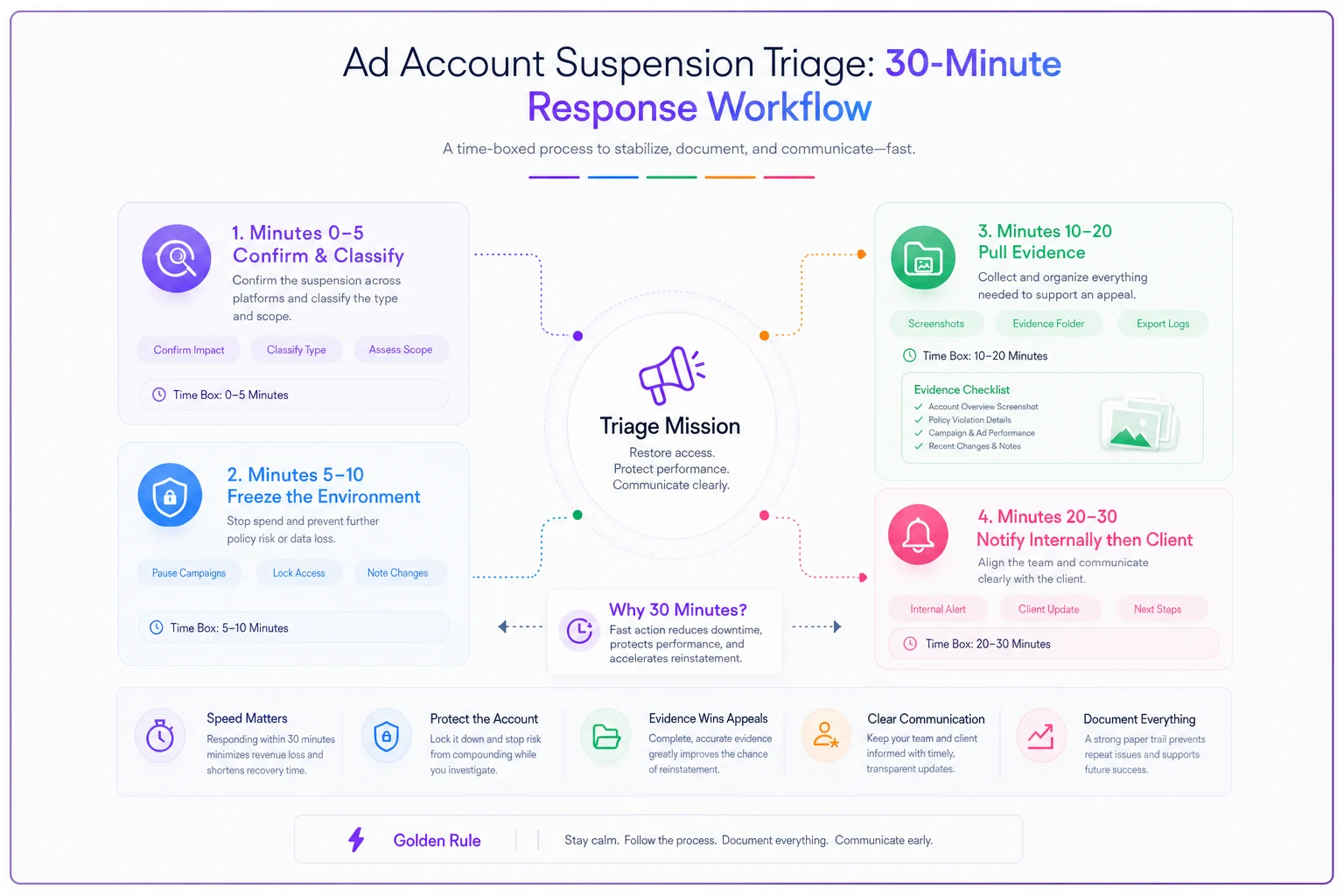
The time-boxed triage sequence
Time-boxing matters here because suspensions create a specific kind of adrenaline that makes people either freeze or overreact. Putting a clock on each phase keeps the response measured.
Eliminate marketing chaos with streamlined campaign control.
Digmaly lets you plan, execute, and track every campaign effortlessly.
- Unified campaign management
- Real-time client reporting
- Collaborative team workflows
No credit card required
-
Minutes 0–5
Confirm and classify.
Log into the actual platform, not just email. Screenshot the exact notification, including the policy category cited and any reference ID. Determine the suspension level using the table above. -
Minutes 5–10
Freeze the environment.
Stop all edits, budget changes, and new campaign uploads across the affected account. Editing a suspended account mid-review is one of the fastest ways to reset the review queue or trigger additional flags. Tell the team: hands off until there's a plan. -
Minutes 10–20
Pull evidence.
Start the evidence checklist below. The goal is a single folder with everything an appeal needs, so you're not hunting later while a review window is open. -
Minutes 20–30
Notify internally, then the client.
Internal first — the account lead and whoever owns the client relationship need the same facts before anyone talks to the client. Then send the holding message.
A simple workflow of the time-boxed triage sequence.
Most agencies do it backwards. They tell the client first, panic sets in on both sides, and then they start gathering evidence while already committed to a story they can't fully back up.
The evidence checklist
An appeal submitted without evidence gets a templated rejection. An appeal with a clean, organized evidence package gets a human read. That's the difference between a two-day recovery and a three-week one.
-
The exact suspension notice — full screenshot, policy category, reference/case ID
-
Account history — screenshots showing account age, spend history, and clean periods
-
The flagged asset (if identifiable) — the specific ad, image, copy, or landing page cited
-
Landing page proof — a live screenshot plus the URL, confirming it matches ad claims and has a visible privacy policy, contact info, and terms
-
Business verification docs — business registration, domain ownership, matching business name across assets
-
Billing records — recent successful payments, no chargebacks, consistent payment method
-
Prior policy communication — any past warnings and how you resolved them
-
Change log — what changed in the account in the 72 hours before suspension (new creative, budget jumps, new users added)
Name the evidence folder by client and date so anyone (or a rep) can find it immediately.
That last one gets overlooked more than it should. A significant share of "mystery" suspensions trace back to something specific — a new team member added to the BM, a sudden 4x budget increase, a landing page swap. When you can show the review team exactly what changed and why it was legitimate, your appeal reads as cooperative rather than defensive.
This is also where solid onboarding hygiene pays off. Agencies that follow a disciplined paid media onboarding process already have verified domains, clean billing, and documented access — which means half this checklist is pre-filled before a suspension ever happens.
Parallel mitigation: keeping the client alive without getting banned
There's real tension here: the client is losing revenue every hour ads are down, but aggressive workarounds can turn a temporary suspension into a permanent one. Mitigation options need to be ranked by risk.
Safe parallel moves (do these):
-
Shift budget to other, unaffected platforms the client already runs. If Meta is down, lean into Google, TikTok, or whatever else is live.
-
Push spend into owned channels — email, SMS, organic — to soften the revenue gap.
-
If only one ad account inside a healthy BM is restricted, and the BM itself is clean, running through a separate legitimately-owned account is sometimes viable — but only after confirming the suspension is asset-level, not a trust signal.
Risky moves (avoid unless you're certain):
-
Creating a brand-new Business Manager to mirror the suspended one. This is circumvention and the fastest path to a permanent ban.
-
Adding the client's assets to a different agency's healthy account "temporarily." You're now exposing that account to whatever flagged the original.
-
Editing and resubmitting the flagged creative repeatedly hoping something sticks.
The judgment call is always: is this suspension a punishment for a specific asset, or a trust decision about the entity? Asset-level problems can tolerate parallel activity. Trust decisions cannot — anything that looks like you're dodging the review makes it worse.
The appeal templates
Appeals fail for boring reasons: they're emotional, they're vague, or they argue instead of clarifying. Reviewers process hundreds of these. Give them a clean, factual, skimmable appeal and you move up the pile.
Template A — Asset-level flag (you believe it's a false positive):
> Account/Business ID: [ID] > Case reference: [ref] > > We received a policy flag on [specific asset] under [policy category]. After review, we believe this was flagged in error. The ad promotes [clear description], the landing page ([URL]) accurately reflects the offer, and includes visible privacy policy, terms, and contact details. > > We have removed/paused the asset as a precaution and are requesting a re-review. Supporting screenshots attached. > > We take policy compliance seriously and are happy to make any specific adjustments required.
Template B — Account restriction (you want reinstatement):
> Account ID: [ID] | Case: [ref] > > This account has operated since [date] with a consistent spend and payment history and no prior enforcement in the last [X] months. We were notified of a restriction under [category] on [date]. > > We have reviewed all active assets and [removed X / found no violating content]. In the 72 hours prior, the only account changes were [list]. All are legitimate and documented. > > We're requesting reinstatement and will implement any required changes immediately.
The pattern in both: acknowledge, state facts, show cooperation, ask clearly. No pleading, no "this is destroying our business," no arguing that the policy is unfair. Reviewers don't set policy and can't be guilted into anything.
One thing worth flagging — inconsistency across your data can itself trigger reviews. If your tracking, business name, and domain signals don't line up, platforms notice. The same discipline that helps you reconcile attribution discrepancies across platforms tends to keep your account signals clean too.
Escalation matrix: who does what, and when to go up a level
Most delays aren't caused by the platform. They're caused by the appeal sitting in the wrong person's inbox for two days. The escalation matrix removes that ambiguity.
| Time since suspension | Owner | Action |
|---|---|---|
| 0–30 min | First responder (whoever spots it) | Triage, classify, evidence, internal alert |
| 30 min–2 hr | Account lead | Submit primary appeal, notify client, start parallel mitigation |
| Day 1 (no response) | Account lead | Follow up in-platform; use any priority support channel available |
| Day 2–3 | Ops manager | Escalate via rep/partner manager if available; second appeal if allowed |
| Day 3+ | Agency principal | Engage platform partner contact, consider formal business support ticket |
If you're a partner-tier agency with a dedicated rep, that contact is your most valuable escalation lever — but only if you've kept the case reference and evidence organized enough to hand over immediately. A rep can't fast-track a mess.
The tighter your internal handoffs, the less a suspension actually costs. Agencies that already run structured campaign orchestration tend to absorb suspensions better simply because roles and handoffs are already defined — the runbook slots into an existing operating rhythm instead of creating a new fire drill.
Client-communication scripts
Clients don't panic because ads are down. They panic because they don't hear from you. Silence reads as incompetence even when you're working furiously behind the scenes.
Script 1 — The holding message (send within 30 minutes):
> Hi [name] — flagging proactively: [platform] placed a temporary restriction on the ad account this morning. We've already started the reinstatement process and are gathering the documentation their review team needs. In the meantime we're [shifting spend to X / keeping Y live] to protect performance. I'll update you by [specific time] regardless of status.
Script 2 — The day-1 update (even if nothing's changed):
> Quick update — the appeal is submitted with full supporting evidence and we're in [platform]'s review queue. These typically resolve in [range]. Current mitigation: [what's running]. Next update from me by [time].
Script 3 — The resolution message:
> Good news — the account is reinstated and ads are ramping back up. Here's what happened and what we've changed to reduce the risk of a repeat: [brief, plain-language explanation]. Full performance should stabilize within [range].
The rule across all three: you always name the next update time. A client who knows they'll hear from you at 3pm doesn't send five anxious messages before then. That single habit does more to preserve the relationship than the speed of the actual reinstatement.
A real scenario
A mid-sized ecommerce brand running roughly $40k–$45k/month through a single Meta account got a Business Manager restriction on a Tuesday morning — flagged under a vague "business integrity" category with no obvious violating ad.
The agency's instinct, before they had a runbook, would've been to spin up a new BM to keep sales flowing. Instead they classified it correctly as a trust-level suspension, froze all edits, and pulled evidence. The change log surfaced the likely trigger: a new freelancer had been added to the BM two days earlier, and a landing page had been swapped to one missing a privacy policy link.
They fixed the landing page, documented the freelancer as a legitimate contractor, submitted Template B with the full evidence folder, and shifted budget to the client's existing Google and email channels. The client got a holding message within 25 minutes and a scheduled update the next morning. Reinstatement came through on day two. Estimated revenue impact was somewhere in the low four figures — not nothing, but a fraction of what a permanent ban from a duplicate-BM mistake would've cost. The client was notably calmer at the end of it than the agency was, purely because they were never left guessing.
When a slower, more deliberate approach makes more sense
Speed isn't always the right call. If the suspension is a genuine repeat violation, or the account has a real history of policy problems, rushing an aggressive appeal can burn credibility with the review team. In those cases, taking an extra day to build a thorough, honest case — including specific changes made to prevent recurrence — beats a fast, thin submission every time.
And if it's a permanent ban after multiple prior violations, the honest move is to stop appealing and start planning a clean, properly-verified new setup with the client's full knowledge — not a stealth duplicate that'll get flagged within a week.
Who should build this before they need it
Every agency running client ad spend should have a suspension runbook written down before the first suspension, not drafted in a panic during one. If you manage more than a handful of accounts, it's not a question of if — it's when, and how many at once.
The agencies that recover fastest aren't the ones with secret platform connections. They're the ones where the first person to notice a suspension knows exactly what to do in the first five minutes, where half the evidence already exists from clean onboarding, and where the client hears from a calm human with a clear plan before they've even had time to worry.
Every agency running client ad spend should have a suspension runbook written down before the first suspension, not drafted in a panic during one. If you manage more than a handful of accounts, it's not a question of if — it's when, and how many at once.
The agencies that recover fastest aren't the ones with secret platform connections. They're the ones where the first person to notice a suspension knows exactly what to do in the first five minutes, where half the evidence already exists from clean onboarding, and where the client hears from a calm human with a clear plan before they've even had time to worry. That's the whole point of a runbook. It turns an emergency into a checklist — and a checklist is something you can actually get right under pressure.
Ready to elevate your agency's performance?
Join 2,000+ agencies using Digmaly to save time, boost efficiency, and deliver superior client results.