

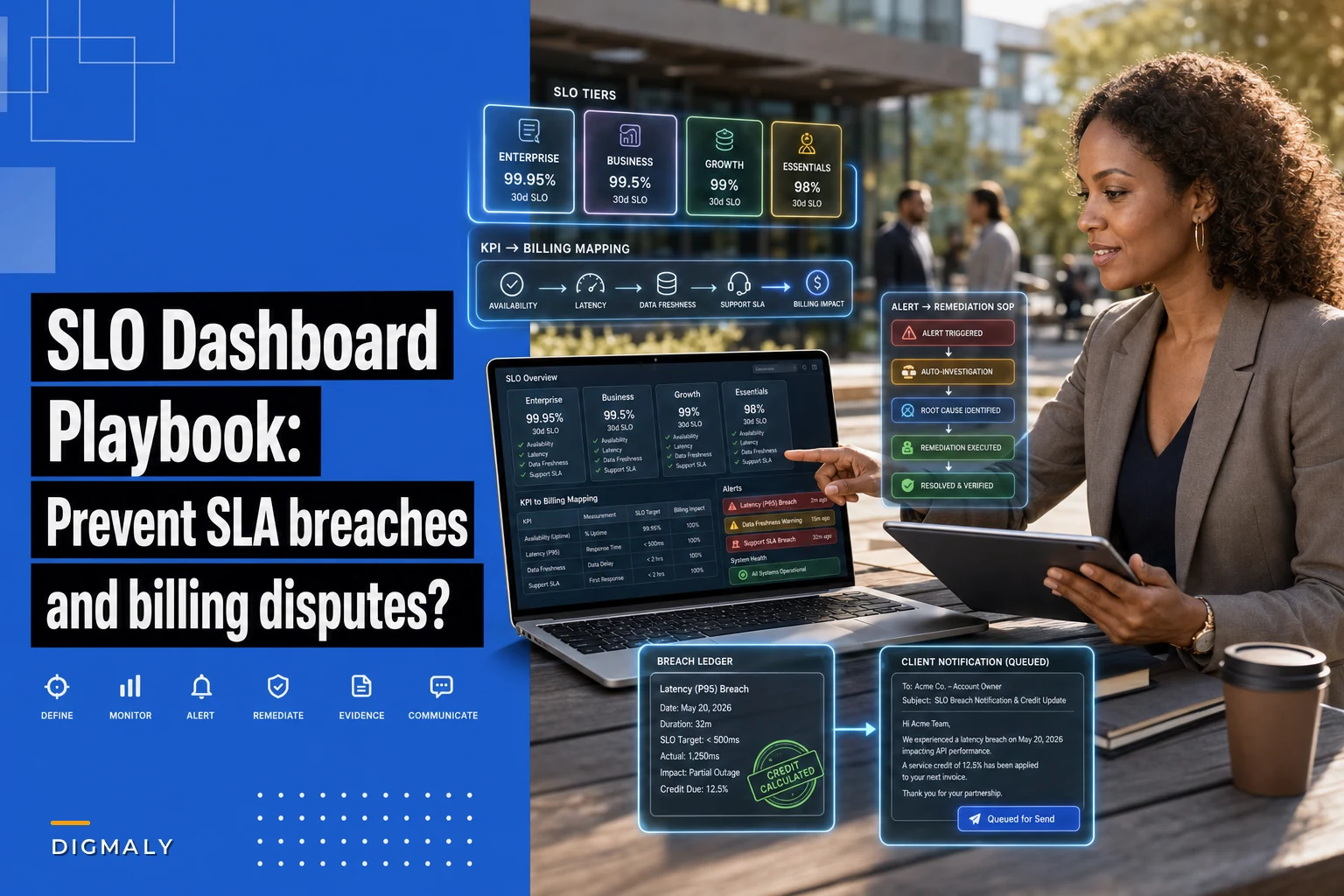

Most agency SLA fights don't start with a missed deliverable. They start three weeks later, when the client pulls up a thread and says "you promised 24-hour turnaround on creative changes and this took four days." And you don't have a clean source of truth to argue back with. You have Slack messages, a project tool, two email chains, and a gut feeling that you were actually pretty responsive that week.
That gap — between what you promised and what you can prove — is where billing disputes live. An SLA monitoring playbook for agencies isn't really about contracts. It's about making the thing you sold observable, so nobody has to argue about it from memory.
This post covers the dashboard layer specifically: how to define SLOs per service tier, wire your KPIs to billing outcomes, sketch the actual dashboard, and build the alert-to-remediation flow that fires before a breach becomes a credit request. If you've already sorted out your service tiers and billing-linked capacity, this is the operational layer that sits on top of it.
The real problem: your SLAs are written but not instrumented
The pattern shows up constantly. An agency sells a Gold tier with "priority support" and "4-hour response time" and "weekly optimization reviews." Those words live in a PDF. Nobody disputes them at signing.
Then operations happen. Response time gets measured by whoever is complaining. Weekly reviews slip to biweekly during a busy stretch. Optimization work gets done but never logged anywhere anyone can point to. The SLA is real on paper and invisible in practice.
An SLA you can't measure in near-real-time is just a liability. It's a commitment you've made with no instrument to tell you when you're about to break it. By the time the client notices, you're already in dispute territory — and the only move left is a credit or an apology.
A dashboard flips the timing. Instead of discovering breaches when a client emails, you catch the degradation while there's still time to fix it. The breach never happens, or if it does, remediation is already in motion and documented before anyone asks.
Step one: define SLOs that map to things you actually track
An SLA is the external promise. The SLO is the internal target you manage to — and it should be stricter than the SLA so you have buffer. The mistake agencies make is setting SLOs identical to the contractual SLA, which means the moment you dip, you're already breaching.
Eliminate marketing chaos with streamlined campaign control.
Digmaly lets you plan, execute, and track every campaign effortlessly.
- Unified campaign management
- Real-time client reporting
- Collaborative team workflows
No credit card required
Set the SLO tighter. If the contract says 4-hour first response, make your internal SLO 2.5 hours. That buffer is what gives your alert system time to escalate before the client-facing clock runs out.
| Metric | Bronze SLO | Silver SLO | Gold SLO | Contractual SLA (Gold) |
|---|---|---|---|---|
| First response to request | 8 business hrs | 4 business hrs | 2.5 business hrs | 4 business hrs |
| Creative change turnaround | 5 business days | 3 business days | 36 hrs | 48 hrs |
| Reporting delivery | By 5th of month | By 3rd | By 2nd | By 3rd |
| Optimization review cadence | Monthly | Biweekly | Weekly | Every 7 days |
| Incident acknowledgment | 4 hrs | 2 hrs | 45 min | 1 hr |
| Budget pacing check | Weekly | 2x/week | Daily | Daily |
The gap between the SLO and SLA columns isn't padding. It's the early-warning zone. When you cross the SLO but haven't hit the SLA, that's your signal to intervene — not your signal to write a credit.
One thing worth flagging: don't put anything on this list you can't timestamp automatically. "Quality of strategic recommendations" is not an SLO. It's a conversation. Keep the dashboard honest by only tracking what has a clock attached.
Step two: map each KPI to a billing consequence before you need to
This is the part most agencies skip, and it's the part that prevents the ugliest disputes. If a breach happens and then you negotiate what it's worth, you're negotiating emotionally with an annoyed client. If the credit value is predefined and visible, the conversation is boring — which is exactly what you want.
-
Minor breach (one missed response window, single late report)
2% of monthly fee, capped at one per month
-
Moderate breach (repeated misses in the same category within a billing cycle): 5% of monthly fee
-
Major breach (missed optimization cadence two weeks running, or a reporting failure that affected client decisions): 10%, with a mandatory review call
The detailed math on how credits accumulate and get enforced is its own topic, worth working through carefully before publishing any of this in a contract. But the dashboard's job is narrower: it needs to automatically flag which category a given breach falls into, so the credit calculation isn't a judgment call made weeks later.
The credit amount almost never becomes the real pain point. The pain point is surprise. A client who sees a 5% credit on their invoice with a line-item explanation ("missed reporting SLA on Nov 3, auto-applied") stays calm. A client who has to chase you for acknowledgment, argue about severity, and wait for a goodwill gesture — that client starts shopping for a new agency.
Step three: the dashboard wireframe that actually gets used
Dashboards die when they're built for reporting instead of operating. A pretty monthly rollup nobody opens on a Tuesday does nothing to prevent breaches. The dashboard that works is the one your account team glances at every morning because it tells them where today's risk is.
Here's the layout that holds up in practice, top to bottom:
Top strip — breach risk, right now. Not last month's performance. A live count of clients currently inside the SLO-to-SLA warning zone. This should be the first thing anyone sees: "3 accounts at risk today." If this strip is green, the day is calm. If it's amber, someone acts before lunch.
Second row — per-client status tiles. One tile per account, color-coded, showing each tracked SLO and how much buffer remains. The Gold client whose creative turnaround clock is at 30 of 36 hours shows amber. Nobody has to run a report to find that. The tile is the report.
Third row — the breach ledger. A running list of every SLO crossed and every SLA breached this billing cycle, with the auto-assigned severity and credit implication attached. This is what you reconcile against invoices at month-end. No one reconstructs it from memory.
Bottom — remediation status. For anything that crossed into breach, where is the fix? Acknowledged, in progress, resolved, client-notified. This closes the loop so a breach doesn't just get logged and forgotten.
The structural insight is that the dashboard should be organized by time-to-breach, not by category of work. Agencies instinctively build dashboards grouped by service — all the reporting metrics together, all the creative metrics together. That's backwards for prevention. Group by urgency. The question the dashboard should answer is "what breaks first if I do nothing," and that's a time question, not a category question.
The dashboard should be organized by time-to-breach, not by category of work.
If you're building out the reporting narrative layer on top of this for clients, that's a separate discipline — worth reading up on how to structure performance reporting around KPI governance and client narratives rather than raw metrics dumps.
Step four: the alert → remediation → communication chain
A dashboard that only shows status is a smoke detector with no one home. The whole value is in what fires automatically when a threshold is crossed.
Here's the sequence that keeps breaches from turning into disputes:
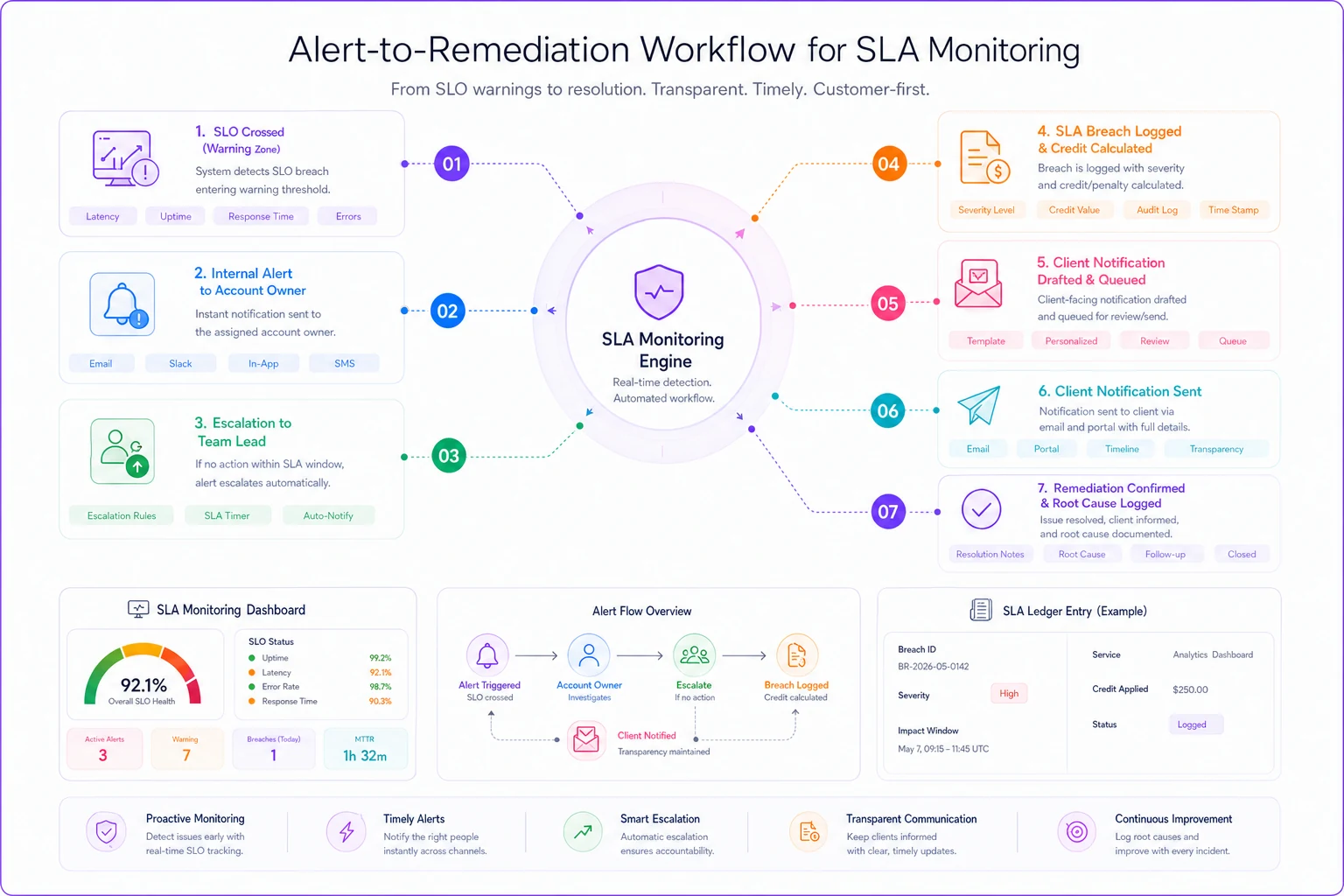
A quick visual helps teams understand escalation points and handoffs.
-
SLO crossed (warning zone). Internal alert to the account owner only. No client involved yet. Message includes the specific metric, remaining buffer, and the linked remediation SOP. Example: "Gold — Acme creative turnaround at SLO threshold, 10 hrs to SLA. Assign now."
-
No action within the response window. Escalate to the team lead. This catches the case where the account owner is heads-down or out. The escalation is time-based, not person-dependent — which matters because the whole point is to not rely on one human remembering.
-
SLA breached. The event gets logged to the breach ledger with auto-assigned severity, the credit value is calculated, and a drafted client notification is queued — not sent automatically, but drafted and waiting for a one-click send. The agency decides whether to send, but the draft exists so nobody has to write an awkward email from scratch under pressure.
-
Client notification sent. Proactive, before the client notices. This single move is what separates agencies that keep clients through breaches from the ones that lose them. "We missed our reporting SLA this cycle by one day. A 2% credit has been applied to your next invoice. Here's what caused it and what we changed." Boring, factual, already handled.
-
Remediation confirmed and root cause logged. The breach doesn't close until there's a note on why it happened and what prevents a repeat. This feeds back into whether your SLOs are realistic or whether you're chronically under-capacity on a tier.
The remediation SOP tied to each alert is where a lot of agencies under-invest. The alert should link directly to the fix procedure, not just announce the problem. If creative turnaround is at risk, the SOP says exactly who gets pulled in, what gets deprioritized, and who approves the reshuffle. The alert and the playbook are one unit.
A realistic example of the whole thing working
A mid-sized paid media shop — maybe 18 people — was running a dozen retainers in the $6k–$11k/month range. They had SLAs in every contract. They had no instrumentation. Over about a four-month stretch they'd handed out ad-hoc credits and goodwill discounts totaling somewhere north of $9k, mostly to calm down clients who'd caught a missed turnaround or a late report after the fact.
The real cost wasn't the credits. Two accounts had quietly started interviewing other agencies, and one churned — worth close to $120k annually.
They built the warning-zone buffer into their SLOs and stood up the risk-strip dashboard. The first month, the top strip caught roughly a dozen accounts crossing into the warning zone before any became an actual breach. Most got resolved the same day because someone saw amber and acted.
By the second full cycle, ad-hoc credits had dropped to near zero — not because performance magically perfected itself, but because the few breaches that did happen were caught early, communicated proactively, and credited at a predefined rate. Clients stopped feeling blindsided. The churn conversations cooled. The agency owner's framing afterward was basically: the dashboard didn't make them faster, it made them legible. Clients could see the agency was managing to the promise, and that was most of the battle.
When this is worth building — and when it isn't
This makes sense when: you've got enough retainers that SLA enforcement is slipping through the cracks, your contracts already specify time-based commitments, and you've started handing out credits or goodwill discounts reactively. If you're writing apologetic "we'll make it right" emails more than once a quarter, you need this.
This is overkill when: you're running a handful of clients and your whole team is in one room. If your account lead already knows the status of every account in their head, a formal SLO dashboard adds overhead without removing a real problem. Don't build instrumentation for a problem you don't have yet.
Who should not do this: agencies whose SLAs are vague on purpose. If your contracts say "we'll be responsive" with no numbers, don't build a dashboard first — fix the contracts first. Instrumenting a promise you never quantified just creates arguments about what the promise was. Nail down the measurable commitments, tighten them into internal SLOs, then build the dashboard to watch them.
The checklist before you build
Before anything gets built or scoped, run through this. If more than a couple items are unchecked, the dashboard will create more confusion than it solves.
-
Every SLA metric in your contracts has a timestampable equivalent
-
Internal SLOs are set stricter than contractual SLAs (build the buffer)
-
Each metric maps to a predefined, capped credit value by severity
-
Dashboard is organized by time-to-breach, not by work category
-
Warning-zone alerts fire to the account owner before any SLA clock runs out
-
Escalation is time-based, not dependent on one person remembering
-
Breach events auto-log severity and credit value to a ledger you reconcile against invoices
-
Client notifications are drafted automatically and sent proactively, not reactively
-
Every breach closes only after a root-cause note that feeds back into SLO realism
If you get through that list and everything is checked, you're ready to build. If half of it is missing, you're not building a monitoring system yet — you're still building the foundation it needs to sit on.
The thing most agencies get wrong
The temptation is to treat SLA monitoring as a reporting exercise — something you look at monthly to see how you did. That framing guarantees you'll keep finding out about breaches after they've already damaged the relationship.
The shift that actually prevents disputes is treating the whole system as a preventive one. The dashboard exists to catch the warning zone, the alerts exist to trigger action while there's still buffer, and the credit mapping exists so that the rare breach that slips through gets handled calmly and consistently instead of negotiated in anger.
Get the instrumentation right and the arguments mostly disappear — not because you never miss, but because when you do, everyone's looking at the same clean record, the consequence was agreed on in advance, and you reached out first. That's what a real SLA monitoring playbook buys an agency: fewer breaches, and the ones that happen stop turning into fights about what was promised.
Ready to elevate your agency's performance?
Join 2,000+ agencies using Digmaly to save time, boost efficiency, and deliver superior client results.