


Most agencies treat seasonal bursts like isolated events. Black Friday runs, wraps, gets a recap deck, and everyone moves on. Next year the team pulls up last year's account, squints at a mess of ad set names, and asks the question that quietly burns hundreds of hours: "Wait, did this actually work last time, or did it just spend?"
Nobody can answer confidently. So they guess, rebuild from memory, and repeat mistakes they technically already paid to learn once.
The reason isn't laziness. Seasonal campaigns are usually run reactively — under deadline pressure, budgets ramping fast, clients asking questions every other hour. Learning gets treated as a byproduct instead of something you actually designed for. A real seasonal campaign planning SOP isn't about running this burst better. It's about making sure next year's team inherits proof, not vibes.
This post is narrow on purpose. It covers one thing: building a calendar-driven SOP that preserves incremental-lift learning across bursts — using pre-burst holdouts, disciplined tagging, budget ramp rules, reserve-budget logic, and a reconciliation template you actually fill out afterward.
The core problem: bursts destroy their own evidence
A burst compresses everything. You go from a $200/day baseline to $2,500/day over ten days. You launch six new creative concepts at once. You turn on three audiences you don't normally run. Budget pacing alarms go off, someone shifts spend at 11pm, a client asks for a promo extension, and the whole structure mutates twice before the sale even ends.
By the time it's over, the account looks nothing like it did on day one. And because everything changed simultaneously, you can't isolate what actually caused the results. Revenue went up — but revenue always goes up during a sale. That's the trap. Seasonal demand inflates every number, so raw performance tells you almost nothing about whether your work drove incremental sales or just rode the wave.
-
No counterfactual. You never measured what would've happened if you'd spent less, so you can't prove lift.
-
Structural drift. The account changed so much mid-burst that before-vs-after comparisons are basically meaningless.
-
Untraceable naming. Six months later nobody can tell which ad set was the test and which was the safety net.
Fix those three and you've solved most of the "we start from scratch every year" problem.
Start before the burst: the pre-burst holdout
The single highest-leverage move happens before you scale anything. You carve out a holdout so you have a counterfactual to measure against.
Eliminate marketing chaos with streamlined campaign control.
Digmaly lets you plan, execute, and track every campaign effortlessly.
- Unified campaign management
- Real-time client reporting
- Collaborative team workflows
No credit card required
For seasonal work, geo holdouts tend to be the most practical. You pick regions that are similar in baseline performance to your treatment regions, and you deliberately don't ramp spend there during the burst — or ramp it far less. When the burst ends, the difference in outcomes between held-out and treated regions is your cleanest read on incremental lift.
-
T-21 days Confirm the burst calendar and budget envelope with the client. Lock promo dates.
-
T-18 days Pull 8–12 weeks of baseline data by region/segment. Identify holdout candidates with stable, comparable baselines.
-
T-14 days Assign holdout vs treatment groups. Document the split and the expected baseline for each so you're not moving goalposts later.
-
T-10 days Freeze structural changes. No new audiences, no restructures after this point except the planned ramp.
-
T-7 days Pre-register your success metric. Write down now what "it worked" means — incremental ROAS threshold, incremental conversions, whatever. Deciding after you see results is how teams fool themselves.
That last step matters more than it looks. Pre-registering the metric before the burst is the difference between measurement and rationalization.
When a holdout is a bad idea
Holdouts aren't free. If a client's total burst budget is small — say under roughly $8k–$10k — carving out a holdout can starve the test of statistical power and irritate the client who sees "underspending" in a key region. In those cases, a staggered start (treatment regions ramp first, holdout regions ramp a few days later) can give you a cleaner-than-nothing read without fully sacrificing coverage. And if the business is genuinely national with no regional variation to exploit, a time-based holdout on a lower-priority channel is your fallback.
Tagging and naming so future-you can actually read the account
This is the boring part everyone skips, and it's exactly why the learning dies. If your burst assets aren't tagged with intent, the account becomes unreadable within weeks.
The fix is baking burst metadata directly into the naming convention so anyone opening the account a year later understands the role of every entity, not just its name. We've written more about enforcing this across accounts in the campaign naming conventions enforcement and migration plan, but for seasonal work specifically you want a few extra fields.
-
Burst ID — e.g.
BF25for Black Friday 2025. This is the anchor that lets you pull the whole burst back later. -
Role —
TREAT/HOLD/BASE/RESERVE. This is the field that saves you. -
Ramp phase —
R1/R2/PEAKso you can reconstruct the spend curve. -
Test flag — whether this entity is part of a pre-registered test or a safety spend.
| Field | Example | Why it matters later |
|---|---|---|
| Burst ID | BF25 | Pull the entire burst back in one filter next year |
| Role | HOLD | Instantly separates counterfactual from treatment |
| Ramp phase | PEAK | Lets you rebuild the spend curve without guessing |
| Test flag | TEST | Distinguishes real experiments from safety spend |
| Concept | giftguide-v3 | Ties creative learning to the specific asset |
The pattern to avoid: naming things for what they are today ("New Audience 2 - COPY"). During a burst that copy gets duplicated four more times and the trail disappears. Name for the role in the experiment, not the momentary state.
Budget ramps: the shape of the spend curve is data too
Agencies obsess over total burst budget and mostly ignore the ramp shape — how fast you scale in. The ramp is one of the biggest hidden variables in whether your learning ends up usable.
Log the exact timestamp and percentage change for every official ramp step so you can reconstruct and compare spend curves precisely next year.
Scale too fast and the platform's learning phase resets right as demand peaks, torching efficiency and contaminating your read. Scale too slow and you miss the front half of the demand window. Either way, if the ramp looks different every year, you can't meaningfully compare bursts.
-
No single day increases budget more than roughly 30–50% over the prior day during ramp phases. Bigger jumps risk re-triggering learning and add a confound you can't untangle later.
-
Ramp changes happen at a fixed time of day, logged, so the spend curve is reconstructable.
-
The ramp schedule is written down before launch and deviations are recorded with a reason. "Client asked to push harder on day 3" is a note that saves next year's analysis.
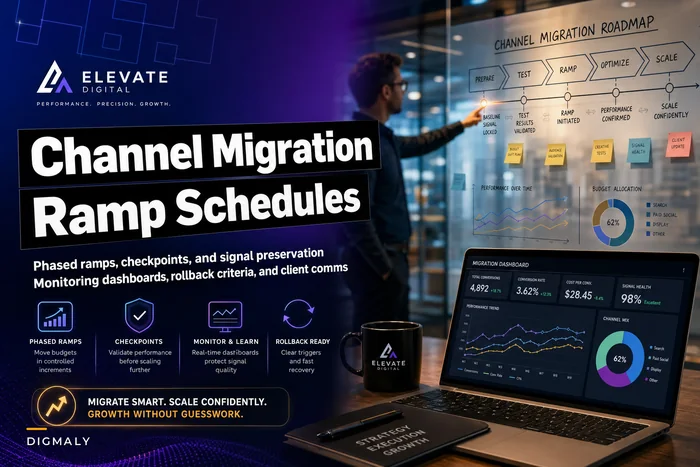
The principle borrowed from moving budgets between channels applies here too — you protect signal by ramping in controlled stages rather than in one jump. The mechanics of staged ramps and what to monitor are covered in more depth in the channel migration playbook on staged ramp schedules, and the same discipline keeps a seasonal ramp from becoming noise.
Reserve-budget rules: plan for the emergency you know is coming
Every burst has a mid-flight scramble. A competitor undercuts on price, a top creative fatigues on day four, or the client suddenly wants to extend the sale 48 hours. Without a plan for it, you do what everyone does — yank spend from wherever's convenient, usually the holdout or a running test, and blow up your own measurement in the process.
The fix is a pre-allocated reserve. Set aside a defined slice of the burst budget — commonly around 10–15% — that lives outside both treatment and holdout. It has its own naming role (RESERVE), its own rules for when it can be deployed, and deploying it never touches the holdout.
The reserve rules should specify:
-
What triggers a deploy — e.g. CPA runs 40%+ above target for 24 hours, or a client-approved extension.
-
Who can authorize it — a single named owner, so it's not a group panic decision at midnight.
-
Where it goes — into clearly tagged reserve entities, never absorbed silently into existing ad sets.
When the emergency spend is isolated and tagged, you can exclude it from your incremental-lift analysis. If it gets smeared across your treatment group, the whole read is compromised.
After the burst: reconciliation while it's still warm
A mandatory reconciliation window before the account gets touched for the next thing — this is the discipline almost no agency actually has. Do it within about a week of the burst ending, while people still remember what happened and why.
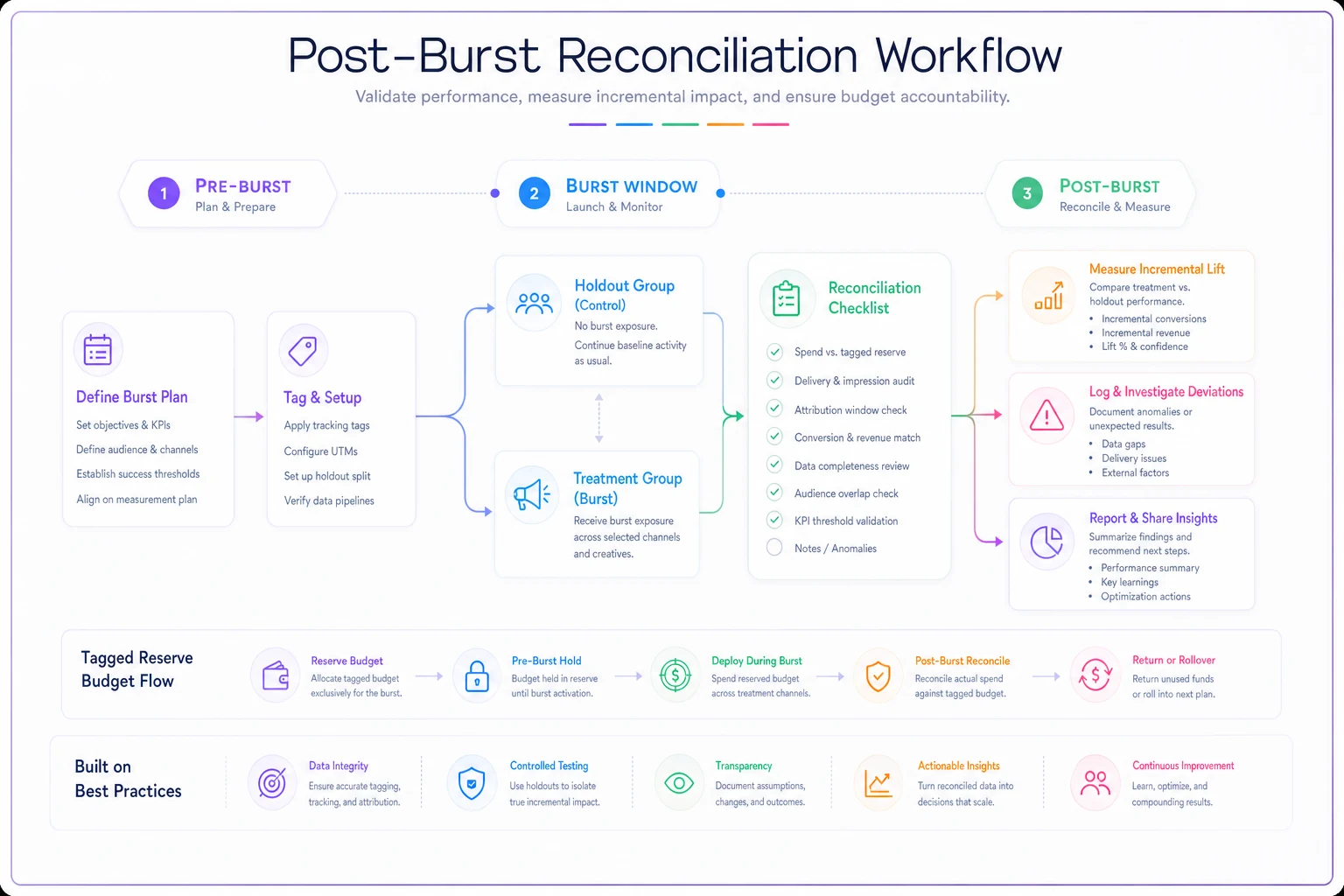
The reconciliation template forces you to answer the questions that actually preserve learning:
-
What was the measured incremental lift? Treatment vs holdout, against the pre-registered metric. Not raw ROAS — incremental.
-
Did we hit the success threshold we wrote down beforehand? Yes or no. No re-negotiating the definition after the fact.
-
What deviated from the plan, and why? Every ramp change, every reserve deploy, every mid-flight restructure.
-
What creative concepts drove the lift (tied to the concept tag), and which fatigued?
-
What would we change next year? Concrete, not "do better."
Here's a quick workflow to visualize the post-burst reconciliation steps.
A realistic reconciliation example
A mid-sized ecommerce client in home goods ran a Black Friday burst with a total budget of roughly $60k. The team held out about four comparable metro regions and pre-registered a target of hitting incremental ROAS above 3.0.
Raw blended ROAS during the burst came back around 6.8, which the client loved and which, on its own, meant nothing. The geo holdout told the real story: treated regions ran an incremental ROAS of roughly 2.4 — below the pre-registered threshold. A big chunk of those "great" sales would have happened anyway from seasonal demand.
The uncomfortable but valuable finding: two of the six creative concepts drove nearly all the genuine lift, while the broad prospecting audiences the team scaled hardest barely moved the needle above baseline. Next year the plan basically wrote itself — concentrate budget on the two proven concepts, ramp prospecting more conservatively, and reallocate the same $60k for a materially better incremental result.
Where tooling actually helps — and where it doesn't
You can run all of this in spreadsheets with a naming discipline everyone follows. Plenty of good agencies do. The failure point is never the concept, it's consistency — across bursts, across people. The analyst who built last year's holdout left. The naming convention got followed for the first two days then abandoned under pressure. The reconciliation deck never got filled out because Q1 planning started.
This is where operational tooling actually earns its place — not by running the campaign for you, but by making the SOP stick. A calendar-driven workflow that auto-generates the pre-burst task sequence, enforces the naming schema at entity creation, flags when reserve budget gets deployed, and won't let a burst close out until the reconciliation template is complete — that's what separates a process that exists on paper from one that compounds knowledge year over year. AI-assisted checks can catch drift a busy human misses: a holdout region that quietly started spending, an untagged entity, a ramp jump that exceeds the rule.
Tooling is downstream of the discipline, though. If you don't have the holdout logic and the pre-registered metric, no software saves you. Build the SOP first.
The checklist to run before your next burst
This isn't meant to be a formality you hand off to a junior account manager and forget about. Each item maps to a specific failure mode that kills seasonal learning. The naming fields get skipped under deadline pressure. The reconciliation window gets bumped because Q1 planning starts. The reserve budget gets silently absorbed into an ad set because nobody wrote down the trigger rules. Going through this as a team, out loud, before launch is worth more than any recap deck after the fact.
-
[ ] Burst calendar and budget envelope locked at least three weeks out
-
[ ] Holdout vs treatment groups assigned from stable baselines, documented
-
[ ] Success metric pre-registered before launch, in writing
-
[ ] Structural freeze date set; no new audiences or restructures after it
-
[ ] Naming schema includes Burst ID, Role, Ramp phase, Test flag
-
[ ] Ramp schedule written down with per-day increase caps
-
[ ] Reserve budget (~10–15%) carved out, tagged, with deploy triggers and a named owner
-
[ ] Reconciliation template scheduled within a week of burst end
-
[ ] Deviations logged in real time, not reconstructed from memory
If more than two items on this list are incomplete at T-10 days, the holdout is probably already compromised before the burst even starts.
Any competent team can run a seasonal push that spends the budget and produces a decent-looking recap. The agencies that quietly outperform are the ones whose year-three Black Friday is dramatically smarter than year one — because every burst deposited a real, measured lesson into an account structure that future-them could actually read.
Preserving learning across bursts is unglamorous work done before and after the exciting part. Pre-burst holdouts give you a counterfactual. Disciplined tagging keeps the evidence legible. Ramp and reserve rules stop you from contaminating your own test. And a reconciliation window forces you to face what the numbers actually said, instead of the flattering story raw ROAS tells.
Do it once and it feels like overhead. Do it for three seasons and you're planning from proof while your competitors are still planning from memory.
Ready to elevate your agency's performance?
Join 2,000+ agencies using Digmaly to save time, boost efficiency, and deliver superior client results.