


The moment a client asks "why does the Q3 report show two different numbers for the same campaign," you already know what happened. Somewhere in the account, two people named the same thing differently. One typed BFSale2024, the other typed blackfriday-sale-Q4, and your reporting tool treated them as separate universes. Now you're rebuilding a pivot table at 11pm the night before the review call.
Naming isn't a cosmetic problem. It's the foundation every downstream report, filter, and automation depends on. When campaign naming conventions drift, you don't lose a little accuracy — you lose the ability to aggregate anything cleanly across accounts, and that failure compounds every single month.
This is a migration and enforcement playbook, not a "why naming matters" lecture. You already know why it matters. The hard part is fixing years of inconsistent labels without breaking live reporting, and then making sure the mess doesn't creep back in three weeks later.
Why the drift happens in the first place
Most naming chaos isn't caused by careless people. It's caused by reasonable people making locally sensible decisions with no shared rule to point to.
-
A new hire launches campaigns before anyone hands them the convention, so they invent their own. It's clean, it's readable — it's just different from everyone else's.
-
The convention exists in a Google Doc nobody opens. It has 14 fields, three of which stopped being relevant a year ago.
-
Two account managers inherit the same client and each keeps their own habits. Now the account has two dialects.
-
Platform quirks force compromises. Google lets you use pipes and colons; some feeds choke on them. So people quietly strip characters, and the "standard" fractures per channel.
The root cause is almost always the same: the naming rule lives in a document, not in the workflow. Documentation is passive. It waits for someone to remember it. Enforcement has to be active — it has to happen at the moment of creation, not in a quarterly audit.
That distinction is the entire point of this playbook.
What a naming schema should actually look like
Before you migrate anything, you need a target. And the most common mistake here is building a schema that's technically perfect and operationally impossible.
Eliminate marketing chaos with streamlined campaign control.
Digmaly lets you plan, execute, and track every campaign effortlessly.
- Unified campaign management
- Real-time client reporting
- Collaborative team workflows
No credit card required
A good schema is short, positional, and machine-parseable. Every field has a fixed position, a controlled vocabulary, and a single delimiter. If a human can't type it from memory after a week, it's too complex.
Here's a structure that holds up across most agency accounts:
``
[Client][Channel][Objective][Geo][Offer]_[YYYYMM]
``
A real example:
``
acmemetaleadgenusspringpromo_202503
``
The key rules that make this survive contact with real teams:
| Rule | Bad | Good | Why it matters |
|---|---|---|---|
| One delimiter only | acme-meta_leadgen us | acmemetaleadgen_us | Mixed delimiters break every split/parse script |
| Controlled vocabulary | fb, FB, facebook, meta | meta (always) | Free text is where drift is born |
| Lowercase enforced | Acme_Meta | acme_meta | Case sensitivity silently splits your groupings |
| Fixed date format | Mar25, 3-2025 | 202503 | Sortable, unambiguous, no locale confusion |
| No spaces, ever | spring promo | springpromo | Spaces are the #1 cause of broken URL tracking |
The controlled vocabulary is the part people skip, and it's the part that matters most. You need a locked list for each field — a fixed set of channel codes, objective codes, and geo codes. leadgen is not sometimes lead_gen and sometimes LG. Pick one. Write it down. Then make the list impossible to deviate from.
That "impossible to deviate from" part is where enforcement comes in — but first, you have to deal with everything that already exists.
The legacy migration: don't rename blindly
The trap almost everyone falls into: they finalize the shiny new schema and immediately start renaming live campaigns. Then reporting breaks in ways nobody predicted, because renaming a campaign can reset attribution windows, orphan historical data in third-party tools, and confuse any automation keyed to the old name.
Migration is a staged process, not a rename spree. The sequence matters more than the speed.
The migration sequence
-
Freeze and snapshot. Export every campaign name across every account into one sheet before you touch anything. This is your rollback insurance. If a mapping goes wrong, you need the original state.
-
Audit and cluster. Group the existing names by what they actually mean, not what they're called. You'll usually find that 200 unique names collapse into maybe 40 real distinct campaigns once you account for typos, casing, and abbreviation variants.
-
Build the mapping table. For every old name, define exactly one new name. This is the single most important artifact in the whole migration. One column old, one column new, no ambiguity.
-
Map legacy names, don't always rename them. For historical campaigns that are already paused, you often don't rename them at all — you map the old name to the new taxonomy in your reporting layer. You only rename active campaigns and templates going forward. Renaming a paused campaign from 2023 gains you nothing and risks breaking historical joins.
-
Rename in waves, by client, during low-traffic windows. Never migrate the whole book in one afternoon. Do one client, verify reporting still ties out, then move to the next.
-
Verify aggregation post-migration. After each wave, pull the same report you pulled during the freeze. The numbers should match. If they don't, your mapping has a gap.
An automated mapping approach
Doing this by hand across a few hundred campaigns is how errors sneak in. A lightweight script beats manual find-and-replace every time. The logic isn't complicated:
-
Pull all campaign names via the platform APIs into a single list.
-
Normalize aggressively for matching
lowercase everything, strip spaces, collapse known synonyms (
fb→meta,lead_gen→leadgen). -
Match each normalized name against your mapping table.
-
Flag anything that doesn't match a known pattern into an "exceptions" list for a human to decide.
That exceptions list is the whole value. It surfaces the weird one-offs — the test campaigns, the "DO NOT TOUCH" experiments, the client-specific hacks — instead of letting a blunt find-and-replace steamroll them. In real migrations, the exceptions list tends to run around 10–15% of names, and it's where all the actual thinking happens.
This diagram shows the staged flow for a safe migration.
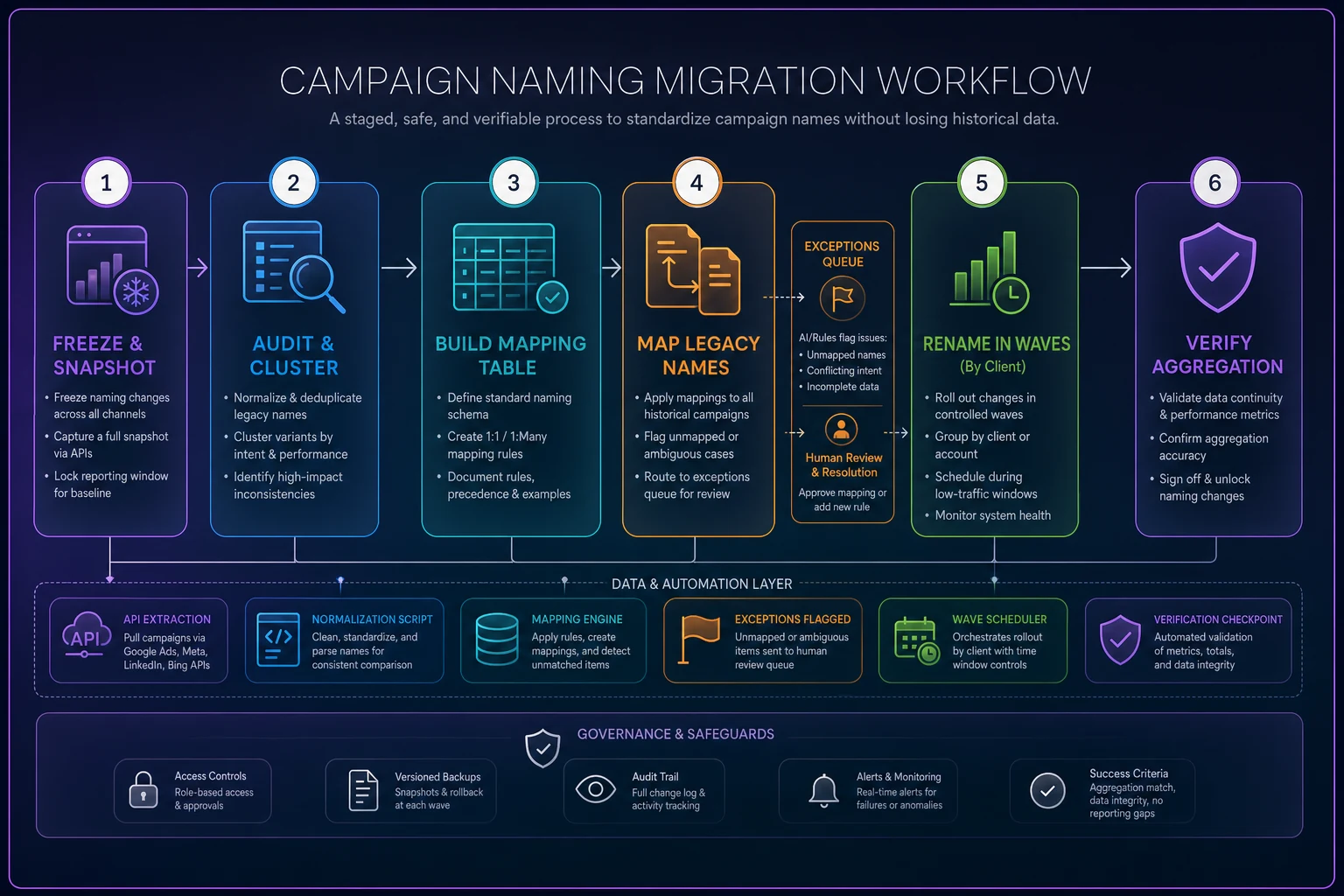
In practice you run the script, review exceptions, and only then apply name changes in controlled waves.
Enforcement: the part that keeps it from breaking again
A migration without enforcement is a fresh coat of paint on a leaking roof. Within a month or two, someone launches a campaign the old way and the drift restarts. Enforcement is what makes the standard permanent.
There are roughly three levels of enforcement, and most agencies need a combination.
Level 1 — Template enforcement (weakest, easiest). Pre-built campaign templates with the naming structure already filled in. Launchers duplicate the template instead of starting blank. This helps, but it's still trust-based — people can and do overwrite the name.
Level 2 — Validation at creation (the real fix). A check that runs when a campaign is created or renamed, and rejects anything that doesn't match the schema. This can be a naming-generator tool the team is required to use, or a validation step baked into your launch process. The name gets parsed against the controlled vocabulary before it's allowed to go live. Wrong format, wrong channel code, illegal character — blocked.
Level 3 — Continuous monitoring (the safety net). A scheduled job that scans all live campaign names daily and flags any that don't conform. This catches the things that slip past the front door — manual edits made directly in the platform, campaigns imported from a client's old account, bulk uploads that bypassed your process.
Route ambiguous matches to a named reviewer so the exceptions queue doesn't become a black hole.
This is where AI-assisted operational tooling earns its keep quietly in the background. A naming validator that does exact string matching is brittle — it can't tell that springpromo and spring_promotion are the same intended concept, so it either rejects both or lets both through. A smarter validation layer can recognize likely intent, suggest the correct standardized form, and route genuinely ambiguous cases to a human instead of blocking work or waving through garbage. The goal isn't to automate judgment away — it's to stop the team from re-litigating the same 40 naming decisions every week. The monitoring runs on its own, surfaces only the real exceptions, and keeps the taxonomy clean without anyone babysitting it.
The pattern that works: Level 2 stops most drift at the door, Level 3 catches what leaks through, and a human only ever looks at the small pile of exceptions.
A short enforcement checklist
Before you call the taxonomy "enforced," you should be able to check every one of these:
-
[ ] The controlled vocabulary for every field is locked and stored somewhere the team actually works, not buried in a doc
-
[ ] New campaigns can't go live without passing a naming validation step
-
[ ] There's a daily or weekly scan flagging non-conforming live campaigns
-
[ ] Non-conforming names route to a named owner, not a shared inbox nobody checks
-
[ ] The mapping table from migration is preserved so historical reports still join correctly
-
[ ] Someone owns the vocabulary and can approve new codes (new channels, new geos) so people don't invent workarounds
-
[ ] Onboarding for new hires includes the schema on day one, not week three
That last point does more work than people expect. Most drift enters through new people who never got the rule. Fix the onboarding and you cut off the largest single source of new mess.
A real scenario
A mid-sized paid media agency managing around 25 client accounts had let naming drift for roughly two years. Across those accounts they had somewhere near 600 campaign names, and when they tried to build a cross-client performance rollup, nothing aggregated cleanly. Reporting for the monthly client decks was eating close to two full days a month of a senior analyst's time, most of it spent manually reconciling mismatched labels in spreadsheets.
They ran the migration in waves over about three weeks. The audit collapsed those ~600 names down to roughly 240 distinct real campaigns once duplicates, casing variants, and abbreviations were normalized. The exceptions list came out to around 70 names — mostly old tests and a few client-specific naming demands they chose to keep and map rather than rename.
After migration, they put a validation step in front of every new launch and a weekly scan behind it. The monthly reporting reconciliation dropped from about two days to a few hours, and — the part the account leads actually cared about — the "why are there two numbers for the same campaign" question basically stopped coming up on client calls. Not because the team got more careful, but because the process stopped letting the mistake happen in the first place.
When this is worth it — and when it isn't
This level of effort makes sense when you're running multiple accounts and need to aggregate across them, or when reporting reconciliation is regularly stealing senior people's time. If cross-account rollups, client dashboards, or automated bid rules depend on parsing names, drift is quietly taxing you every month whether you've measured it or not.
It's overkill if you're running a single account with a couple of active campaigns and one person launching everything. In that case a simple template and a bit of discipline is plenty — building validation tooling would cost more than the problem.
One word of caution: do not start the migration until the schema is genuinely final and the vocabulary is locked. The worst outcome is migrating everything to a standard, then changing the standard, and having to migrate again. Half a migration is arguably worse than none, because now you have three dialects instead of two. Get agreement first, freeze the vocabulary, then move.
The takeaway
Naming chaos feels like a discipline problem, so people try to fix it with reminders and stern Slack messages. That never holds, because you're asking humans to be perfect on a repetitive task with no guardrails. The durable fix is structural: a schema simple enough to type from memory, a staged migration that maps history instead of blindly renaming it, and enforcement that lives inside the launch workflow instead of in a document nobody reads.
Get those three pieces in place and campaign naming conventions stop being the thing that breaks your reports every quarter. They become invisible — which is exactly what good infrastructure is supposed to be.
Ready to elevate your agency's performance?
Join 2,000+ agencies using Digmaly to save time, boost efficiency, and deliver superior client results.