



The ugliest meetings in an agency aren't with angry clients. They're the internal ones where your account lead says a campaign hit its targets, your finance person says the month came in under forecast, and nobody can explain why the two numbers don't line up. Someone pulls up a reporting dashboard. Someone else pulls up the invoice. A third person opens a spreadsheet nobody's touched since the quarter started. Forty minutes later you've learned nothing except that your systems disagree with each other.
This is the core failure of agency revenue operations: measurement, forecasting, and billing run on three separate tracks, maintained by three different people, reconciled basically never. Everyone trusts their own numbers and distrusts everyone else's. The longer it goes unfixed, the more it quietly costs you — in misquoted renewals, in revenue recognized in the wrong month, in forecasts that are off by enough to influence bad hiring and cash decisions.
This post is about building the connective tissue between those three systems. Not the theory of RevOps — the actual artifacts. Forecast templates, reconciliation cadences, escalation triggers, and finance-ready reports that make campaign performance, recognized revenue, and invoices reconcile instead of argue.
Why the three systems drift apart in the first place
The drift isn't anyone's fault. It's structural. Each system was built to answer a different question for a different audience.
Your measurement layer answers "is the campaign working?" It's optimized for optimization — pacing, CPA, ROAS, creative performance. It lives in platform UIs, a BI tool, or whatever your performance reporting strategy is built on. The numbers move daily and they're measured in media metrics.
Your forecasting layer answers "what will we book this quarter?" It's maintained by someone senior, usually in a spreadsheet, built on assumptions — expected retainer renewals, probable upsells, projected media spend and the margin on it. It updates weekly at best and runs on gut as much as data.
Your billing layer answers "what did we actually charge?" It's the invoices. Governed by contract terms, billing cycles, and whatever your finance person remembers to reconcile. It moves monthly and it's the only one of the three that's legally binding.
Three questions, three cadences, three owners, three sources of truth. Nobody designed them to reconcile because nobody owns the space between them. That gap is where agency revenue operations either exists or doesn't.
A pattern that shows up constantly: an agency grows to a dozen or so clients and the founder is still the human reconciliation layer. They know in their head that Client A is on a performance bonus tied to ROAS, Client B's media is pass-through and shouldn't count as revenue, Client C paused mid-month so the invoice needs prorating. Nothing's written down. The founder is the system. Then they hire an ops lead or a finance contractor, and the whole mental model walks out the door every time that person is on vacation.
What actually breaks at scale
Revenue recognition gets wrong, not just late. When media spend is a pass-through cost, it shouldn't inflate your recognized revenue. But if your forecast is built off gross billings and your P&L is built off net, your margin picture lies to you. Some agencies think they're running at 40% margins when the real number is closer to 22%, because pass-through media was quietly counted as agency revenue in the forecast.
Eliminate marketing chaos with streamlined campaign control.
Digmaly lets you plan, execute, and track every campaign effortlessly.
- Unified campaign management
- Real-time client reporting
- Collaborative team workflows
No credit card required
Forecasts become fiction because the inputs are stale. A forecast built in week one of the month and never updated isn't a forecast, it's a wish. By week three the ROAS on a bonus-eligible account has shifted, a client has signaled they're pausing, and an upsell closed early. None of that flows back into the number leadership is making decisions on.
Billing disputes multiply because nobody can show their work. When a client questions an invoice, you need to reconcile the charge back to the measured delivery. If your campaign metrics and your invoice line items don't share a common structure, you're reconstructing the story from scratch every time — and every reconstruction is a chance to find out you under-billed or over-billed. This is the same discipline that drives SLA credit calculations: if you can't tie the measured outcome to the contractual term, you can't defend the number.
What makes this worse at scale is compounding. Every new client adds a new set of billing rules. Every new service tier adds a new revenue recognition pattern. The reconciliation work doesn't grow linearly with headcount — it grows with the number of distinct contract shapes you're running, and that number explodes faster than you'd expect.
The reconciliation model: mapping measurement to money
The fix starts with one decision: every client gets a revenue mapping that connects three things explicitly.
-
1. The measured output — the campaign metrics your reporting produces (spend, conversions, ROAS, delivered impressions, whatever the contract cares about).
-
2. The recognition rule — how that output becomes recognized revenue (flat retainer recognized monthly, percentage-of-spend, performance bonus above a threshold, pass-through excluded, etc.).
-
3. The billing trigger — what fires the invoice and for how much (fixed monthly, spend-based with a cap, milestone, bonus invoiced quarterly).
Write this down once per client. It's the single most valuable artifact in the whole system because it turns "what does this client's revenue actually look like?" from a memory exercise into a lookup.
Here's what a simplified mapping table looks like across a few common client shapes:
| Client type | Measured output | Recognition rule | Billing trigger | Reconciliation risk |
|---|---|---|---|---|
| Flat retainer | Deliverables shipped | Even over the month | Fixed monthly invoice | Low — but scope creep hides here |
| % of media spend | Actual spend | Recognized on spend as incurred | Spend + agency fee, monthly | Pass-through vs. net confusion |
| Performance bonus | ROAS / revenue above threshold | Recognized only when threshold is cleared | Bonus invoiced after period close | Timing — recognized before confirmed |
| Hybrid retainer + bonus | Both of the above | Split recognition | Base monthly, bonus quarterly | Double-counting the base |
| Project / milestone | Milestone acceptance | Recognized at milestone sign-off | Invoice on acceptance | Milestone slippage shifts the month |
The reconciliation risk column is the one people skip, and it's the most important. Each client shape has a characteristic way it goes wrong. Percentage-of-spend clients confuse gross and net. Performance bonuses get recognized optimistically before the number's confirmed. Milestone work slides across month boundaries and lands in the wrong quarter. Knowing the failure mode per client type tells you exactly what to watch for.
Keep the mapping row at the top of any client workbook so it travels with forecasts and invoices for easy reference.
This mapping is the bridge between your measurement systems, your forecast model, and your billing rules — write it once and refer to it every reconciliation.
Reconciliation cadence: how often, and who owns it
A mapping is static. Reconciliation is the rhythm that keeps it true. The mistake most agencies make is reconciling only at month-end, when it's too late to fix anything and too close to the invoice to catch errors before they go out.
-
Weekly pacing-to-forecast check. Does measured delivery so far this month track the forecast? This is where you catch a performance-bonus account that's suddenly going to clear its threshold (good news, but your forecast needs to know) or a spend-based account pacing 30% under. This ties directly into your budget pacing alerts — the same signal that protects client spend also protects your forecast accuracy.
-
Pre-invoice reconciliation. Two or three days before invoices go out, reconcile measured delivery against what's about to be billed, per client, using the mapping. Catching a prorated pause before the invoice is a non-event. Catching it after is a credit memo and an awkward email.
-
Month-end recognition close. Lock recognized revenue against the forecast, explain variances, roll the explanation into next month's assumptions. This is the feedback loop that makes forecasts improve over time instead of just getting re-guessed.
The ownership rule: one person owns reconciliation end to end, even if they don't produce either side. They don't need to build the dashboard or send the invoice. They own the question "do these agree, and if not, why?" Split that ownership and it becomes nobody's job — which is exactly where you started.
Below is a simplified view of how these three cadences connect across the month:
[Weekly pacing check] --> [Amber/Red flag raised] --> [Pre-invoice reconciliation] --> [Invoice sent] --> [Month-end close] --> [Variance explanation feeds next forecast]
A quick visual helps make handoffs and flags obvious to the whole team.
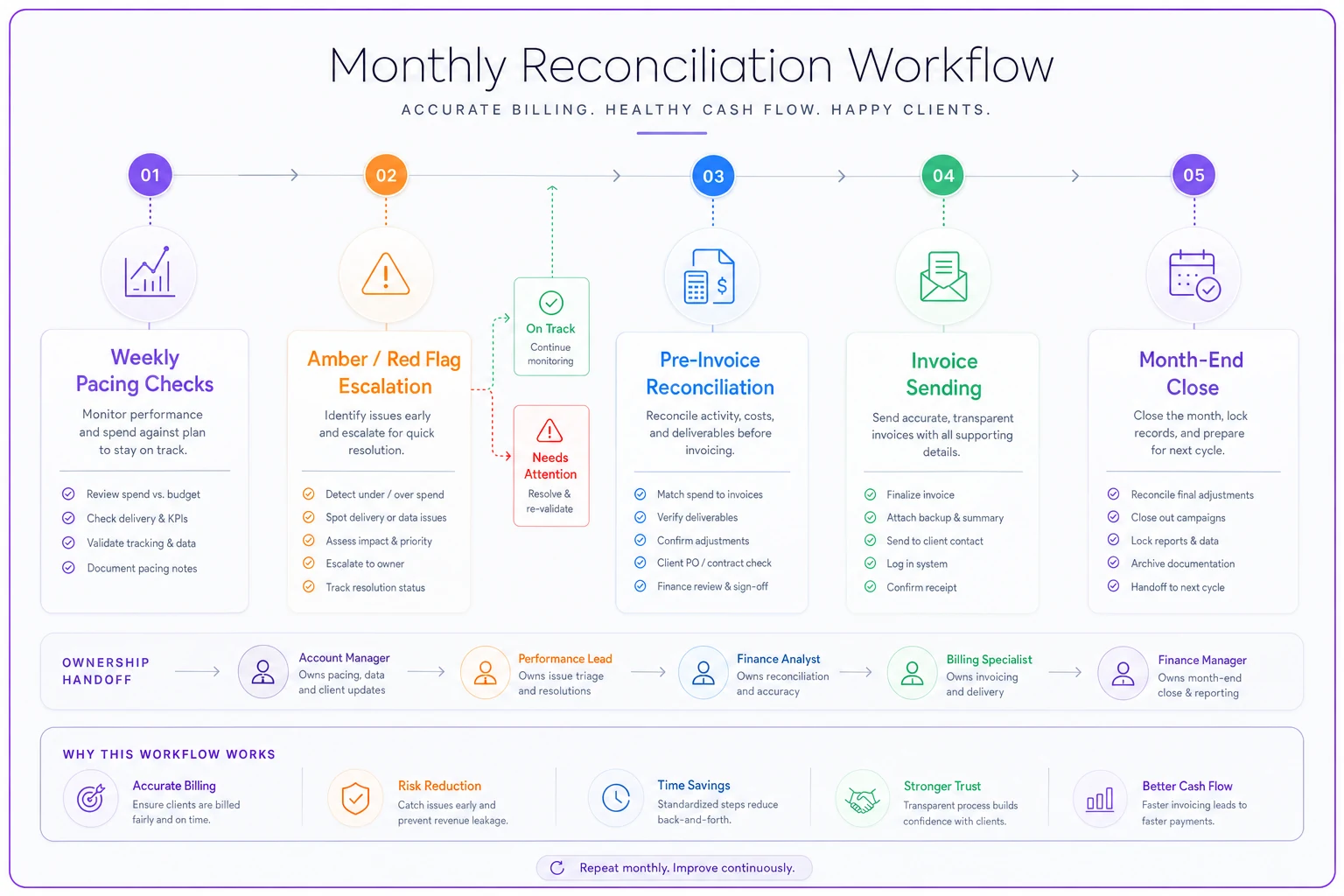
Use this visual in your ops docs so everyone knows the cadence and who closes each loop.
Escalation triggers: when a variance becomes a problem
Not every variance is worth a meeting. You need thresholds that decide when drift becomes an escalation. Without them, you either flag everything and people stop paying attention, or you flag nothing and problems surface at quarter-end.
-
Green measured delivery and forecast within roughly 5%. Note it, move on.
-
Amber variance between around 5% and 15%, or any performance-bonus account crossing its threshold either direction. Flag to the reconciliation owner, document the cause, adjust the forecast.
-
Red variance over roughly 15%, any invoice that can't be reconciled to measured delivery, or any pass-through amount that's landed in recognized revenue. Stop, escalate to finance and the account lead, resolve before invoices go out.
The specific percentages matter less than having them written down and enforced. What breaks most often isn't that nobody noticed a variance — it's that someone noticed, assumed someone else would handle it, and the invoice went out anyway. An escalation trigger removes the assumption.
One pattern worth calling out: the most dangerous variances are often the favorable ones. A performance bonus clearing early feels like good news, so nobody escalates it. But if it gets recognized in the wrong period, you've created a revenue-recognition problem your accountant will find at year-end. Good-news variances need the same discipline as bad-news ones.
Finance-ready reporting artifacts
The output of all this is a small set of documents that make finance and account teams speak the same language. The goal is artifacts that a bookkeeper or a client can read without a translator.
-
Per-client revenue reconciliation sheet — measured output, recognized revenue, billed amount, and variance, with the mapping rule stated at the top so anyone reading it knows why the numbers relate the way they do.
-
Forecast-to-actual variance report — rolled up across all clients, with every amber and red variance explained in a sentence. This is what leadership actually makes decisions on.
-
Invoice-to-delivery backup — for each invoice, the measured delivery that justifies it. This is your dispute defense. When a client questions a charge, you send this and the conversation ends.
-
Pass-through segregation report — gross billings, pass-through media, net agency revenue, clearly separated. This is what keeps your margin picture honest and your recognized revenue defensible.
The connective principle across all four: they share a common client structure and common naming, so a line in the reconciliation sheet maps to a line in the variance report maps to a line on the invoice. When those don't share structure, every reconciliation is manual archaeology. When they do, it becomes a lookup.
This is also where tooling earns its keep. The mapping, cadence, and triggers can live in spreadsheets when you're small, but past a dozen or so distinct billing shapes, the manual reconciliation load becomes its own full-time job. An operational platform that pulls measured delivery and ties it to recognition rules and invoice triggers automatically — flagging variances against your thresholds — turns reconciliation from a process you have to run into one that largely runs itself. But the mapping and cadence have to exist first. Automating a reconciliation you haven't defined just produces wrong answers faster.
A real scenario
A mid-sized performance agency — around 18 retained clients, a mix of flat retainers and percentage-of-spend accounts, roughly $140k–$160k in monthly billings — was closing every month with a two-to-three day scramble. Finance reconciled invoices by hand against platform exports. Forecasts were built once a month and routinely off by 10–15%. Twice in one quarter they sent invoices that counted pass-through media as agency revenue, which inflated a renewal quote and forced an uncomfortable walk-back with the client.
They built the mapping table — one row per client, recognition rule and billing trigger explicit. They moved to the three-cadence reconciliation and assigned one ops person to own it. They set the green/amber/red triggers.
The month-end scramble dropped from two-plus days to a few hours, mostly because the pre-invoice reconciliation was catching things before they became corrections. Forecast variance tightened to low single digits within about two months, because month-end explanations were feeding back into the next forecast's assumptions. The pass-through confusion stopped entirely, which cleaned up the margin picture enough that they realized two accounts they'd thought were profitable were barely breaking even. That last discovery was worth more than the time savings.
When this level of rigor makes sense — and when it doesn't
If you're running a handful of clients on identical flat retainers, you don't need this. Your reconciliation is "did the five invoices go out, yes." Building a mapping system for that is overhead you'll never recoup.
This becomes necessary when your contract shapes diversify. The moment you mix flat retainers with spend-based fees, performance bonuses, and project work, the number of distinct reconciliation patterns crosses what one person can hold in their head reliably. That's usually somewhere around 10–15 clients with mixed billing models, though it's really about variety, not count.
It's a mistake to build the full apparatus before you have the drift to justify it. Some agencies install heavy RevOps process at five clients and spend more time maintaining the system than it saves. Let the pain show up first. When you've had two billing disputes you couldn't quickly defend, or one forecast miss that led to a bad hiring or cash decision, that's the signal.
And it's genuinely the wrong move for an agency with no finance discipline at all. If invoices go out late and inconsistently and nobody reconciles anything, the answer isn't a reconciliation cadence — it's getting the basics of billing in order first. You can't reconcile a system that doesn't reliably produce the two things you're reconciling.
Where to start
The whole model collapses into one starting move: write the mapping for your five most complex clients. Not all of them — the five that cause the most billing confusion. Three columns: measured output, recognition rule, billing trigger. Add the reconciliation-risk note. That document, which takes an afternoon, immediately surfaces half the disagreements your monthly meetings have been having.
From there, layer in the pre-invoice reconciliation cadence before anything else, because it pays off fastest — it stops errors before they reach clients. The weekly pacing check and the month-end close feedback loop come next. The escalation triggers formalize what you're already starting to notice.
The agencies that run clean revenue operations aren't the ones with the fanciest tools. They're the ones who decided that the space between measurement, forecasting, and billing was somebody's actual job — and then wrote down the rules that keep those three systems telling the same story.
The agencies that run clean revenue operations aren't the ones with the fanciest tools. They're the ones who decided that the space between measurement, forecasting, and billing was somebody's actual job — and then wrote down the rules that keep those three systems telling the same story.
Ready to elevate your agency's performance?
Join 2,000+ agencies using Digmaly to save time, boost efficiency, and deliver superior client results.