

The riskiest window in any campaign isn't launch day. It's the two or three weeks right after, when the account is technically live, spend is real, and everyone quietly assumes someone else is watching the numbers. The strategist thinks the media buyer's on it. The media buyer thinks the account lead is checking pacing. The client assumes the agency has a plan. And for about 12 days, nobody actually makes a decision.
That's the gap this roadmap fills. Not another dashboard, not another "we'll optimize as we go" — an actual time-boxed schedule where each check has a date, a threshold that triggers action, and a name attached to it. Because the difference between a campaign that stabilizes in month one and one that limps along for a quarter usually comes down to whether the first 90 days had structure or vibes.
Why the post-launch window quietly falls apart
Most agencies pour their operational energy into getting live. The paid media onboarding checklist gets followed, tracking gets verified, the launch happens. Then the checklist ends. There's no equivalent structure for the days after, so optimization turns reactive — someone notices CPA creeping up on day 18, panics, and starts changing four things at once.
The pattern worth naming: the absence of a time box turns optimization into either paralysis or thrash. Either people wait too long because there's no scheduled moment to act, or they're in the account constantly because there's no rule about when not to touch things. Both destroy learning. Change bids, creative, and audience in the same 48 hours and you've made it impossible to know what actually moved the needle.
The other reason it falls apart is that early-campaign data lies in predictable ways. Day 3 CPA on a fresh conversion campaign is basically noise — the algorithm hasn't exited learning, sample sizes are tiny, and one weird high-value conversion can make a bad day look great. Teams that don't build "when is this data trustworthy" into their schedule end up optimizing against randomness.
The 30/60/90 structure at a glance
Splitting into three phases works because each one answers a fundamentally different question:
Eliminate marketing chaos with streamlined campaign control.
Digmaly lets you plan, execute, and track every campaign effortlessly.
- Unified campaign management
- Real-time client reporting
- Collaborative team workflows
No credit card required
| Phase | Core question | What you're allowed to touch | What you protect |
|---|---|---|---|
| Days 0–30 | Is it working at all, and is the data real? | Budget caps, obvious tracking breaks, disapprovals | Structure, audiences, creative rotation |
| Days 31–60 | What's driving results, and what can we scale? | Bids, budget allocation, winning creative, audience expansion | Naming/measurement consistency |
| Days 61–90 | How do we lock in efficiency and hand it off? | Efficiency levers, bid strategy shifts, retirement of losers | The documented baseline |
The mistake teams make is running all three phases at once — trying to scale on day 8 while the campaign is still proving it works. Each phase has permission boundaries on purpose. In the first 30 days you're mostly watching and protecting, not tuning, because premature optimization on thin data is how you kill a campaign that would've stabilized on its own.
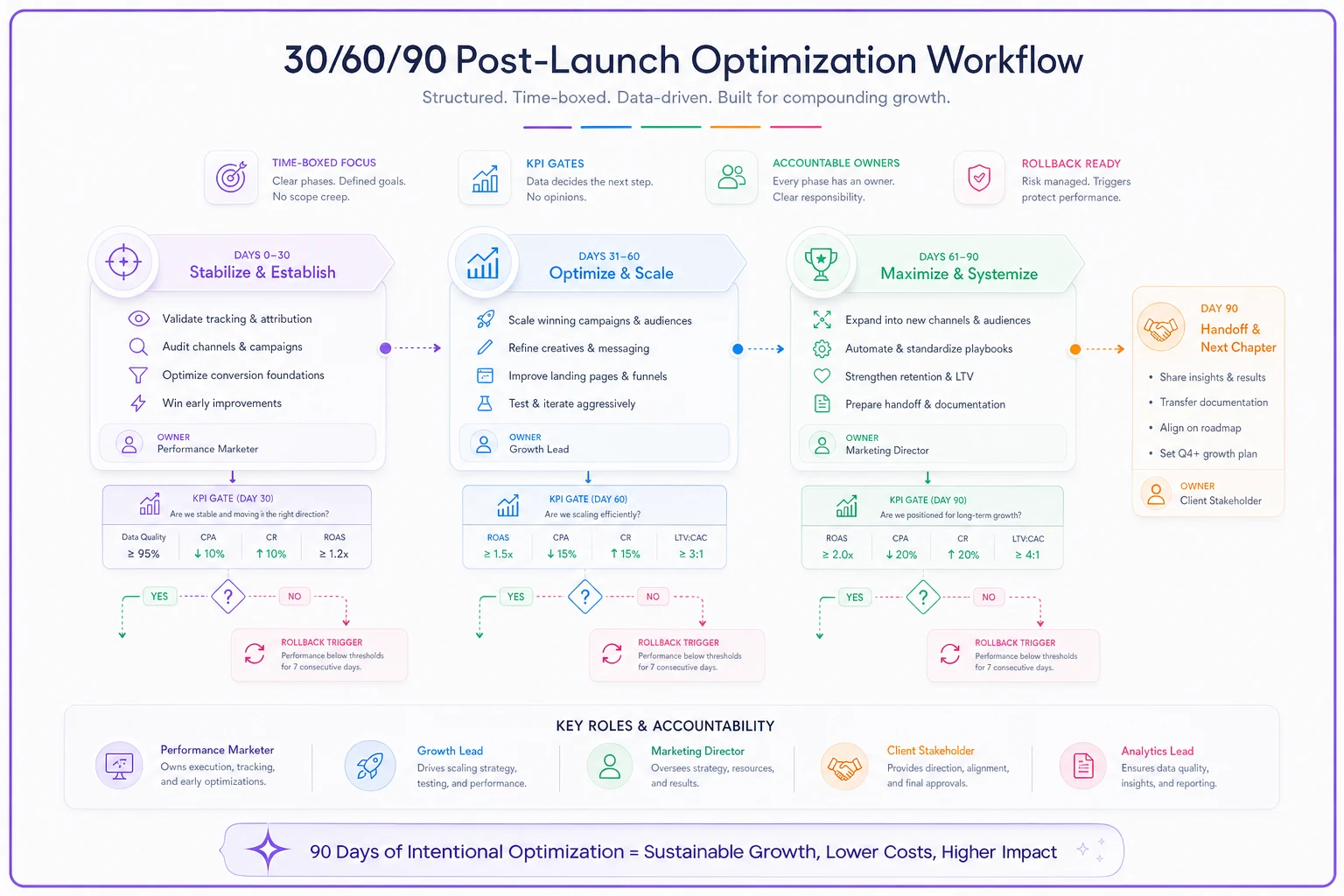
A quick visual like this makes the phases, gates, and owners obvious at a glance.
Days 0–30: stabilize before you touch anything
The first phase is about answering one honest question: is this thing structurally sound, or is it broken in a way nobody's noticed yet? Optimization here is almost entirely defensive.
-
Delivery check (daily, days 1–7) Is every ad set actually spending? A common silent failure is one ad set eating 80% of budget while three others get starved — not because of performance, but because of bid or audience overlap. Owner: media buyer.
-
Tracking sanity check (day 2 and day 7) Conversions firing, values passing correctly, no duplicate events. You verified this at launch, but platforms have a way of quietly breaking things when volume ramps. Owner: analytics/ad ops.
-
Disapproval and policy scan (daily) One disapproved ad in a two-ad ad set kills half your delivery instantly. Owner: media buyer.
-
Learning-phase status (day 10, day 14) Are conversion campaigns exiting learning? If an ad set is still stuck at day 14, that's a structural signal, not a performance one.
-
Spend pacing vs. plan (weekly) Not to optimize — just to catch a campaign that's about to blow the month's budget by day 20.
The KPI gate at day 30 is deliberately loose. You're not asking "is CPA at target?" You're asking: is the campaign delivering across intended ad sets, is tracking clean, and is the trend pointing the right direction? If yes, move to phase two. If tracking is broken or delivery is concentrated in one place, fix structure — don't start bid-tuning on top of a broken foundation.
Rollback trigger for phase one: if spend crosses roughly 50% of the monthly budget before day 15 with CPA more than 2x target, pause and diagnose. That's not optimization territory — that's a "something is fundamentally wrong" alarm, and the account lead owns the call to pull it.
Days 31–60: this is where you actually optimize
Now the data is real enough to act on and the permission set opens up. This is the phase where the rapid-experiment schedule lives, because you finally have a stable enough baseline to run a clean test against.
-
Pick one lever per experiment. Creative angle, audience, landing page, or bid strategy — one at a time.
-
Size it before you run it. Roughly how many conversions do you need to call a winner? If an experiment needs 100 conversions and the ad set does 15 a week, that's a six-week test, not a three-day one. Knowing this upfront stops the "it's been two days, let's call it" mistake.
-
Set a decision date. Every experiment has a date on the calendar where someone looks and decides: scale, kill, or extend. No open-ended tests.
-
Log the result before starting the next one. This is the part everyone skips, and it's why agencies re-run the same losing test across three different clients.
-
One experiment per ad set at a time. Overlapping tests in the same ad set contaminate both.
The KPI gates in phase two are where real money decisions get made. A reasonable structure:
-
Green (scale) CPA at or under target, volume trending up, quality holding. Action: increase budget in measured steps and expand the winning audience. Owner: media buyer, with account lead sign-off on budget moves.
-
Yellow (hold and test) CPA within roughly 20–30% of target. Action: run experiments, don't scale. This is the default state for most campaigns in month two.
-
Red (intervene) CPA more than 30% over target with stable delivery. Action: structured troubleshoot — creative first, then targeting, then bid strategy, in that order, one at a time.
Size experiments to achievable conversion volumes before launching them so tests finish in a reasonable window.
That ordering matters. When performance is soft, people reach for bid changes because they're fast. But creative fatigue and audience mismatch are usually the real culprits earlier in a campaign's life. Bids are the last lever, not the first.
Days 61–90: lock efficiency and prepare the handoff
By phase three the campaign should be past the "will this work" question and into "how efficient can this get." The work shifts to consolidating winners, retiring the long tail of underperformers, and capturing what you learned so it doesn't evaporate.
This is also the phase where the channel migration and ramp logic becomes relevant if the plan was always to shift budget toward a proven channel. You now have 60 days of real signal to justify those moves instead of guessing.
-
Efficiency audit (day 65) Where's spend going that isn't producing? Retire the bottom performers you were tolerating during testing.
-
Bid strategy re-evaluation (day 70) With enough conversion history, automated bidding often outperforms manual at this point — the opposite of what was true in week one.
-
Baseline documentation (days 75–80) Write down the current stable-state numbers so month four has something to be measured against.
-
Handoff and learning capture (days 85–90) The part almost everyone does badly or skips entirely.
The phase-three checks are lighter but more strategic:
The rollback and troubleshoot trigger map
The single most useful thing you can hand a team is a table that says: when X happens, this person does Y. No debate, no Slack thread, no waiting for the account lead to respond. Ambiguity about ownership is what turns a two-hour problem into a two-week one.
| Trigger | Threshold | Immediate action | Owner |
|---|---|---|---|
| Spend spike | Daily spend >150% of planned daily | Cap budget, investigate bid/auction | Media buyer |
| Tracking drop | Conversions fall to ~zero for 24h with steady spend | Pause net-new scaling, audit pixel/API | Ad ops |
| CPA breach | CPA >2x target for 3+ consecutive days, stable volume | Structured troubleshoot (creative→audience→bid) | Media buyer |
| Disapproval | Any ad disapproved in a live ad set | Replace or appeal within same day | Media buyer |
| Volume collapse | Conversions down ~40%+ week-over-week | Check creative fatigue and competitor pressure | Strategist |
| Client escalation | Client flags a problem before the agency does | Acknowledge same day, root-cause within 48h | Account lead |
The rule that makes this work: every trigger has exactly one owner. Shared ownership means no ownership. If two people are responsible for tracking drops, both assume the other is handling it — the exact failure mode from the intro.
When strict time-boxing is a bad idea
This roadmap fits campaigns with enough volume to generate real signal. It doesn't fit everything.
If a campaign does five conversions a week, a 30-day KPI gate is meaningless — you don't have the sample size for any decision to be trustworthy, and forcing a "green/yellow/red" call on noise is worse than waiting. Very low-volume accounts need longer windows and more qualitative judgment, not a rigid schedule.
It also doesn't fit brand or awareness campaigns judged on reach and lift rather than direct conversions. Applying CPA gates to a brand campaign pushes teams to optimize for the wrong outcome entirely. And if you're launching into a genuinely new channel with no historical baseline, phase one probably needs to stretch past 30 days before the data means anything.
The teams that get burned are the ones who take a framework built for a high-volume performance account and bolt it onto a boutique client doing a handful of conversions a month. The structure is a tool, not a religion.
A real scenario
A mid-sized agency ran a lead-gen launch for a B2B services client — roughly $18k/month across search and paid social. Their post-launch process historically was "check in when something looks off," which usually meant week three.
On this account they ran the time-boxed version. Days 0–30 caught something they'd have missed otherwise: one ad set was consuming close to 70% of social budget due to audience overlap, starving two better-performing sets. That was a structural fix, not a bidding one — and without the roadmap, they wouldn't have looked until CPA got ugly.
Phase two experiments were sized properly for the first time. Instead of calling creative tests after three days, they let a landing-page test run the roughly four weeks it actually needed to hit sample size. The winner cut cost-per-lead somewhere in the 20–25% range — a result they'd have discarded early under the old "it's not working, kill it" reflex.
By day 90, blended cost-per-lead had come down meaningfully from the launch weeks, and — maybe more valuable — the client stopped being the one flagging problems first. That shift, from the agency reacting to the agency getting ahead of it, did more for retention than the CPA number did.
The post-launch handoff template
The last mile — capturing learning — is where most of the compounding value lives and where almost nobody puts effort. Three months of insight walks out the door because it lived in one media buyer's head. When that person moves onto a new launch or leaves, month four starts from zero.
-
Baseline state current CPA/CPL, volume, spend by channel and ad set as of day 90.
-
What worked winning creative angles, audiences, and bid strategies — with the why, not just the what.
-
What failed and why the experiments that lost, so nobody re-runs them. This section is worth more than the winners list.
-
Open questions hypotheses you didn't have time or volume to test yet.
-
Trigger history which rollback triggers fired, what caused them, how they were resolved.
-
Ownership map who currently owns ongoing checks and at what cadence.
The value of this whole system isn't the tables or the thresholds. It's that it forces a decision to happen on a specific date, by a specific person, against a number everyone agreed on beforehand. Most post-launch failures aren't wrong decisions — they're decisions that never got made because the schedule left room for everyone to assume someone else would handle it.
The value of this whole system isn't the tables or the thresholds. It's that it forces a decision to happen on a specific date, by a specific person, against a number everyone agreed on beforehand. Most post-launch failures aren't wrong decisions — they're decisions that never got made because the schedule left room for everyone to assume someone else would handle it.
Ready to elevate your agency's performance?
Join 2,000+ agencies using Digmaly to save time, boost efficiency, and deliver superior client results.