



Most agencies don't have a partner program. They have a pile of relationships that accumulated over years — a white-label dev shop someone found on Slack, a call-tracking vendor a client insisted on, two freelance media buyers, a reporting tool, a translation partner, and a "friend of the founder" who does landing pages. Each one made sense at the time. Together, they form an ungoverned mesh that nobody fully understands until something breaks in front of a client.
The problem isn't that agencies use partners. Partners are how you scale service breadth without carrying every skill in-house. The problem is that the lifecycle around those partners — how you pick them, contract them, onboard them, pay them, measure them, and eventually fire them — is almost always improvised. And improvised partner management fails in a very specific way: quietly, then all at once, usually across your three biggest accounts simultaneously.
This is a playbook for treating your agency partner program as an operating system rather than a contact list. It covers selection, contracts, onboarding QA gates, revenue-share models, performance SLAs, and — the part everyone skips — how to end a partnership cleanly. The thread running through all of it: partners don't fail in isolation. They fail at the seams where their work touches your delivery workflow and your client accounts.
Why the mesh gets dangerous at scale
Small agencies get away with loose partner management because the blast radius is small. One partner, three clients, and the founder personally knows every handoff. If the dev shop is slow, the founder chases them directly. Governance is unnecessary because the founder is the governance.
The trouble starts around the point where you're running partners across many accounts at once. Now a single underperforming partner isn't one problem — it's the same problem replicated across every client they touch. A reporting vendor that miscalculates ROAS doesn't embarrass you once; it embarrasses you in fourteen client decks in the same week. A white-label SEO partner that misses their content deadline doesn't slip one timeline; it slips every retainer that depends on their output.
Agencies almost always discover their partner risk through incidents, not audits. The tracking breaks, the client escalates, and only then does someone ask "wait, who actually owns this vendor relationship?" — and the answer is a person who left eight months ago. No contract on file, no SLA, no defined escalation path, and no clean way to swap the partner out because they're wired into six accounts with no documentation.
The structural issue is coordination. A partner relationship isn't a two-party thing. It's a three-party thing — you, the partner, and the client — and often more when multiple partners touch the same account. When you don't govern the seams, every new partner multiplies the number of ungoverned handoffs. That's the math that quietly kills delivery reliability as you grow.
Selection: filtering for delivery fit, not just capability
Most partner selection focuses on whether the vendor can do the work. That's necessary but nowhere near sufficient. Capability failures are actually rare. Delivery-fit failures are constant — the partner is genuinely good at the craft but incompatible with how your agency operates.
Eliminate marketing chaos with streamlined campaign control.
Digmaly lets you plan, execute, and track every campaign effortlessly.
- Unified campaign management
- Real-time client reporting
- Collaborative team workflows
No credit card required
-
Turnaround under load. Can they hold their SLA when you're slammed, or do they treat you as a buffer client they deprioritize during their busy weeks?
-
Communication cadence. Do they proactively flag risk, or do you find out about slips when the deadline is already gone?
-
Multi-account capacity. If you bring them 3 accounts today and 12 next quarter, does their model scale or does quality degrade past a threshold nobody told you about?
-
Data handling maturity. If they touch client accounts, pixels, or reporting, do they follow credential hygiene or will they become your next compliance incident?
-
Substitutability. How locked-in do you become? A partner you can't replace is a partner who eventually sets your terms.
A useful selection habit is to run a paid pilot on a low-stakes account before granting access to anything important. Not a free trial — a real, small, paid engagement where you watch how they behave when a deadline gets tight. Partners are on their best behavior during sales conversations. You learn who they actually are on week three of a live project, when a scope question comes up and you see whether they hide it or raise it.
Run a paid pilot on a low-stakes account to see how a partner behaves under deadline pressure.
One pattern worth naming: the most impressive partner in the pitch is frequently the worst operationally. Slick sales, thin delivery. The partner who asks annoying, detailed onboarding questions before they'll start is usually the one who won't blow up your accounts later. Friction during setup often correlates with reliability during delivery.
Contracts: templates that assume things will go wrong
Agency partner contracts tend to be either a generic MSA copied from a template site or a handshake with an invoice attached. Both fail the same way — they describe the happy path and say nothing about the failure modes that actually occur.
A partner contract built for agency reality needs to cover these areas explicitly:
| Contract area | What weak agreements say | What it should actually specify |
|---|---|---|
| Scope & deliverables | "Provide SEO services" | Exact deliverables, formats, revision limits, what's explicitly out of scope |
| Turnaround SLAs | Nothing, or "reasonable timeframes" | Response times, delivery windows, and what happens when they're missed |
| Multi-account terms | Silent | Per-account pricing, volume tiers, capacity commitments |
| Data & access | Silent | Credential handling, access scoping, offboarding of access on exit |
| Quality standards | "High quality work" | Measurable QA criteria and rework obligations |
| Confidentiality & client contact | Silent | Whether they can contact your clients directly (usually: no) |
| Payment & revenue share | A flat rate | Structure, timing, clawbacks, what happens on client churn |
| Termination | "Either party may terminate" | Notice periods, transition obligations, data return, final deliverable rights |
The single most valuable clause most agencies are missing is the transition-on-exit obligation — a contractual requirement that on termination, the partner hands over all work product, documentation, and access in a usable state within a defined window. Without it, a partnership ending badly means you're locked out of your own client deliverables. That clause is cheap to add and enormously expensive to lack.
The second most valuable is direct-client-contact restrictions. A white-label partner who starts talking directly to your client is one bad week away from stealing the account. Non-negotiable, and it needs teeth.
Onboarding QA gates: where partner risk actually enters
The moment a partner enters your workflow is the moment their risk enters your client accounts. Bad onboarding is how you inherit their mistakes as your own.
Partner onboarding should run through defined gates — the partner doesn't get expanded access or additional accounts until they clear each one. Think of it as a graduated trust model rather than a single yes/no.
-
Access provisioning gate. Partner gets scoped, least-privilege access — not the client's full account. This is exactly where partner governance overlaps with the broader problem of managing third-party access to ad accounts and tracking infrastructure. If you haven't tightened that layer, the same failure modes covered in vendor governance for pixels, server-side partners and APIs will show up through your partners too.
-
Standards alignment gate. The partner acknowledges your naming conventions, reporting formats, QA checklists, and communication cadence in writing before real work begins. Assume nothing is obvious.
-
Pilot delivery gate. First deliverable goes through a heightened review. You're not just checking the work — you're checking whether they followed your process, hit the timeline, and communicated well.
-
Scaling gate. Only after clean pilot delivery do you route additional accounts to them. Volume is earned, not granted.
Here's a simple visual of the onboarding gates workflow.
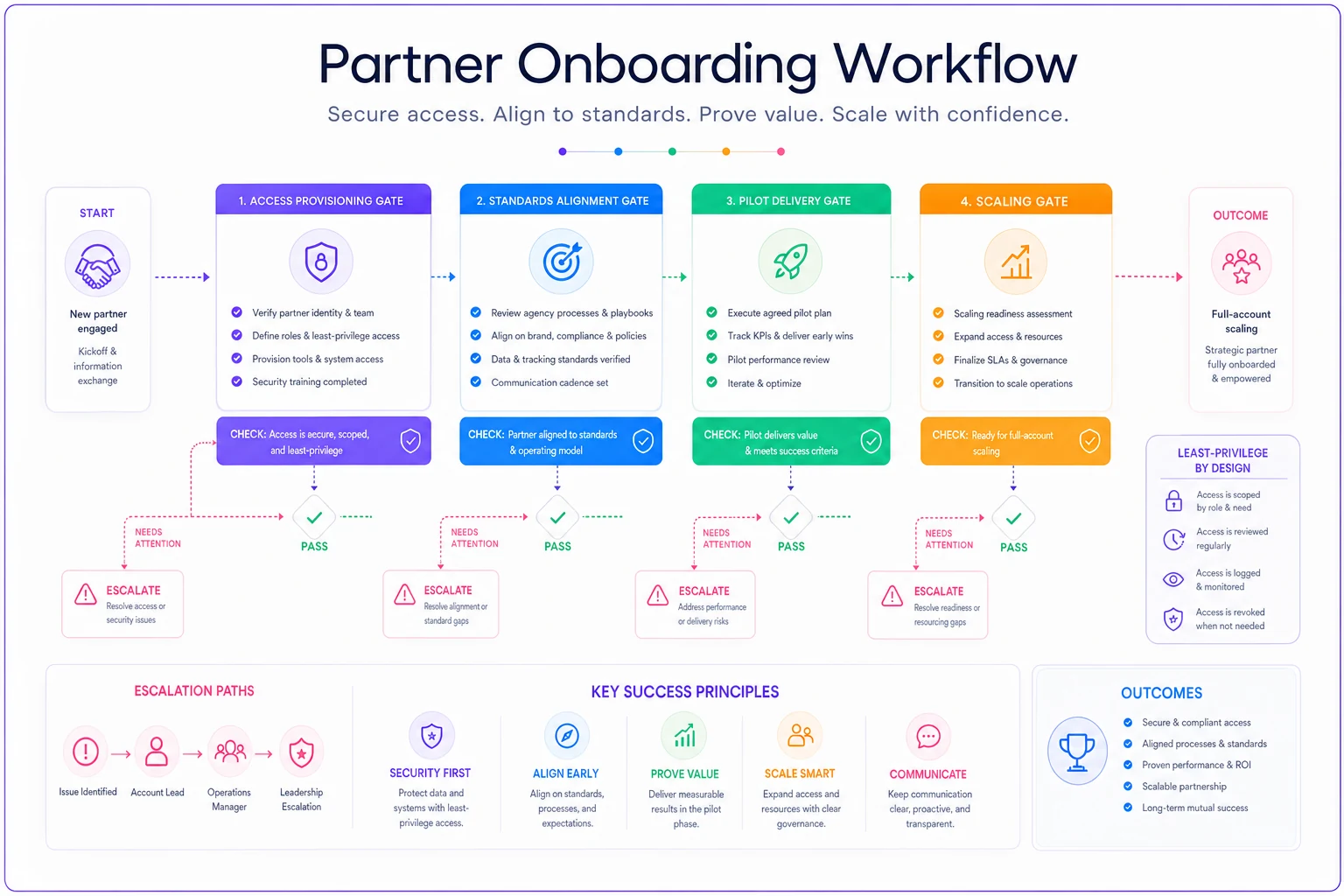
The mistake that recurs: skipping straight to the scaling gate because you're busy and the partner seems fine. You hand them five accounts on day one, and if their process has a flaw, you now have five simultaneous instances of that flaw to untangle. Graduated onboarding costs you a couple weeks. Skipping it costs you a client.
For partners who touch reporting specifically, the QA gate should include verifying their outputs against your KPI definitions — mismatched metric logic between your platform and a partner's is a common and embarrassing source of client confusion. If reporting is the partner's core function, the evaluation rigor in selecting the right white-label reporting platform applies directly to how you vet and gate them.
Revenue-share models: aligning incentives without creating new problems
How you pay a partner shapes how they behave. This is obvious and yet constantly ignored. The three common structures each create different incentives and different failure modes.
Flat fee per deliverable. Simplest to manage, easiest to forecast. The failure mode: the partner optimizes for volume over quality because their pay is decoupled from outcomes. Great for commoditized, well-specified work. Risky for anything where quality is subjective.
Markup / cost-plus. You pay the partner's rate and mark it up to the client. Clean margins, but the partner has no stake in client retention. If the client churns, the partner shrugs — their incentive ended at delivery.
Revenue share on the account. The partner gets a percentage of the client's retainer. This aligns them to retention and quality far better, but it introduces complexity: what happens when the client scales down, churns, or when you did most of the work that saved the account? Revenue share without clear rules becomes a source of disputes.
When revenue share actually makes sense: high-skill partners who materially influence client outcomes and retention — a strategic media buyer, a conversion specialist whose work directly moves the client's results. You want them thinking like an owner.
When it's a bad idea: commoditized, high-volume work. Sharing revenue on production-line deliverables just complicates your accounting for no behavioral benefit. Pay flat, keep it clean.
A realistic structure many agencies land on is a hybrid: a modest base fee that guarantees the partner covers costs, plus a performance component tied to something measurable — retention, delivered quality scores, or hitting SLA thresholds. The base keeps them stable; the performance piece keeps them engaged. Whatever you choose, write the clawback and churn scenarios into the contract before they happen, because they will.
Performance SLAs: measuring partners the way clients measure you
You have SLAs with your clients. Your partners' performance feeds directly into your ability to hold those SLAs. Yet most agencies measure partners by vibes — "they're good," "they've been flaky lately" — with no actual data. When the relationship needs to end, there's no record to justify it, and when it's working, there's no way to reward it.
-
On-time delivery rate — percentage of deliverables hitting the agreed window. This is the single most predictive metric.
-
Rework rate — how often their work bounces back for revisions. Rising rework is an early warning that quality is slipping before clients notice.
-
Response time — how fast they answer when you need something, especially during escalations.
-
Escalation frequency — how often their work triggers a client complaint or a fire drill on your side.
-
Capacity reliability — whether their quality holds as you send more volume.
The pattern to watch for is rework creeping up while on-time delivery stays fine. That's a partner hitting deadlines by cutting corners — the most dangerous kind of degradation because the surface metric looks healthy. By the time it shows up in client complaints, it's been happening for weeks.
A monthly partner scorecard, even a simple one, changes the entire relationship. It turns "I feel like they've gotten worse" into "your rework rate went from 8% to 19% over three months, here's what needs to change." Partners take documented performance conversations far more seriously than vague dissatisfaction, and the good ones actually appreciate the clarity.
Exit rules: the part nobody plans and everybody needs
Every partnership ends. Some end well, most end awkwardly, a few end in a scramble that damages client relationships. The difference is almost entirely whether you planned for the exit before you needed it.
Bad exits share a signature: the partner is deeply embedded, undocumented, and holds access or knowledge you can't quickly replace. You keep tolerating declining performance because switching feels harder than enduring. That's not a partnership anymore — it's a hostage situation you built yourself.
-
Documentation kept current — you always know what the partner does, how, and for which accounts.
-
Access you control — provisioned and revocable by you, not held solely by them.
-
Work product in your possession — deliverables and source files live in your systems, not only theirs.
-
A named backup or alternative — you know who you'd switch to before you need to.
-
Contractual transition obligations — the exit clause from earlier, actually enforced.
A clean offboarding process should run predictably: notice given per contract, transition plan agreed, access rotated and revoked, work product transferred and verified, clients transitioned without disruption, final payment settled with any clawbacks applied. When those steps exist as a runbook rather than an improvised panic, ending a partnership becomes a routine operation instead of a crisis.
The deeper point: exit-readiness isn't only about exits. Every condition that lets you leave a partner cleanly also protects you while the partnership is active — from lock-in, from access risk, from single points of failure. Building for the exit makes the whole relationship safer.
A real scenario: when the mesh finally snapped
Consider a mid-sized agency running around 30 client accounts across paid media, SEO, and reporting, leaning on roughly six partners with no formal program. The SEO content partner was handling deliverables for about a dozen retainers. No SLA, no scorecard, no exit clause — just a long-standing relationship and monthly invoices.
Over a couple of quarters, the partner quietly took on more of their own clients and started deprioritizing the agency's work. Delivery slipped from reliable to "usually a few days late," then to genuine misses. Rework climbed as junior staff on the partner's side picked up the slack. Because there was no scorecard, the decline registered as a nagging feeling rather than a documented trend — until three clients escalated in the same month about missing content and stale reporting.
The scramble was brutal precisely because there was no exit plan. Work product lived in the partner's systems. There was no named alternative. And with no transition clause, replacing them across a dozen accounts meant weeks of reconstruction while clients watched. The estimated cost — two lost retainers plus the internal hours spent firefighting — landed somewhere in the range of $40k–$60k, most of it avoidable.
The rebuild wasn't complicated. Scorecards on every partner, SLA terms retrofitted into contracts, graduated onboarding for new partners, documentation pulled into the agency's own systems, and a named backup for every critical function. Nothing exotic — just the difference between a partner program and a partner pile. The following quarter, when another partner started slipping, the scorecard caught it early and the transition took days instead of weeks, with no client ever noticing.
Where tooling fits — and where it doesn't
You can run a partner program on spreadsheets and calendar reminders. Plenty of agencies do, up to a point. What breaks down is coordination across many partners and many accounts at once — remembering which contracts are up for renewal, tracking scorecards consistently, catching rework trends before they become client incidents, and keeping documentation current when everyone's busy.
Workflow and business-management platforms with AI-assisted automation earn their place here by handling the parts humans reliably forget: flagging when a partner's on-time rate drifts below threshold, surfacing contracts approaching renewal or missing key clauses, keeping partner documentation and access records in one place instead of scattered across inboxes, and nudging the scorecard review that otherwise gets skipped for three months. The point isn't to replace judgment — deciding whether to keep or cut a partner is entirely yours. It's to make sure the signals reach you before the client escalation, not after.
Ungoverned partner meshes fail because problems surface as incidents. A governed program surfaces them as data, early enough to act. Automation just makes that early signal reliable when you're running too many relationships to track by memory.
The system view
A partner program isn't a procurement function bolted onto your agency. It's part of your delivery operation, and it fails at the same seams your delivery fails — the handoffs, the undocumented dependencies, the single points of failure nobody mapped. Selection, contracts, onboarding gates, revenue models, SLAs, and exit rules aren't six separate checklists. They're one continuous lifecycle, and a gap in any stage tends to surface as a crisis in another. Weak selection shows up as onboarding pain. Weak contracts show up at exit. Missing scorecards show up as client escalations.
The agencies that scale partner networks without chaos treat every relationship as something to be governed from first contact through clean exit — with documentation kept current, access under their control, performance measured honestly, and the exit planned before it's needed. That's not bureaucracy. It's the thing that lets you add partners aggressively because you can remove them safely. Build the lifecycle once, and your partner network becomes leverage instead of liability.
Build the lifecycle once, and your partner network becomes leverage instead of liability.
Ready to elevate your agency's performance?
Join 2,000+ agencies using Digmaly to save time, boost efficiency, and deliver superior client results.