



Most agencies hire media buyers the way they dated in their twenties: based on vibes, a good first impression, and a resume that looks right. Then three months in, the panic sets in. The new hire can build a campaign but can't read a pacing report. Or they're great at Meta but freeze the moment someone mentions Google's search terms report. Or — my personal favorite — they've been "running campaigns" for four years that someone else actually set up and optimized.
The problem isn't that these people are bad. It's that "media buyer" means roughly fifteen different jobs depending on the agency, and almost nobody writes down which version they're actually hiring for. So you end up paying junior rates for junior output, senior rates for junior output, and occasionally junior rates for someone who could be running your whole paid social team if you'd just noticed.
A media buyer competency matrix fixes the measurement problem. Not the hiring speed problem directly — the measurement problem that makes hiring slow, expensive, and inconsistent. Once you can measure skill precisely, everything downstream gets faster: screening, onboarding, promotion decisions, and the awkward "why am I not getting a raise" conversations.
Here's how to actually build one that holds up in real operations — not a spreadsheet that sits in a Notion doc nobody opens.
Why "years of experience" is a garbage proxy
Agencies post for a media buyer with "3+ years experience." They interview five people, all of whom have 3+ years. The interviews feel similar. They pick based on who seemed most confident or who they'd want to grab lunch with.
Then performance varies wildly. Two people with identical tenure can have radically different actual capability:
-
One spent three years managing $5k/month local lead-gen accounts with one channel.
-
The other managed $200k/month ecommerce accounts across four platforms with server-side tracking and incrementality testing.
Same "3 years." Completely different operators. The resume can't tell you which is which, and neither can a 45-minute conversation that starts with "tell me about a challenging campaign."
The deeper issue is that experience measures time exposed to a thing, not demonstrated ability at the thing. A competency matrix flips this. Instead of asking how long someone has done media buying, you ask whether they can do these specific 40 things — and to what level.
That shift is what makes everything faster. You stop re-litigating what "good" means every single time you hire.
What actually goes in the matrix
A competency matrix is a grid. Skills down the left, proficiency levels across the top. The art is in picking the right skills and defining levels that are observable, not fuzzy.
Eliminate marketing chaos with streamlined campaign control.
Digmaly lets you plan, execute, and track every campaign effortlessly.
- Unified campaign management
- Real-time client reporting
- Collaborative team workflows
No credit card required
Avoid the trap of listing platform names like "knows Meta Ads Manager." That's a feature checklist, not a competency. Knowing where the buttons are is table stakes. Competency is about judgment: knowing when to consolidate ad sets, why a CPA spiked, whether to kill a campaign or give it another three days.
Group your competencies into clusters. Here's a structure that holds up across most agency setups:
| Competency cluster | What you're actually measuring | Example skill |
|---|---|---|
| Platform execution | Can they build and ship without errors? | Correct conversion event + attribution window setup |
| Analysis & diagnosis | Can they figure out why something moved? | Isolating a CPA spike to audience vs. creative vs. tracking |
| Budget & pacing | Do they protect spend and hit targets? | Rebalancing a flight that's 18% behind pace mid-month |
| Strategy & planning | Can they design, not just operate? | Building a channel mix for a new client from a brief |
| Client communication | Can they explain results without hand-holding? | Writing a performance narrative a non-marketer understands |
| Process & hygiene | Do they follow the system? | Naming conventions, documentation, QA before launch |
The clusters matter because they map directly to career progression. A junior buyer should be solid on platform execution and process hygiene before you expect anything resembling strategy & planning. When you see someone weak on execution but eager to talk strategy all day, that's a red flag worth catching in the interview — not month four.
Defining proficiency levels that aren't meaningless
The second axis — the levels — is where most matrices fall apart. People write "Beginner / Intermediate / Advanced / Expert" and call it a day. Those words mean nothing. One manager's "intermediate" is another's "barely functional."
-
Assisted — Can complete the task with a checklist and review. Needs someone to catch mistakes before launch.
-
Independent (simple) — Handles the task alone on straightforward accounts. Single channel, modest budget, clear goals.
-
Independent (complex) — Handles the task alone on messy, multi-channel, high-budget accounts with ambiguous goals.
-
Teaches / sets standard — Can define how the team does this and train others. This is the level that justifies senior pay.
The jump between levels 2 and 3 isn't about the task — it's about the complexity of context. Anyone can rebalance a budget on a $3k account. Rebalancing a $150k flight across three platforms when the client just changed the target CPA mid-month is a different animal entirely.
Most agencies have a bunch of people stuck at level 2 across the board and are paying several of them like they're at level 3 or 4. The matrix surfaces that gap, which is uncomfortable but necessary.
Tying the matrix to billable expectations
This is the part most competency framework articles skip, and it's the whole point for agency economics. A skill ladder floating in space is an HR exercise. A skill ladder tied to billable output is an operating tool.
Each level should correspond to a billable rate or capacity expectation — how many accounts or how much managed spend this person can realistically own — a supervision cost reflecting how much senior time they consume being reviewed, and a promotion gate defining the specific threshold that moves them up.
A level-2 buyer might carry 6–8 straightforward accounts but needs roughly 3–4 hours of senior review time per week. A level-3 buyer carries 10–12 accounts — including the ugly ones — and needs maybe 30 minutes of check-in. The level-3 person isn't just better at their job. They free up senior capacity, which is the scarcest resource in any growing agency.
When you frame promotion this way, the economics become obvious. Moving someone from level 2 to level 3 isn't just a raise cost — it's a reduction in senior supervision drag plus an increase in account capacity. That math feeds directly into broader capacity planning, the same logic behind using capacity formulas, hiring scorecards, and profitability triggers to drive your operational playbook. The matrix is the input that makes those formulas trustworthy instead of guesses.
The training curriculum that mirrors the matrix
A matrix without a training path is just a report card. The curriculum is how you move people up the ladder on purpose instead of hoping they absorb skills by osmosis.
For every competency, define the fastest path from one level to the next. Not a course — a sequence of real work plus a checkpoint.
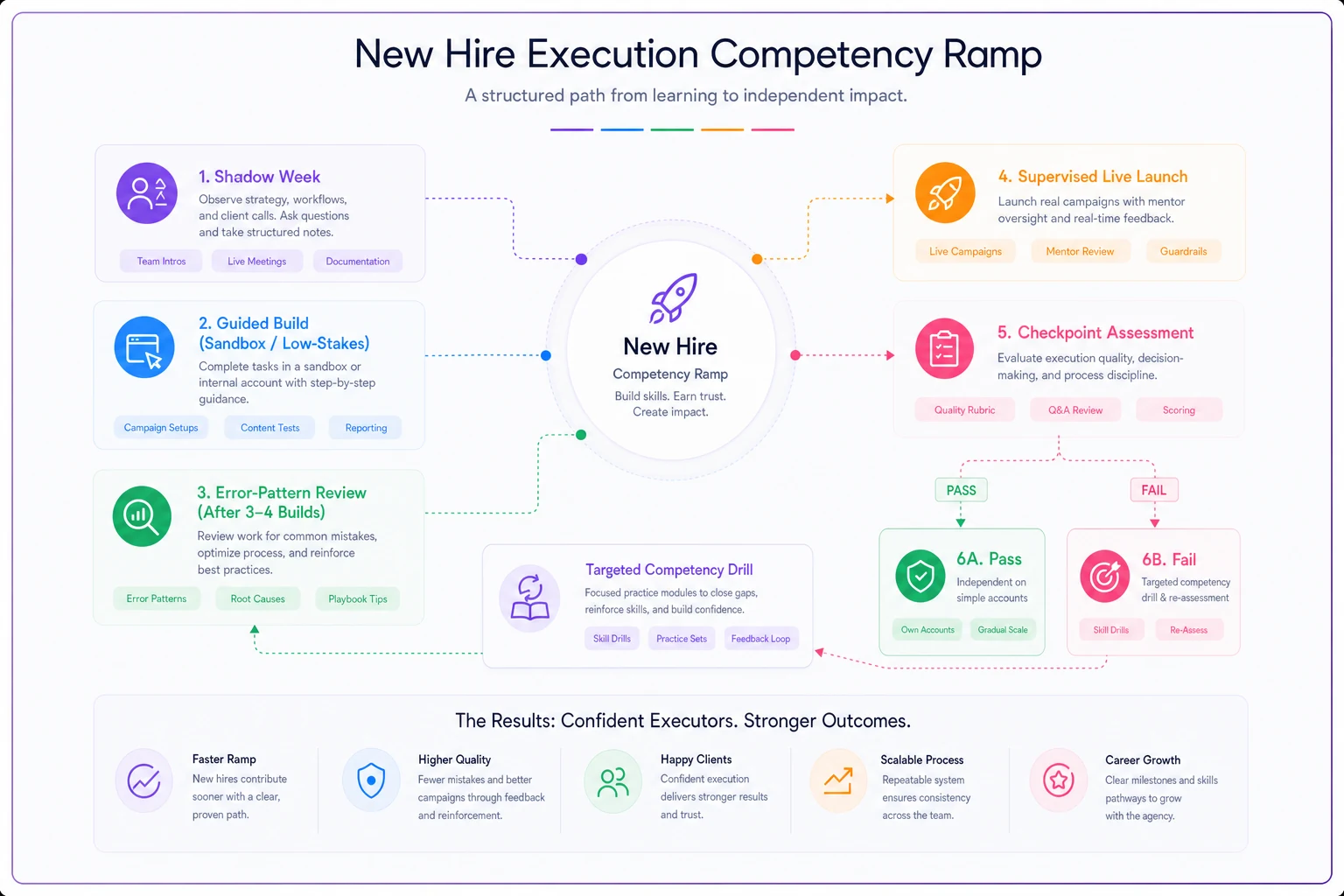
Here's a workflow for getting a new hire from "assisted" to "independent (simple)" on campaign execution:
The workflow below shows the ramp steps for new-hire execution competency.
-
Shadow week — They watch two full build-and-launch cycles, taking notes against your launch checklist. No building yet.
-
Guided build — They build in a sandbox or on a low-stakes account, with a senior reviewing before anything goes live. Every error gets logged.
-
Error-pattern review — After 3–4 builds, you look at the logged errors together. Patterns emerge fast — usually conversion setup, naming, or budget allocation.
-
Supervised live launch — They own a real launch end to end, senior reviews pre-flight only.
-
Checkpoint assessment — Against the rubric. Pass means they move to independent on simple accounts. Fail means you know exactly which competency to drill.
The error log in step 3 is genuinely underrated. The same mistakes repeat across onboarding again and again: wrong attribution window, missing UTMs, broken naming conventions, budget set at the campaign level when it should be ad-set level. If you track these, your curriculum basically writes itself — because you're training against actual failure points, not imagined ones.
Onboarding discipline here connects directly to keeping launches predictable. The same operational backbone covered in the campaign orchestration framework for turning chaotic launches into on-time ones applies here too. A new buyer who learns inside a messy launch process learns the mess. A new buyer who learns inside a clean process gets productive months faster.
Assessment rubrics: making "pass" objective
An assessment that depends on a manager's gut feel is just the vibes-hiring problem moved downstream. The rubric has to be specific enough that two different reviewers would score the same work similarly.
For each competency checkpoint, write the rubric as observable behaviors, not adjectives. Instead of "demonstrates good analytical skills," write:
-
Correctly identified the primary driver of the CPA change (audience / creative / tracking / external)
-
Checked the search terms report or placement report before concluding
-
Quantified the impact — not just "it went up"
-
Proposed a specific next action with a rationale
-
Flagged what they'd monitor to confirm the fix worked
That's gradeable. You can hand someone a real account diagnosis scenario and check boxes. No debate about whether they're "intermediate."
One practical habit worth building: use real past situations from your own accounts as assessment cases. Pull an actual CPA spike from six months ago, strip the client name, and ask the candidate or trainee to diagnose it. You already know the answer and what the actual fix was. It's the single most predictive assessment you can run — far better than hypotheticals.
Time-to-competency benchmarks
Once you've run the curriculum a few times, you start to see how long each level transition actually takes. Write those down. They become your planning benchmarks.
Rough ranges that show up across agency onboarding:
| Transition | Typical range | Notes |
|---|---|---|
| Assisted → Independent (simple) | 4–8 weeks | Faster with structured training; longer if onboarding is chaotic |
| Independent (simple) → Independent (complex) | 6–12 months | Needs reps on genuinely messy accounts — hard to simulate |
| Independent (complex) → Teaches/sets standard | Varies widely | Depends as much on temperament as skill level |
The value of writing these down isn't precision — it's that you can budget for ramp. If you know a new hire takes roughly six weeks to carry simple accounts solo, you stop expecting billable output in week two and stop panicking in week three when they're still slow. You also know when someone is lagging the benchmark badly enough to be a real concern versus just normal ramp.
There's a quieter insight here too: people who blow past the benchmark are your future leads, and most agencies don't track this, so they miss it entirely. The buyer who hit independent-complex in four months instead of nine is a different asset than the one who took a year. The matrix catches that signal while it's still actionable.
When this is worth building — and when it isn't
A competency matrix is real work. It's not free. So be honest about whether it fits your situation.
When it makes sense:
-
You have 4+ buyers and hiring is now a recurring event, not a one-off.
-
Promotion and pay decisions are starting to feel arbitrary or politically charged.
-
Senior people are drowning in review time and you can't tell who's actually ready to be cut loose.
-
You're onboarding frequently enough that winging it is costing you real ramp time.
When it's premature:
-
You're a two-person shop. You know exactly what everyone can do. Writing it down is procrastination dressed as process.
-
You're hiring your very first buyer. Build the first version from that hire's ramp — don't front-load a theoretical matrix.
One group who definitely shouldn't bother: agencies that will build the matrix, launch it with fanfare, and never use it to make an actual promotion or hiring decision. A matrix that doesn't change a single real outcome is pure overhead. If leadership won't commit to using it as the basis for pay and promotion, skip it — you'll just end up with a very detailed document that breeds cynicism.
A real scenario
A mid-sized paid social shop — around nine buyers, mostly ecommerce clients — had a chronic ramp problem. New hires took close to four months to carry a normal account load, and even then the senior team was doing a lot of silent cleanup after launches.
They built a matrix with six clusters and four levels, plus a six-step onboarding curriculum anchored to an error log from past launches. Nothing fancy. The whole thing lived in a shared sheet.
The first measurable change wasn't hiring speed — it was review time. Within a couple of months, senior buyers reported spending noticeably less time catching launch errors, because trainees were being drilled against the actual mistakes that used to slip through. Ramp to carrying simple accounts dropped from roughly four months to something closer to six or seven weeks for the next two hires.
The less expected win: two existing buyers who'd quietly been operating at a high level got formally recognized and moved up, which stopped one of them from leaving. They'd been interviewing elsewhere because progression felt invisible. Hard to put an exact number on retention like that, but replacing a strong buyer isn't cheap — and the matrix is what made the gap visible before it turned into a resignation.
The thing most people get wrong
The biggest mistake isn't building a bad matrix. It's building a perfect one and never updating it. Platforms change. Your client mix changes. The competencies that mattered two years ago aren't identical to the ones that matter now, especially as more of the grunt execution gets automated and the premium shifts toward diagnosis and strategy.
Treat the matrix as a living document you revisit maybe twice a year. Add competencies that keep showing up in your error logs. Retire ones that no longer predict performance. The agencies that get real leverage out of this aren't the ones with the fanciest framework — they're the ones who actually use it to make the next hire, the next promotion, and the next "you're ready to run this solo" decision with evidence instead of a gut feeling.
That's the whole game. Not more process for its own sake — just a clear, honest way to answer whether this person can do the job and how you get them there faster, written down once and used every time.
That's the whole game. Not more process for its own sake — just a clear, honest way to answer whether this person can do the job and how you get them there faster, written down once and used every time.
Ready to elevate your agency's performance?
Join 2,000+ agencies using Digmaly to save time, boost efficiency, and deliver superior client results.