


Most agencies hit the same wall the moment a client says "we have a big email list, let's use it." Someone exports a CSV, drops it into Meta Custom Audiences and Google Customer Match, and three weeks later the client's legal team asks a question nobody can answer: which of these people actually agreed to this?
That's the real problem. Not "how do I upload a list." Anyone can do that. The problem is that first party data activation agency work falls apart when consent state isn't tracked at the field level, because platforms don't care about your intentions — they care about match rates, and your client's regulators care about proof. You need both. This playbook covers the boring plumbing that makes both possible: a consent taxonomy, an activation matrix, and the transformation rules that sit between them.
## The specific failure: "we have consent" is not a data model
Here's how it actually breaks.
A DTC skincare brand hands you a 180k-row customer export. It has email, phone, purchase history, a marketingoptin boolean, and a created_at timestamp. You build a lookalike seed from the top spenders, upload it, launch, and performance is fine for a while.
Then the client migrates their email platform. Turns out the marketingoptin flag only covered email marketing under their old ESP's terms. It said nothing about sharing hashed identifiers with advertising platforms. Nobody mapped the difference because nobody wrote down what each consent field actually permitted. The boolean looked like permission. It wasn't permission for this.
Agencies treat consent as a single yes/no gate when it's really a set of permissions tied to specific purposes. Email opt-in ≠ ad platform sharing ≠ personalization ≠ cross-device matching. A single column can't carry that nuance, and when you flatten it to one flag, you lose the ability to answer the only question that matters during an audit: for this specific person, what were they told, and what did they agree to?
## Start with a consent taxonomy, not an upload
Before you touch a platform, you need a controlled vocabulary for consent states. Not marketing language — actual categories your data team can filter on. The taxonomy is what makes everything downstream auditable.
Eliminate marketing chaos with streamlined campaign control.
Digmaly lets you plan, execute, and track every campaign effortlessly.
- Unified campaign management
- Real-time client reporting
- Collaborative team workflows
No credit card required
-
Purpose scope — what the user agreed to (email marketing, SMS, ad targeting, personalization, analytics only)
-
Jurisdiction — which rules apply (GDPR, CCPA/CPRA, CAN-SPAM-only, other)
-
Consent basis — how it was obtained (explicit checkbox, implied/legitimate interest, pre-checked legacy, unknown)
-
Freshness — when it was captured and whether it's expired under the relevant regime
A typical taxonomy table looks like this:
| Field | Allowed values | Notes |
|---|---|---|
purposeadtargeting | granted, denied, unknown | Must be explicit for GDPR records |
purpose_personalization | granted, denied, unknown | Separate from targeting on purpose |
jurisdiction | gdpr, cpra, canspam, other | Derived from billing/IP country |
consent_basis | explicit, implied, legacy, unknown | legacy and unknown are high-risk |
consentcapturedat | ISO date | Drives freshness rules |
source_system | string | Where the flag came from — critical for lineage |
The single biggest mistake here is collapsing unknown into denied or granted out of convenience. unknown is its own state and it should stay unknown until you can prove otherwise. Agencies that silently default unknowns to "granted" to pad audience size are making exactly the decision that turns a routine audit into an incident.
If you're thinking about how this ties into broader controls, it's the same discipline covered in agency data governance for ad ops — lineage and field-level accountability aren't separate problems, they're the same problem at different levels.
## The activation matrix: map consented attributes to platforms
Once you have a taxonomy, you build the activation matrix. This is the document that answers: given a consent state, which platforms can this record go to, which fields, and how transformed.
Think of it as rows of consent states crossed against columns of destinations. Every cell answers: eligible or not, and if eligible, what gets sent.
A simplified version:
| Consent state | Meta Custom Audience | Google Customer Match | TikTok | Server-side (CAPI) |
|---|---|---|---|---|
ad_targeting=granted, gdpr, explicit | ✅ email+phone (hashed) | ✅ email+phone (hashed) | ✅ email only | ✅ full |
ad_targeting=granted, cpra, explicit | ✅ email+phone | ✅ email+phone | ✅ full | |
ad_targeting=unknown, any | ❌ | ❌ | ❌ | ❌ |
personalization=granted, targeting=denied | ❌ | ❌ | ❌ | ⚠️ analytics-only event |
consent_basis=legacy | ❌ until re-consent | ❌ until re-consent | ❌ | ❌ |
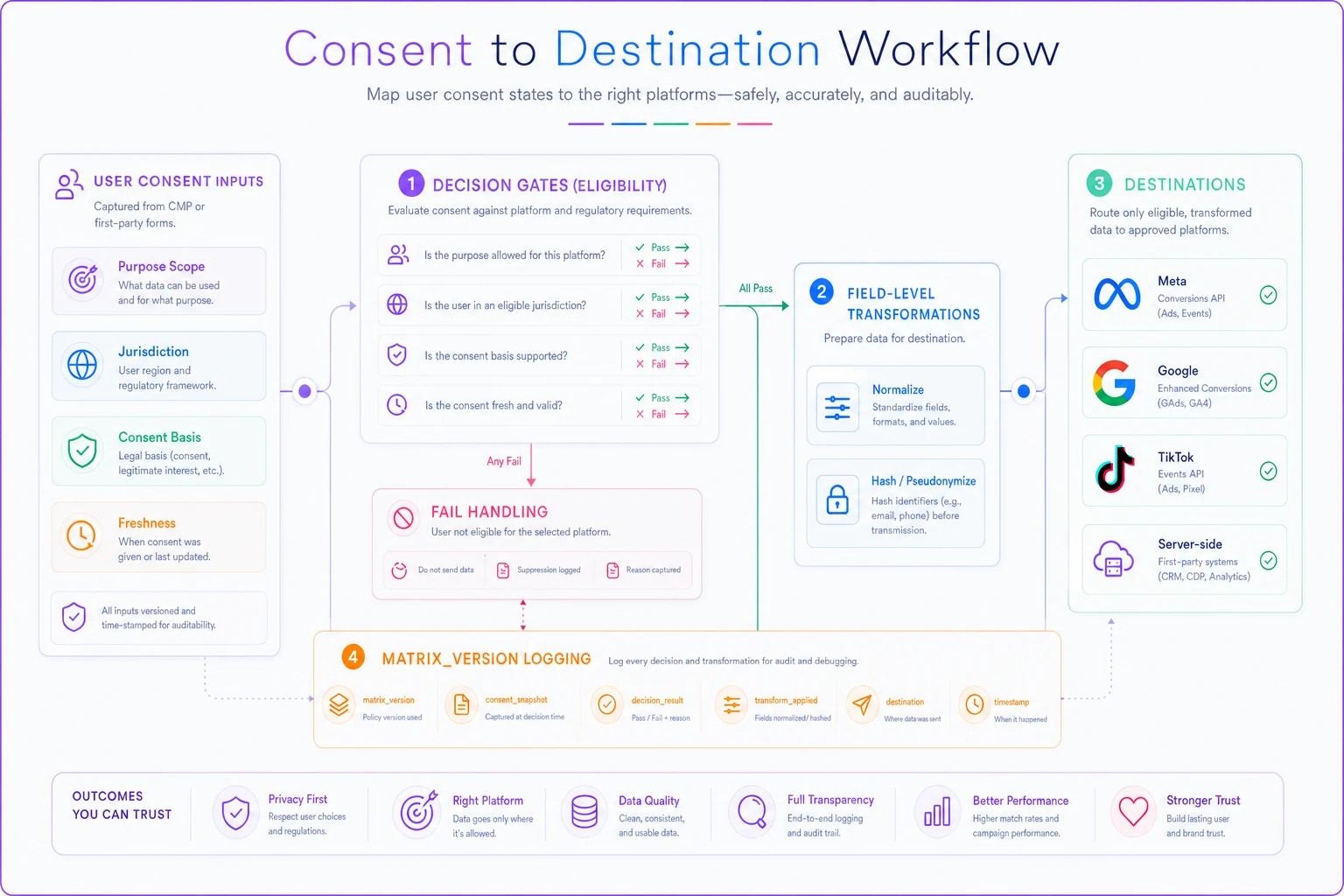
A simple workflow for mapping consent states to platform destinations:
Two things people get wrong with the matrix.
First, they build it once and never version it. Platform terms change, jurisdictions change. A matrix without a version number and a review date is a liability waiting to expire. Put a matrix_version on every upload job so you can trace which record went out under which ruleset.
Second, they forget that different platforms accept different identifiers, and that itself is a consent question. Sending a phone number to a platform the user only consented to receive email contact through is a scope violation — even if the person broadly agreed to "advertising." The matrix forces you to be explicit about the field-level grant, not just the purpose-level one.
## Transformation rules: where match rate meets compliance
Between the matrix and the actual upload sits transformation. This is hashing, normalization, and field selection. It's also where most match-rate problems originate, and where a surprising amount of accidental non-compliance hides.
Normalization rules that actually move match rates:
-
Lowercase and trim all emails before hashing. Gmail dot/plus normalization is optional but worth testing per platform.
-
E.164 phone formatting — strip spaces, dashes, parens, prepend country code based on jurisdiction, then hash.
-
SHA-256 the normalized value, not the raw one. Hash after normalize, never before.
-
Drop empty-after-normalization fields rather than sending empty hashes, which some platforms count against your match quality.
-
Attach the consent snapshot to the upload log — not the uploaded file, the log — so you can prove what state each record was in at send time.
The non-obvious thing: the order of operations in transformation is itself a compliance artifact. If your pipeline drops the consent check after building the audience file instead of before, you've already materialized a file full of people who shouldn't be in it. Filter on consent state first, transform second. Always.
import hashlib def normalizeemail(e): return e.strip().lower() if e else None def normalizephone(p, countrycode="1"): if not p: return None digits = "".join(c for c in p if c.isdigit()) if not digits.startswith(countrycode): digits = countrycode + digits return "+" + digits def sha256(v): return hashlib.sha256(v.encode()).hexdigest() if v else None def eligibleformeta(row): # Consent FIRST, transform second return ( row["purposeadtargeting"] == "granted" and row["consentbasis"] == "explicit" and row["consentbasis"] != "legacy" and row["jurisdiction"] in ("gdpr", "cpra") ) def buildmetaaudience(rows, matrixversion): out = [] for r in rows: if not eligibleformeta(r): continue # excluded records never get transformed emailh = sha256(normalizeemail(r.get("email"))) phoneh = sha256(normalizephone(r.get("phone"))) if not (emailh or phoneh): continue out.append({ "email": emailh, "phone": phoneh, "matrixversion": matrixversion, "consentsnapshot": r["consentcaptured_at"], }) return out
The eligibility filter runs before any hashing happens, and the matrix version rides along with every record. That's the whole point. If anyone ever asks "why was this person in the Meta upload on March 14," you can answer it from the log alone.
## Fallback strategies when consent is thin or messy
Real client data is never clean enough for the ideal matrix. Half your records will be unknown, legacy flags will be everywhere, and the client will still want volume. You need predefined fallbacks so your team isn't improvising under deadline pressure.
The fallback ladder, in order of preference:
-
Re-consent campaign — the only fallback that expands your eligible pool legitimately. Run a lightweight opt-in flow, capture explicit consent, and watch
unknownconvert togranted. Slow but it's the real fix. -
Modeled/lookalike seeding from the clean subset — use only your
granted+explicitrecords as the seed, let the platform expand. You never upload the questionable records; the platform does the extrapolation on its side. -
Server-side analytics-only events — for records that consented to personalization but not targeting, you can still feed conversion signal without using them as an audience.
-
Contextual fallback — when the consented pool is too small for any list-based activation, pivot that budget to contextual placements rather than stretching consent interpretation.
The mistake is using lookalike seeding as a laundering step — seeding off records you shouldn't have in the first place. A lookalike built from a non-consented seed carries the same problem one layer removed. Dirty seed in, you've just hidden the problem.
### When this matters most, and when it's overkill
Full taxonomy-plus-matrix discipline makes sense when:
-
The client operates under GDPR or CPRA, or sells into the EU/California
-
You're handling lists above roughly 50k records where manual review isn't feasible
-
The client has legal counsel who will eventually ask questions
-
You're running first-party uploads across three or more platforms
It's probably overkill for a one-off, small US-only CAN-SPAM list for a local service business with no EU exposure. Don't build a 40-cell matrix for a 2,000-row list. Match the governance weight to the actual risk.
Who should not do this half-heartedly: agencies that plan to automate uploads on a schedule. The moment uploads become automated, the consent filter has to be codified, because there's no human in the loop to catch the legacy-flag mistake. If you're moving toward scheduled or automated activation, the guardrails and rollback thinking in AI governance for campaign automation apply directly — an automated upload with no consent gate is exactly the kind of thing that scales a small mistake into a big one overnight.
## Real scenario: the skincare brand, cleaned up
Back to that DTC skincare client. After taxonomy mapping, their 180k-row list broke down into roughly:
-
~95k
explicit+grantedfor ad targeting -
~60k
legacyorimplied(old pre-checked boxes, pre-GDPR signups) -
~25k
unknown
Before mapping, all 180k were going into uploads. Meta match rate hovered in the high-50s percent, and the client's counsel was uneasy because they couldn't document basis for a substantial portion of it.
After applying the matrix — only the clean ~95k going direct, the legacy segment pushed into a re-consent email flow, the unknowns held back — a few things shifted. Match rate on the clean upload climbed into the mid-60s because better-normalized records with less junk dragging down quality. The re-consent flow recovered somewhere around 11k–14k of the legacy pool into explicit consent over about six weeks. And the client's legal review went from "we can't answer this" to a documented export showing consent basis per record.
Audience size dropped initially, which made the client nervous for exactly one reporting cycle. Performance held because the dropped records were mostly low-match, low-signal anyway. The real win wasn't the metrics — it was that the next time the client changed platforms or got a data request, the answer already existed in the logs.
## A short checklist before any first-party upload
Running through this before every upload takes maybe five minutes and has saved more than a few awkward client conversations.
-
- [ ] Every record has a resolved consent state (no silent defaulting of
unknown) -
- [ ] Jurisdiction is derived and stored, not assumed
-
- [ ] The activation matrix has a version number and a last-reviewed date
-
- [ ] Consent filter runs before transformation in the pipeline
-
- [ ] Normalization matches each platform's spec (email lowercase, phone E.164)
-
- [ ] Hashing happens after normalization, never before
-
- [ ] Upload log captures matrix version + consent snapshot per record
-
- [ ] Legacy and unknown records are routed to fallback, not into the upload
-
- [ ] Someone can answer "why was person X in this upload" from the log alone
If you can't check most of these off, the upload isn't ready. That's not a bureaucratic standard — it's just what defensible activation actually looks like in practice.
Where this leaves you
Consent isn't a checkbox you pass through on the way to an upload — it's a state you carry with every record, all the way to the platform and back into your logs. The agencies that get burned are the ones who treat it as a one-time gate. The ones who don't get burned treat it as a column that travels with the data.
Build the taxonomy once. Version the matrix. Filter before you transform. Keep the log. None of it shows up in a client deck, and none of it is glamorous work. But it's the difference between first-party activation that quietly compounds value and a CSV that turns into a legal problem eighteen months from now.
Ready to elevate your agency's performance?
Join 2,000+ agencies using Digmaly to save time, boost efficiency, and deliver superior client results.