


Most agencies think they handle client data responsibly because they signed a DPA and ticked the GDPR box during onboarding. Then a client's legal team asks a simple question during a quarterly review — "Can you show me exactly what consent basis we're relying on for the lookalike audiences you built?" — and the room goes quiet. Nobody can answer cleanly. Somebody mumbles something about Meta's terms. The account lead promises to "circle back."
That silence is the gap. Baseline compliance tells you what you're legally required to do. It says almost nothing about the hundred small judgment calls your media buyers, analysts, and account managers make every week — whether to upload a customer list, how to describe a tracking setup to a nervous client, or whether to run that slightly creepy retargeting segment the client asked for.
An ethical data agency isn't one with perfect legal coverage. It's one that has turned those judgment calls into a repeatable system — something your most junior coordinator can follow without guessing. That's what this is about: how the whole thing fits together, where it breaks as you scale, and what the operational layer actually looks like beyond the compliance paperwork.
The real problem: policy and practice live in different buildings
A pattern that shows up constantly — an agency has a privacy policy. It's a 14-page PDF a lawyer drafted, sitting in a shared drive folder nobody opens. Meanwhile the actual data work happens in Slack threads, ad platform UIs, spreadsheets, and the heads of three senior people who've "always done it this way."
The policy describes an idealized world. Practice is whatever gets the campaign live by Friday.
This split is nearly invisible when you're small. With five clients and four people, the senior team is the governance layer. They know which clients are sensitive, which data sources are shaky, which audiences make them uncomfortable. The knowledge is real — it's just trapped in people instead of systems.
Then you grow. You hire two junior buyers, bring on a contractor for creative, add a reporting analyst. Suddenly the people making data decisions are not the people who hold the context. A new coordinator uploads a client's full customer email list to build a Custom Audience because that's how the last three accounts worked — except this client is a healthcare practice and that list includes patients, and now you have a genuine problem that no DPA clause is going to fix.
The failure isn't legal. It's operational. The context that used to travel inside senior people's heads never got written down in a form anyone could act on.
Start with a consent taxonomy, not a consent checkbox
Most agencies treat consent as binary — did the user accept cookies or not. That's useless for actual operations, because the data flowing through your agency comes from wildly different sources with wildly different permission footprints, and your team needs to know which is which before they act.
Eliminate marketing chaos with streamlined campaign control.
Digmaly lets you plan, execute, and track every campaign effortlessly.
- Unified campaign management
- Real-time client reporting
- Collaborative team workflows
No credit card required
| Data type | Typical source | Permitted uses | Hard limits |
|---|---|---|---|
| First-party, explicit opt-in | Newsletter signups, account creation | Suppression, measurement, modeled audiences | No sharing with third-party data brokers |
| First-party, implied | Purchase history, site behavior | On-site personalization, measurement | No upload to ad platforms without review |
| Sensitive-category data | Health, finance, kids, location | Heavily restricted — review required | Never used for targeting without legal sign-off |
| Platform-derived | Pixel, conversions API, platform audiences | Standard campaign use | Governed by platform terms, not yours to re-export |
| Third-party / purchased | Data co-ops, list brokers | Case-by-case, high scrutiny | Default to "don't" unless proven clean |
The power isn't the table itself. It's that once every data source carries a tag, your workflow can enforce rules automatically. A coordinator who tries to push a "sensitive-category" list into an audience build hits a stop sign instead of a shrug.
The mistake agencies make is building this once and never maintaining it. Data sources change. A client switches their CRM, starts collecting location data, launches a loyalty program. If nobody re-classifies the new source, your taxonomy is lying to you within a quarter. Treat classification as part of onboarding and part of every new integration — not a one-time exercise.
Transparency playbooks: scripting the conversations nobody wants to have
Transparency fails not because agencies want to hide things, but because explaining data practices to a client is genuinely hard and nobody's prepared a good way to do it. So the account manager improvises, under-explains to avoid scaring the client, and creates a trust problem for later.
A transparency playbook is just pre-written, honest language for the recurring moments where you need to explain what you're doing with data. The goal is to make the truthful answer the easy answer, so your team doesn't default to vague reassurance.
-
Onboarding data intake — exactly what you're collecting, from where, and why
-
Audience strategy explanation — in plain language, how targeting works and what it uses
-
Tracking setup disclosure — what the pixel and server-side setup actually captures
-
Incident notification — what you say when something goes wrong, before the client finds out elsewhere
-
End-of-relationship data handling — what happens to their data when they leave
The insight most agencies miss: clients don't lose trust because your data practices are imperfect. They lose trust because they feel managed. A plainly-worded explanation of a limitation builds more trust than a slick reassurance that papers over it. When you tell a client "we can't reliably measure view-through on this channel after the iOS changes, here's what we use instead," you sound like someone who knows what they're doing. When you say "don't worry, our attribution is best-in-class," you sound like everyone else who's lied to them.
A transparency playbook also protects you internally. When the honest script is written down and approved, a nervous account manager doesn't have to decide in the moment how much to disclose. That decision was already made by people with more context.
Decision frameworks for trade-offs: where the real judgment lives
The hard part of ethical data work isn't the obvious stuff. Everyone knows not to sell patient lists. The hard part is the gray zone — the client who wants the aggressive retargeting, the data source that's probably fine but you're not totally sure, the measurement approach that works great but relies on data you'd rather not be holding.
These are trade-offs, and trade-offs need a framework, not a vibe. Without one, the decision defaults to whoever argues loudest — usually the person under the most deadline pressure.
-
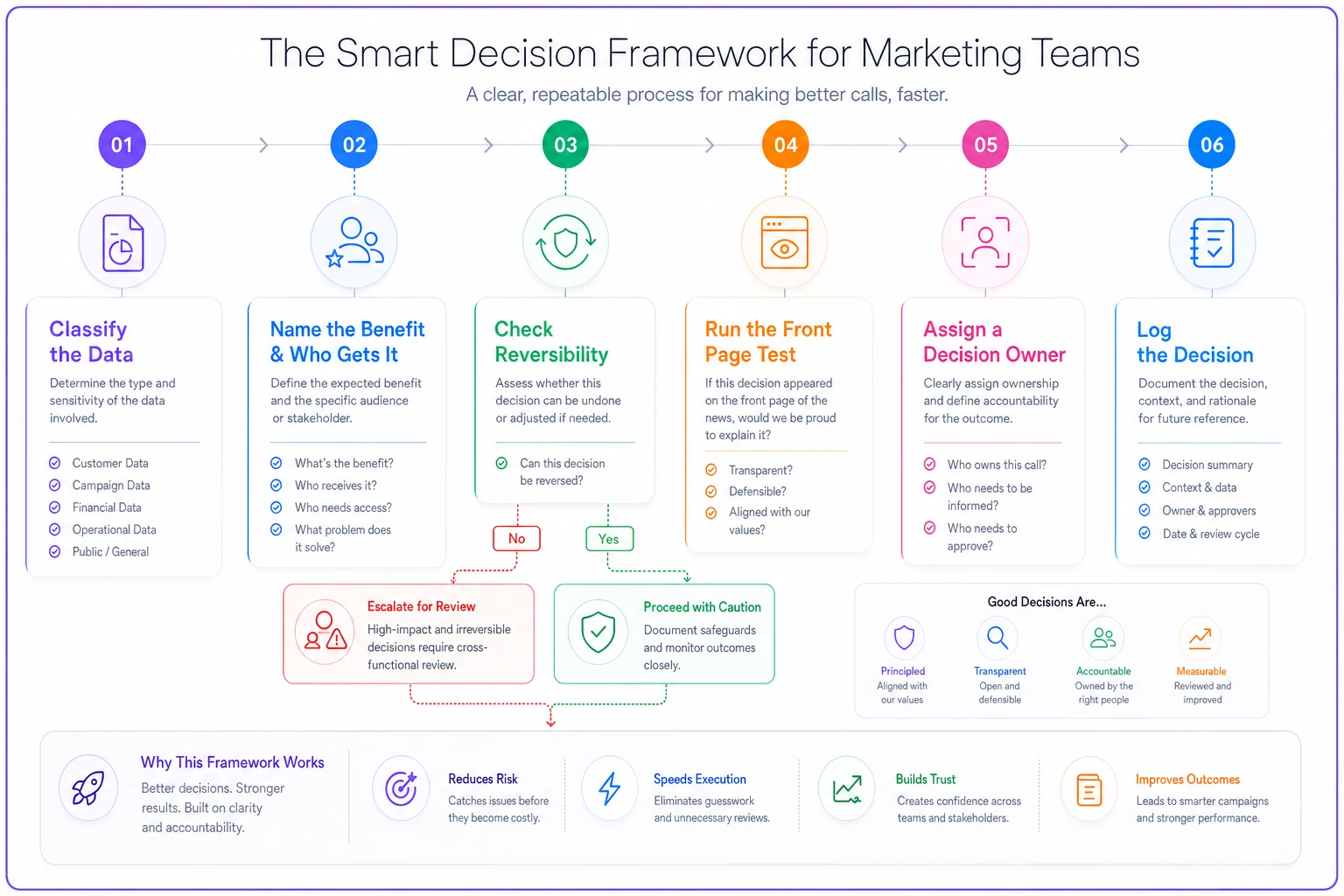
Classify the data. What taxonomy category does every input fall into? If anything is sensitive-category or third-party, it escalates automatically.
-
Name the benefit and who gets it. Is this genuinely better for the end user, or only better for campaign metrics? Be honest about this one.
-
Check reversibility. If a user objected tomorrow, could you cleanly remove them and unwind the targeting? If not, that's a flag.
-
Run the "front page" test. If a journalist described this practice in plain language to the end customer, would the client be comfortable? Would you?
-
Assign a decision owner. Someone with authority signs off, and the reasoning gets logged. Not for bureaucracy — so the next person facing the same call has a precedent.
The logging step matters more than it looks. The second time a similar question comes up, you don't re-litigate it from scratch. You've built institutional memory. Over a year, those logged decisions become your real policy — far more useful than the PDF, because they're grounded in actual situations your team faced.
Visualised below is the decision workflow.
When to escalate vs. when to just decide
Not every decision needs a committee. Over-escalating is its own failure mode — it teaches your team that governance means delay, so they start routing around it. The art is calibrating. First-party data for standard measurement? The buyer just proceeds. Sensitive-category data, a new third-party source, or anything that fails the front-page test? Escalate. Everything in between gets a lightweight log entry and moves on.
Good governance isn't about slowing things down — it's about making sure the right calls get made by the right people, without turning every routine upload into a committee meeting.
Client-facing trust artifacts: proving it without a 14-page PDF
Clients increasingly ask agencies to demonstrate responsible data handling, not just assert it. The agencies that handle this well have a small set of trust artifacts ready — short, concrete documents that show the system actually working.
-
A one-page data inventory per client — what you hold, where it lives, how long you keep it
-
A consent basis summary — for each audience or data use, the taxonomy category it relies on
-
A sub-processor list — every vendor, pixel, and API touching their data, kept current (this ties directly into vendor governance, which most agencies already neglect)
-
An access log summary — who on your team can touch their data and when it was last reviewed
-
A deletion-readiness statement — proof you can actually honor a deletion request on demand
That last one is where a lot of agencies quietly fail. They promise deletion in the contract and have no real mechanism to execute it. If a client — or a regulator — asks you to prove you deleted something, "we're pretty sure we did" is not an answer. Building genuine data deletion procedures for client requests with audit-ready evidence is what turns a contractual promise into an artifact you can actually show.
The broader infrastructure behind all of this — role matrices, data lineage, measurement governance — is something we've mapped out in the agency privacy and compliance operations framework for measurement teams. The trust artifacts are the client-facing surface of that deeper system. If the system underneath isn't real, the artifacts are just marketing.
What breaks at scale
The ethical-data system that works at ten clients does not automatically work at fifty. The failure points shift as you grow, and knowing where they'll appear lets you reinforce before they crack.
The context-transfer failure. Early on, senior people carry the sensitivity map in their heads. By the time you've got multiple pods and contractors, that knowledge has to live in the taxonomy and the logs or it simply vanishes. Agencies that don't make this transition get a slow drift where newer accounts are handled more loosely than older ones — not out of malice, just missing context.
The volume-review failure. A trade-off framework that requires human review works fine at five escalations a month. At forty, the review queue becomes a bottleneck, people start skipping it to hit deadlines, and governance quietly collapses. The fix is better triage — automating the classification step so humans only review genuine gray zones, not every routine upload.
The artifact-drift failure. Your sub-processor list was accurate in January. By June you've added two new pixels and swapped a reporting vendor, and nobody updated the document. Now your trust artifact is confidently wrong, which is worse than not having one. At scale, artifacts need an owner and a refresh cadence, or they rot.
The inconsistency failure. Different account teams making different judgment calls on identical situations. One pod uploads customer lists freely; another refuses without legal review. When a client with multiple product lines notices the inconsistency, the trust hit is severe — it signals there's no real system, just individual habits.
These failures are predictable. They happen at roughly the same growth stages across agencies of different sizes and verticals. The agencies that avoid them aren't smarter — they just built the reinforcement before they needed it.
A real scenario
A mid-sized performance agency — around 30 clients, roughly 18 people — picked up a regional healthcare network. The account was worth close to $12k a month in management fees, meaningful but not enormous.
During the first quarter, a junior buyer built a retargeting audience from a patient-facing landing page and, following the playbook from every other e-commerce account, uploaded a customer list to extend reach. Nobody flagged it. The data was health-adjacent — appointment-request form fills. It sat live for about six weeks before a compliance-minded contact on the client side asked how the audiences were built.
The agency had no consent taxonomy, no escalation framework, and no clean way to prove what they'd done. The scramble took close to two weeks — reconstructing what data had gone where, manually purging the audience, drafting an honest explanation. They kept the account, barely, but spent the next quarter rebuilding trust that should never have been spent.
Afterward they put in the basics: a five-category taxonomy, mandatory escalation for anything health- or finance-adjacent, and a per-client data inventory refreshed quarterly. The direct cost of the near-miss was hard to pin down — somewhere in the $15k–$20k range between scrambled hours and discounted fees — but the real number was the renewal they almost lost. The following year, that same compliance contact referred them two more accounts, specifically because the agency had handled the situation honestly instead of hiding it.
The lesson isn't "install a taxonomy." It's that the cost of not having the operational layer shows up as a crisis, and crises are always more expensive than systems.
When this framework is overkill — and when it isn't
If you run three clients, all e-commerce, all first-party data, and you're the one touching everything — you don't need a formal escalation framework yet. Building heavy governance before you have the scale to need it just slows you down and teaches your team that process is friction. A lightweight taxonomy and a habit of writing down tricky decisions is enough.
This becomes genuinely necessary the moment any of these appear: you take on a client in a regulated vertical, you hire people who make data decisions without senior context, you start handling third-party or sensitive-category data, or a client's legal team enters the conversation. Any one of those shifts the math. Two or more, and you're exposed if you don't have the system.
The agencies that struggle most are the ones in the awkward middle — too big for everything to live in one person's head, too small to have appointed anyone to own data governance. That gap is where the expensive mistakes live, because responsibility is assumed by everyone and held by no one.
The system, not the policy
A policy is a statement of intent. A system is what actually happens when a coordinator is under deadline pressure at 4pm on a Friday. Clients don't experience your intentions — they experience your systems. The taxonomy that catches a bad upload. The script that gives them an honest answer. The artifact that proves you did what you said.
Becoming an ethical data agency is less about writing better policies and more about closing the distance between what you've promised and what your operation actually does when nobody senior is watching. The consent taxonomy, the transparency playbooks, the trade-off frameworks, the trust artifacts — these are the mechanisms that carry judgment from the people who have it to the people who need it, consistently, as you scale.
Trust isn't a value you declare in a pitch deck. It's an operational output. Build the system that produces it deliberately, and it stops being something you hope you have and becomes something you can actually show.
Trust isn't a value you declare in a pitch deck. It's an operational output. Build the system that produces it deliberately, and it stops being something you hope you have and becomes something you can actually show.
Ready to elevate your agency's performance?
Join 2,000+ agencies using Digmaly to save time, boost efficiency, and deliver superior client results.