
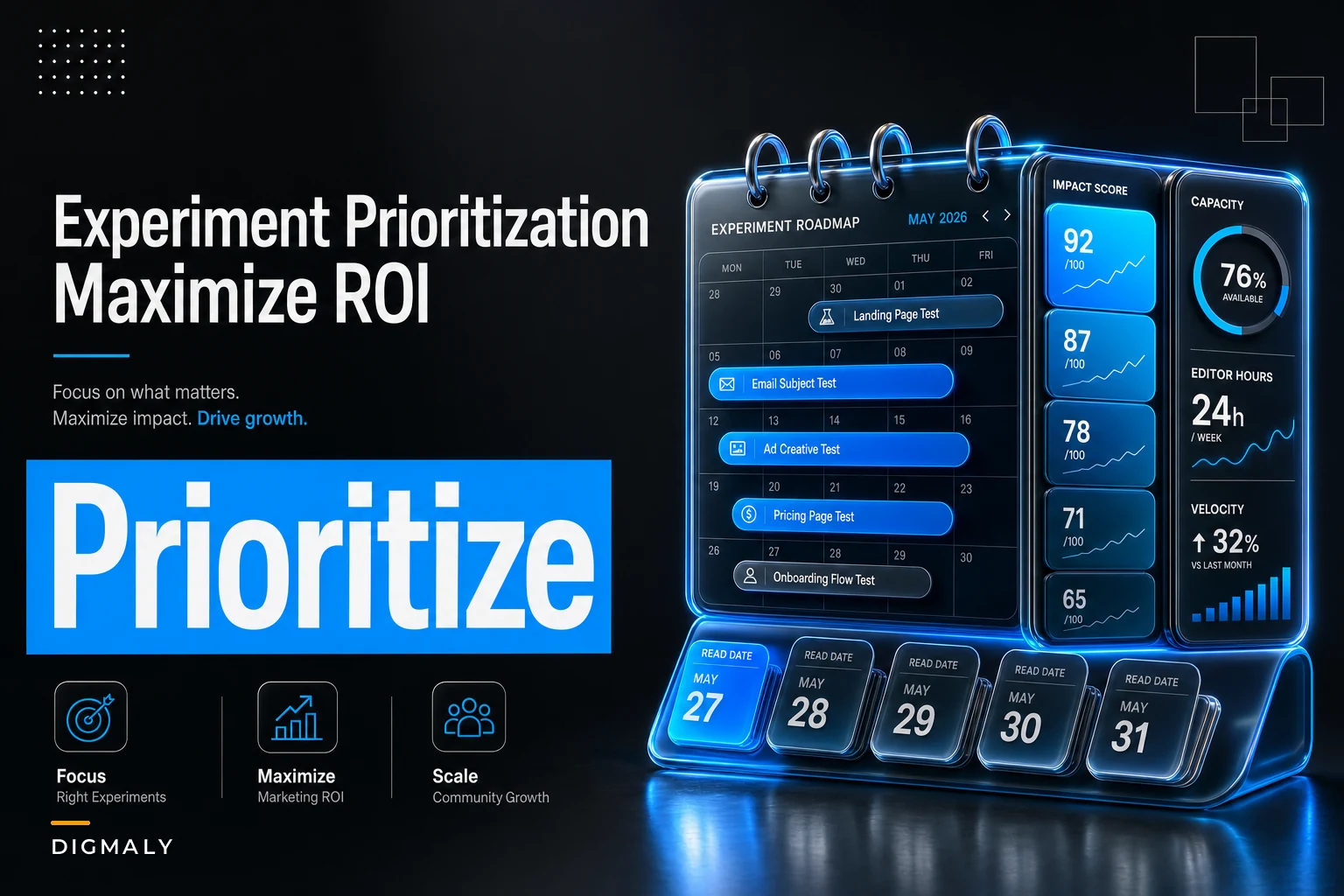

Most agencies don't have a creative testing problem. They have a creative prioritization problem. The backlog is full — 40 ideas in a Notion board, 12 Slack threads saying "we should test this," three strategists who each think their angle is the one that unlocks the account. What's missing is a defensible way to decide which five experiments run this month and which thirty wait.
The stakes are higher than people usually admit. Run the wrong five tests and you don't just waste media spend — you burn production hours, clog the pipeline, and end up with inconclusive results that teach you nothing. Three months later the client asks "so what have we learned?" and the honest answer is "a bunch of stuff that didn't reach significance."
This is a scoring problem, and it's solvable with a model that's simple enough to use every week but structured enough to survive a client QBR.
The actual failure mode: loudest idea wins
Here's how prioritization usually works inside a mid-sized agency. The creative lead and account strategist get on a call. Someone pitches a bold concept — UGC testimonials, a wild hook format they saw a competitor crush. It sounds exciting. It gets greenlit. Goes into production.
Nobody asked three questions that actually matter:
-
How much will this cost to produce and run with enough budget to learn something?
-
If it wins, can we reuse the insight across other ad sets, other clients, other channels?
-
If it loses, will we even know why?
What ends up happening across a lot of accounts is that the ideas getting prioritized are the ones with the best pitch, not the best expected value. Charismatic strategists win the backlog. Quiet, boring experiments — testing a pricing callout or a new first-frame — get buried, even though those are frequently the tests that move CPA the most and transfer everywhere.
The result is a portfolio over-indexed on novelty and under-indexed on leverage. A reel of creative swings, a couple of lucky hits, and no compounding learning.
The four dimensions worth scoring
A good creative experiment scoring model doesn't need to be a data science project. It needs four inputs that force honest conversations.
Eliminate marketing chaos with streamlined campaign control.
Digmaly lets you plan, execute, and track every campaign effortlessly.
- Unified campaign management
- Real-time client reporting
- Collaborative team workflows
No credit card required
Expected impact. If this works, how much does it move the metric that matters — CPA, ROAS, hook rate, thumbstop? This is a judgment call, but it should be anchored to the account's actual numbers, not vibes. A test that might shave 15% off a $42 CPA on an account spending $80k/month is worth a lot more than one that might improve a $9 CPA on a $6k/month account.
Cost. Not just production cost — total cost to reach a conclusion. That includes the media budget required to hit a decision threshold, the production hours, and the opportunity cost of the pipeline slot. A concept requiring a three-day shoot plus $12k in media to read clearly is expensive even if the shoot itself was cheap.
Learnability. This is the one everyone skips. Can this experiment produce a clean, isolated insight? If you're changing the hook, the offer, the format, and the CTA all at once, you'll get a result but no learning. Clean tests score high. Kitchen-sink tests score low — even when they occasionally win, because the win doesn't transfer.
Reusability. If this wins, where else does the insight apply? A winning hook structure that works across five clients in the same vertical is massively more valuable than a one-off creative tied to a seasonal promo that's gone in three weeks.
The useful thing about these four dimensions is that they pull against each other. High-impact ideas are often high-cost. Highly learnable tests are often lower-impact because they're narrow. Scoring forces the tradeoff into the open instead of letting it get papered over in a pitch.
Building the score
Keep the scale tight. 1–5 for each dimension works well. 1–10 creates fake precision and endless debates about whether something is a 6 or a 7.
| Dimension | 1 (low) | 3 (medium) | 5 (high) |
|---|---|---|---|
| Expected impact | Marginal metric movement, small account | Meaningful lift on a mid-spend account | Large lift on a high-spend account |
| Cost (inverted) | Expensive shoot + heavy media to conclude | Moderate production, standard media | Cheap to produce, fast to read |
| Learnability | Many variables changed at once | One or two clean variables | Single isolated variable, clear hypothesis |
| Reusability | One-off, seasonal, single client | Reusable within the account | Reusable across clients/channels |
Cost is inverted — a high score means low cost. That keeps the math consistent so a higher total always means "do this sooner."
For the composite, don't just add them. Weight them to your situation. A boutique agency with two editors and a tight production pipeline should weight cost and reusability heavily, because capacity is the binding constraint. An agency with a deep production bench and big-budget clients can afford to weight impact harder.
-
Expected impact
35%
-
Learnability
25%
-
Reusability
25%
-
Cost (inverted)
15%
Run each experiment through the weighted score and you get a single number between 1 and 5. That number isn't the final decision — it's what reorders your backlog so the debate starts from the right place.
Turning scores into expected value
The scoring model ranks ideas. Expected value tells you whether an idea is worth running at all. These are different jobs, and skipping the second one is how agencies greenlight expensive tests that can't pay for themselves.
EV = (probability of a meaningful win × value of that win) − total cost to conclude
Say an account spends around $75k/month on a channel and currently runs at a $38 CPA. You've got a hook-reframe test. Honest estimate: maybe a 35% chance it produces a real 12% CPA improvement that holds. A 12% improvement on that spend, if it sticks for six months, is worth somewhere in the $20k–$30k range in efficiency gains depending on volume.
Take the conservative end — call the value of a win roughly $22k.
-
Probability of win
0.35
-
Value of win
~$22k
-
Expected gross value
~$7.7k
Production is light — a reframe of existing footage, maybe 6 hours of editor time. Media to reach a clean read: around $4k–$5k. Total cost: ~$6k.
EV ≈ $7.7k − $6k ≈ $1.7k positive. Worth running, but not a slam dunk.
Compare that to a flashy new concept: 60% chance of a win worth maybe $15k, but it needs a $14k shoot and $9k in media to read. Expected gross value is $9k, cost is $23k. EV is deeply negative — even though the concept is more likely to "work." This is exactly the test the loudest-idea-wins model greenlights and the EV math kills.
That gap between "likely to work" and "worth running" is where most creative budgets quietly bleed out.
When this framework actually makes sense
This level of rigor is overkill for a client spending $4k/month.
It earns its keep when:
-
A client is spending enough that a CPA improvement is worth real money (roughly $30k/month and up)
-
Your production pipeline is a genuine bottleneck and slots are scarce
-
You run creative across multiple similar accounts and reusability compounds
-
You're being asked to justify creative spend in QBRs with something better than "we felt good about it"
The whole EV calculation might be worth less than the hour it takes to run. For small accounts, just use the 1–5 scores to sort the backlog and move on.
When it's a bad idea
Don't bolt this onto a team that isn't running clean experiments in the first place. If your tests change five variables at once, the learnability score is meaningless and the EV math is built on sand. Fix the experiment design first — getting the fundamentals right with a proper A/B testing workflow matters more than any scoring spreadsheet.
Also skip it if your team will treat the score as gospel. The number is a conversation starter, not an oracle. The moment a strategist games the inputs to justify their pet idea, the whole thing rots. Scores are only as honest as the people filling them in.
Tying winners to a rollout calendar
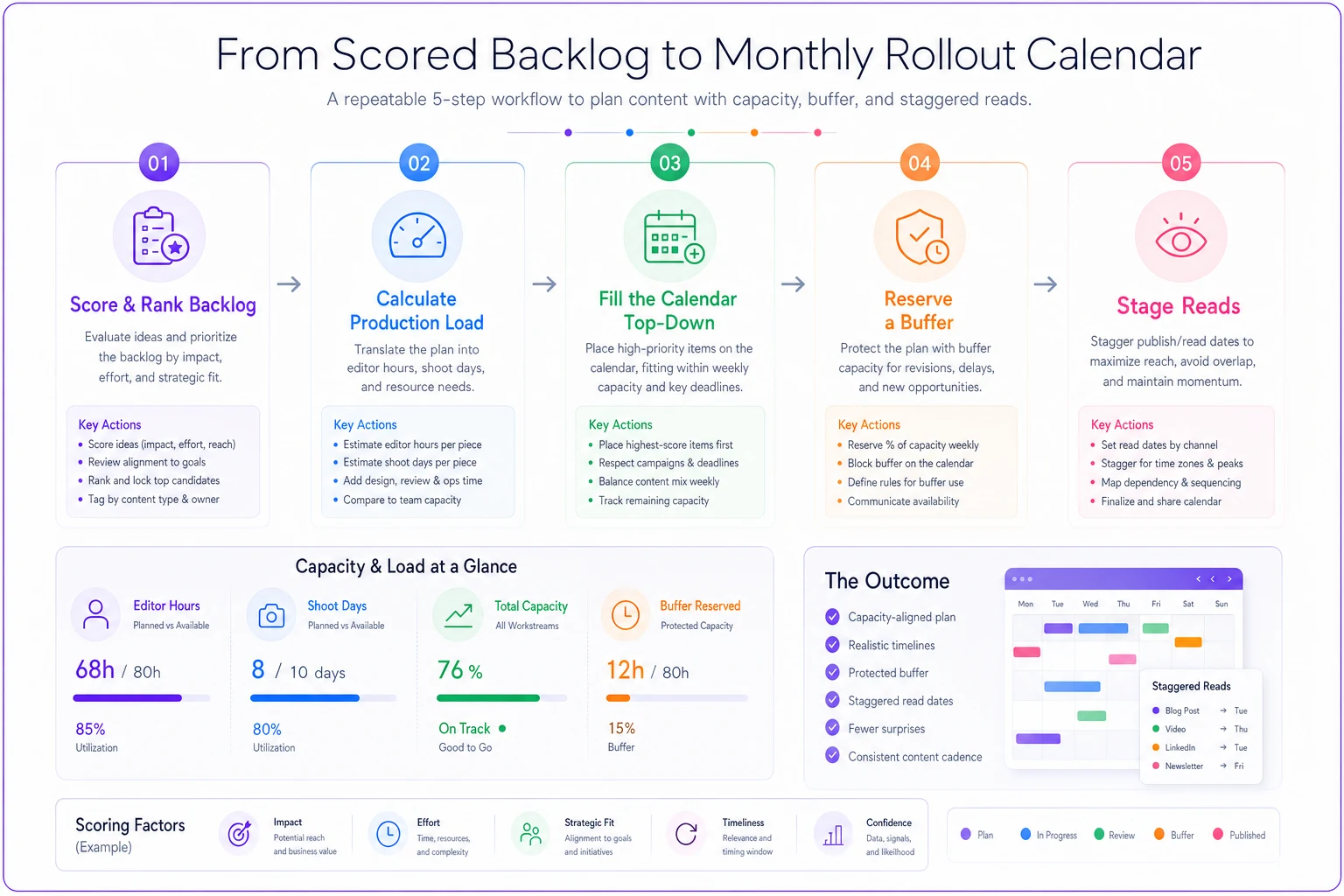
A ranked backlog is useless if it ignores what production can physically build this month. The constraint isn't ideas — it's editor hours, shoot days, and QA capacity. So the rollout calendar has to start from capacity and pull experiments off the ranked list until the capacity is full, not the other way around.
The workflow for turning a scored backlog into an actual monthly plan runs in five steps:
-
Score and rank the backlog weekly. Recompute as account numbers shift — a test's impact score changes when the account's spend or CPA changes.
-
Calculate production load for the top candidates. Each experiment carries an estimate in editor hours and shoot days. Pull these straight from your creative production SOP so estimates are consistent and not invented on the spot.
-
Fill the calendar top-down. Start with the highest-ranked positive-EV experiment, subtract its production load from available capacity, move to the next, repeat until capacity runs out.
-
Reserve a buffer. Leave roughly 15–20% of production capacity unallocated. Winning tests create scaling work — new variants, resizes, placements — and if you book to 100% you can't act on your own wins.
-
Stage the reads. Don't launch all experiments the same day. Stagger so decision points spread across the month and your analysts aren't reading eight tests in one week.
Here's a quick visual of the rollout workflow.
A simple version of a monthly rollout plan for a team with ~120 editor hours and 4 shoot days available:
| Week | Experiment | EV | Editor hrs | Shoot days |
|---|---|---|---|---|
| 1 | Hook reframe (existing footage) | +$1.7k | 8 | 0 |
| 1 | Pricing callout variant | +$2.4k | 6 | 0 |
| 2 | UGC testimonial set | +$3.1k | 20 | 2 |
| 3 | Offer-forward static batch | +$1.1k | 14 | 0 |
| 4 | Format test (vertical carousel) | +$0.9k | 16 | 0 |
| — | Buffer (scaling winners) | — | ~22 | 2 |
The buffer row is the one agencies cut first and regret most. When week 2's UGC set wins, you need those week-4 hours to scale it — not to launch another speculative test.
A quick checklist before any experiment enters the calendar
Run every proposed experiment through these seven questions before it gets a calendar slot. If it can't clear them all, it stays in the backlog — not killed, just not scheduled yet.
-
Does it have a single, written hypothesis?
-
Is there one primary variable being tested?
-
Do we have a production-hour estimate from the SOP, not a guess?
-
Is the EV positive at conservative assumptions?
-
Do we know where a win reuses?
-
Is there a defined decision threshold and read date?
-
Does it fit the remaining capacity for the month?
These aren't bureaucratic hoops. They're the minimum viable conditions for a test to actually teach you something.
A real scenario
A performance agency managing a mid-market ecommerce brand — around $90k/month in paid social — was running about 10–12 creative tests a month. Most were greenlit by the creative director based on instinct. Results were scattered. About half the tests never reached a clean conclusion because budget was spread too thin across too many concepts.
They moved to a scored backlog with EV gating. The immediate effect wasn't more tests — it was fewer. They dropped to around 6 experiments a month, but each one got enough budget to actually read clearly. Three of the six tests they killed that first month were ones the EV math flagged as negative before a single dollar was spent.
Over the following quarter, the rate of conclusive tests went from roughly half to something closer to 80%. Because reusability was now a scored dimension, two winning hook structures got redeployed across three other accounts in the same vertical. The client's blended CPA improved in the mid-teens percent range — not from one magic creative, but from running fewer, cleaner, higher-leverage experiments.
The team's own summary was pretty blunt: they weren't being more creative. They were just stopping themselves from spending money on tests that couldn't win.
The point
A solid creative experiment prioritization process isn't about killing bold ideas. It's about making sure bold ideas have to clear the same bar as boring ones — and that the bar is expected value, not enthusiasm. Score the four dimensions, run the EV math on anything expensive, and never build a rollout calendar that ignores what your production team can physically ship.
Do that consistently and the backlog stops being a graveyard of good intentions. The next five tests become the right five tests. The budget goes further not because you found better creative, but because you stopped funding experiments that were never going to teach you anything.
Do that consistently and the backlog stops being a graveyard of good intentions. The next five tests become the right five tests. The budget goes further not because you found better creative, but because you stopped funding experiments that were never going to teach you anything.
Ready to elevate your agency's performance?
Join 2,000+ agencies using Digmaly to save time, boost efficiency, and deliver superior client results.