



Most agency churn doesn't happen in the cancellation call. By the time a client types "we've decided to pause," the decision was made two or three weeks earlier — usually after a quiet buildup of unanswered Slack messages, a report that landed late, and one strategy call where nobody on your side had a clear answer.
The frustrating part is that almost every churn has a warning trail. The client went quiet. Response times stretched. Their satisfaction score dipped half a point and nobody flagged it. The signals were there — they just weren't anyone's job to watch.
This is a playbook for building the early-warning system, the ownership rules, and the scripted recovery offers that turn "we're churning" into "we're staying, with a clearer plan." Not a motivational pep talk. The actual mechanics.
The three signal categories that predict churn weeks early
Churn almost never shows up first in revenue. It shows up in behavior. And behavior is measurable if you decide to measure it.
There are three early-warning categories worth tracking, and they tend to fire in this order:
1. Performance signals. The campaign stops delivering against the thing the client actually cares about. Not your internal KPIs — theirs. An e-commerce client cares about ROAS and new-customer revenue. A B2B client cares about qualified leads, not clicks. When the metric they bought starts sliding for two reporting periods in a row, that's signal one.
2. Communication latency signals. This is the most underused predictor. How long does it take the client to reply to you, and how long do you take to reply to them? When a normally-responsive client starts taking three days to answer a one-line question, something shifted internally. Maybe they're interviewing other agencies. Maybe their boss is asking hard questions. Either way, the latency is data.
3. Relationship/NPS signals. The softer one, but real. A quarterly pulse survey, a satisfaction score after each QBR, or even a manually-logged temperature read by the account lead after major calls.
The pattern worth internalizing: performance problems you can often fix, but latency and relationship problems are what actually kill accounts. A client will forgive a bad month if they trust you. They will not forgive feeling ignored, even during a good month.
| Signal category | What to track | Warning threshold (example) | Who owns it |
|---|---|---|---|
| Performance | Client-defined primary KPI vs. target | 2 consecutive periods below 85% of target | Account strategist |
| Comms latency | Avg client response time + your response time | Client reply time doubles from baseline | Account manager |
| Relationship | Post-call temperature read + quarterly NPS | NPS drops 2+ points, or any "detractor" score | Account lead |
The thresholds matter less than the fact that someone decided what a threshold is. Most agencies have no number that triggers action, so action never triggers until the client triggers it for them.
Why the warning signs get missed
It's rarely because the team doesn't care. It's structural.
Eliminate marketing chaos with streamlined campaign control.
Digmaly lets you plan, execute, and track every campaign effortlessly.
- Unified campaign management
- Real-time client reporting
- Collaborative team workflows
No credit card required
The account manager who'd notice the latency is buried in execution for five other accounts. The strategist who'd catch the performance dip only looks at the account the day before the report goes out. And nobody looks at the relationship signals at all because there's no field to put them in.
The reporting stack makes this worse. Most dashboards are built to show the client how things are going — not to show the agency which accounts are drifting. That's a completely different lens. A client-facing report celebrates the good weeks. An internal early-warning view surfaces the accounts you'd rather not look at. If your reporting is purely reactive, you're always explaining churn after it happens. This is exactly the shift from reactive dashboards to a reporting strategy built on KPI governance — the internal view and the client view serve different purposes and shouldn't be confused for each other.
The other quiet killer: no ownership. The strategist thinks the AM has the relationship. The AM thinks the strategist watches performance. Both assume leadership would flag something if an account were at risk. So the account slides into the gap between roles.
The triage and ownership playbook
When a signal fires, you need a pre-decided path. Deciding what to do during a crisis is how agencies panic-discount their way to zero margin.
Here's the ownership structure that works:
-
Every account has one named "health owner." Not a team. One person. Usually the account lead. They're accountable for the health score — not necessarily for fixing every problem, but for making sure a response happens.
-
Signals route to a weekly health review, not an inbox. Once a week, the health owner looks at every flagged account. Ten minutes per account, max. Green, yellow, red.
-
Yellow triggers an internal huddle. Red triggers a recovery plan. Yellow means "watch and lightly intervene." Red means "this account will churn in 30–45 days unless something changes."
-
Red accounts get a single directly-responsible individual (DRI) for recovery. This person owns the outcome and reports on it until the account is back to green or offboarded.
The gap between detection and action is the whole ballgame. Agencies that act in the first week of yellow recover accounts at a much higher rate than those that wait until things are obviously red.
A triage checklist for the health owner when an account goes yellow:
-
Has the client's primary KPI missed target two periods running?
-
Has client response time noticeably increased in the last 3–4 weeks?
-
Did the last QBR or major call feel "off," even subjectively?
-
Have we missed any committed deliverable or deadline recently?
-
Is the main champion on the client side still responsive — or have they gone quiet?
-
Is there a renewal or contract decision point in the next 60 days?
Three or more "yes" answers and you treat it as red regardless of what the dashboard says.
Here's a simple workflow to visualize the triage and ownership steps.
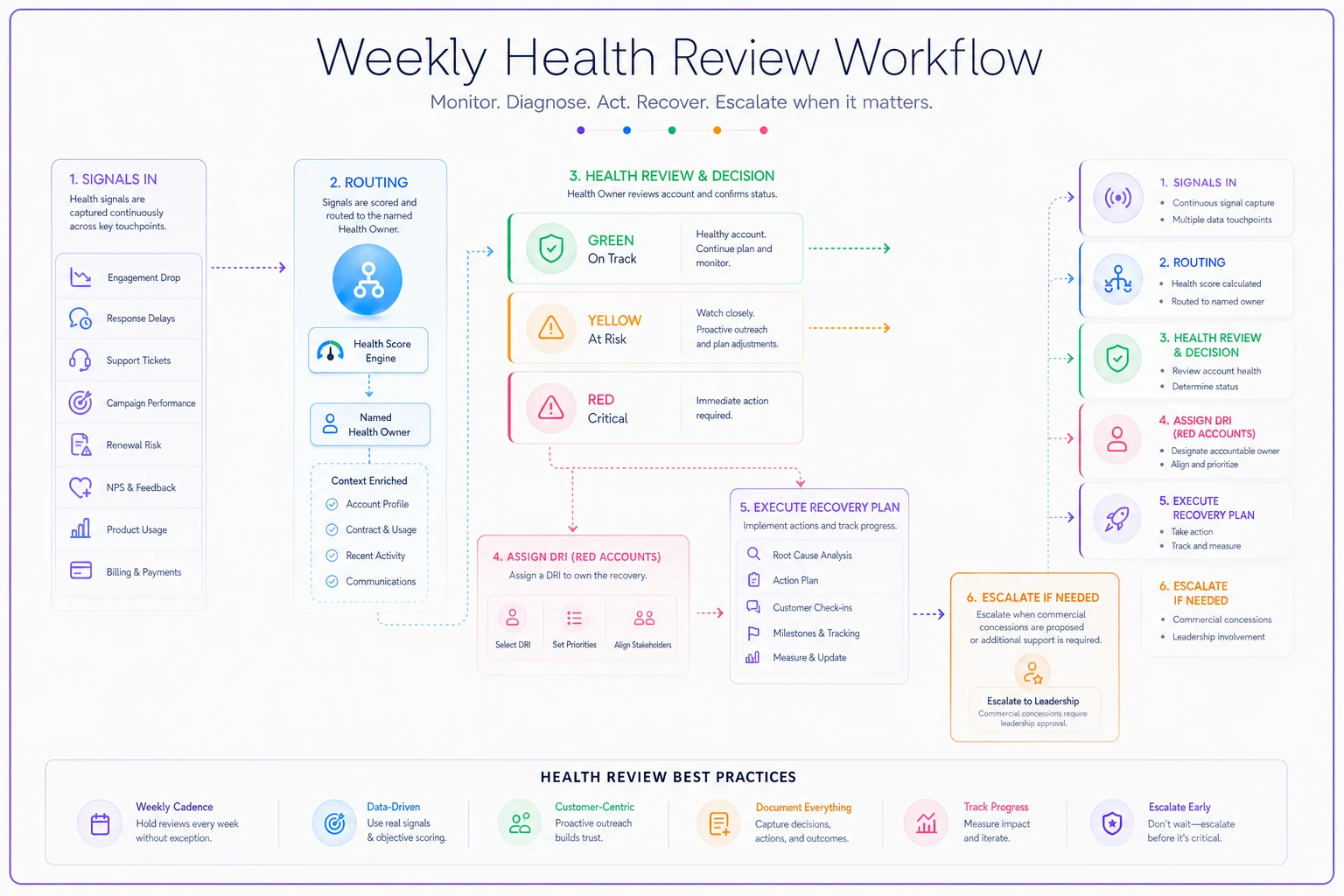
The visual maps signal detection to action so the team knows who does what and when.
Scripted recovery offers (so you stop improvising discounts)
This is where most agencies lose money. An account goes red, panic sets in, and someone offers 30% off for three months. The account stays, the margin evaporates, and you've just trained the client that threatening to leave gets them a discount.
Scripted recovery offers fix this. You build a small menu of pre-approved responses before you're under pressure, each tied to the type of problem.
Recovery offer menu (examples):
-
Performance recovery sprint. "We're reallocating senior resource to your account for the next 30 days with a specific target." No discount — more value. Best when the problem is genuinely performance-related.
-
Strategic reset session. A structured re-alignment on goals and expectations, often with a revised measurement plan. Best when the client feels the work drifted from what they actually need.
-
Scope rebalance. Shift the same budget toward work the client values more. Best when they feel they're paying for stuff that doesn't matter to them.
-
Commercial concession (last resort, governed). A temporary credit or rate adjustment, only approved above a certain level, and only tied to a renewed commitment term.
The governance piece matters: the person recovering the account should not be the person who can approve a discount. Separate those roles. The DRI proposes a recovery path; a leader approves any commercial concession. That one rule stops a lot of margin bleed.
A good recovery conversation almost never leads with money. It leads with "here's what we noticed, here's what we're changing, here's the specific outcome we're committing to." Price only enters if the relationship and performance paths are genuinely exhausted.
The hold / renew / offboard decision
Not every red account should be saved. This is the part agency owners avoid, and it costs them.
A simple governance frame:
| Decision | When it applies |
|---|---|
| Hold | Signals are early/yellow, relationship intact, problem is fixable with normal effort. Keep watching, light intervention. |
| Renew (fight for it) | Account is profitable, strategically valuable, or a strong reference — and the problem is actually solvable. Deploy a full recovery plan. |
| Offboard | Account is unprofitable and high-effort, or the relationship is beyond repair, or they want something you can't deliver. Exit gracefully. |
The common mistake: treating every at-risk account as a renew-and-fight. That dilutes recovery effort across accounts you shouldn't keep, which means the ones worth saving don't get enough attention. Deciding to offboard is itself a retention strategy — it protects capacity for clients who are actually worth it.
When you do offboard, do it cleanly. A client who leaves feeling respected refers people and sometimes comes back. A messy exit becomes a bad review.
A real scenario
A mid-sized performance agency running paid social and search for mostly e-commerce clients kept losing accounts around the 7–9 month mark. Revenue looked fine month to month, then suddenly three clients would churn in a quarter and blow a hole in the forecast.
When they mapped it out, the pattern was consistent: every churned account had gone quiet in email for a few weeks before cancelling, and most had missed their ROAS target for two reporting cycles while the internal team was still reporting "on track" against click metrics.
They put in a basic weekly health review. Each account got a named health owner, a client-defined primary KPI, a logged response-time baseline, and a temperature read after every call. Three recovery offers got pre-approved so account leads stopped improvising.
Over the following two quarters, they caught roughly five accounts in yellow that previously would have slipped to churn. They saved three with performance sprints and strategic resets — no discounting. One they deliberately offboarded after realizing it had been unprofitable the entire time. The recovered accounts represented somewhere around $11k–$14k in monthly recurring revenue that would otherwise have walked.
The interesting part wasn't the saved revenue. It was that the team finally knew which accounts were drifting before the client did.
Where this connects to the rest of your operations
Retention health doesn't live in isolation. Chaotic delivery is itself a churn signal — if your execution is unreliable, no recovery script saves you. That's why a solid campaign orchestration framework for predictable, on-time delivery sits underneath any retention playbook. You can't retain clients on top of broken delivery.
The tracking itself — response times, KPI thresholds, NPS logging — is the kind of thing that quietly falls apart when it's manual. Health reviews get skipped during busy weeks, which are exactly the weeks accounts drift. Agencies that sustain this bake the signal-watching into their workflow software so flags surface automatically and route to the right person, rather than depending on someone remembering to check. The tooling isn't the point, though. The point is that someone owns the number, and the number triggers a pre-decided action.
Churn feels sudden from the inside, but it almost never is. The account was sending signals — slower replies, a missed KPI, a flat QBR — and nobody had the job of catching them. Build the warning indicators, assign one owner per account, pre-script your recovery offers so you stop panic-discounting, and get honest about which accounts are actually worth saving. Do that, and most of your "surprise" churn turns into a problem you catch while you can still fix it.
Ready to elevate your agency's performance?
Join 2,000+ agencies using Digmaly to save time, boost efficiency, and deliver superior client results.