



Most agencies don't lose clients because the work is bad. They lose them because of what happens between the parts of the business. Sales promises something delivery didn't hear. Delivery ships great work but finance is still chasing a signed SOW three weeks later. Renewal comes up and nobody prepared for it, so the conversation happens under pressure. Then a client leaves and the account manager who owned everything walks out the door with all the context still in their head.
The frustrating part is that each individual team is usually competent. The failure is in the seams—the handoffs where one function assumes another has it handled. A client lifecycle orchestration agency approach treats the entire journey from pitch to offboard as a single connected system, with defined deliverables, checks, and ownership at every stage transition. Not a CRM stage list. An actual operating model.
The real problem: your lifecycle isn't a system, it's a relay race with dropped batons
Agencies almost always map the client journey as neat CRM stages—Lead, Proposal, Onboarding, Active, Renewal, Churned. Clean on a whiteboard. But those stages describe where the client is, not who owns the handoff or what has to be true before the client moves forward.
So what actually happens: a client signs. Sales celebrates and mentally moves on to the next deal. The deliverables promised in the pitch deck live in a proposal PDF that delivery never fully reads. Onboarding starts from a vague verbal briefing. Three weeks in, the client references "the dedicated Slack channel and weekly strategy calls" from the sales conversation, and delivery has no idea that was ever committed.
-
Sales → Delivery promises without documented scope
-
Delivery → Finance work delivered but billing triggers unclear
-
Delivery → Renewal nobody's tracking the signals that predict renewal risk until it's too late to do anything about them
-
Active → Offboard a client leaves and institutional knowledge evaporates
Each of these is a handoff. And handoffs are where accountability goes to die unless someone designs them deliberately.
Why this happens across almost every agency
Agencies grow function-first. You hire a salesperson because you need pipeline. You hire a delivery lead because you need throughput. You bring in someone to handle invoicing because chasing payments is eating your time. Each hire optimizes their own lane. Nobody's job is the space between lanes.
Eliminate marketing chaos with streamlined campaign control.
Digmaly lets you plan, execute, and track every campaign effortlessly.
- Unified campaign management
- Real-time client reporting
- Collaborative team workflows
No credit card required
At five to eight people, this works fine because everyone's in the same conversations. The founder is usually the connective tissue—they were in the pitch, they know what was promised, they nudge finance when something's off. The lifecycle runs on the founder's memory.
Cross roughly 15–20 people and that breaks. Now you have two salespeople, three delivery pods, and a finance person, and none of them share a single source of truth about what a given client was promised, what stage they're in, or what needs to happen next.
One real example: an agency doing around $2M in revenue with 18 people had a churn spike they couldn't explain. When they traced it, most departing clients had one thing in common—they churned within 90 days of a delivery team change. Nobody had a documented rule for what a knowledge handoff looked like when an account manager left. So each transition quietly reset the relationship to zero, and some clients used that reset as their exit.
That's not a people problem. That's a missing stage transition.
What actually breaks at scale
Margin leaks silently. Scope creep isn't dramatic. It's a small favor here, an extra deliverable there, because delivery doesn't have a clean record of what was actually contracted. By the time you notice, you're servicing a client at half the margin you priced.
Renewals become surprises. Without a defined checkpoint starting 60–90 days before contract end, renewal conversations happen reactively. You find out a client is unhappy when they give notice, not three months earlier when you could've fixed it.
Cash flow gets choppy. Finance is downstream of everything but usually the last to know. A milestone gets delivered, the trigger to invoice sits in someone's head, and the invoice goes out two weeks late. Multiply that across accounts and you've got a working-capital problem caused entirely by handoff lag.
Offboarding is a fire drill. A client leaves. Do you have their asset access documented? Are there deletion obligations? Does the case study get captured while the results are fresh? Almost never. The knowledge and the goodwill both walk out at once.
The connective failure across all of these is the same: nobody defined what "done" means at each stage, and nobody assigned who owns confirming it before the client advances.
The better system: a single lifecycle model with gates and ownership
The fix isn't more meetings or a fancier CRM. It's defining your lifecycle as a sequence of stages where each stage has required deliverables, a governance check, and a named owner for the handoff into the next stage. A client cannot advance until the gate is cleared.
Think of it as service level objectives applied to your own internal process, not just to client-facing work. Here's the backbone:
| Stage | Required deliverables | Governance check (gate) | Handoff owner |
|---|---|---|---|
| Pitch → Signed | Scoped proposal with itemized deliverables, pricing tied to capacity | Deal review: does delivery have capacity? Is scope realistic? | Sales lead → Delivery lead |
| Onboarding | Signed SOW, access provisioned, kickoff completed, tracking verified | Onboarding checklist 100% complete before "Active" | Delivery lead |
| Active delivery | Deliverables shipped per cadence, billing triggers logged | Monthly health review, margin check | Account owner → Finance |
| Renewal gate | Value recap, results narrative, capacity check for next term | 90-day pre-renewal review; risk score assigned | Account owner → Sales |
| Offboard | Access revoked, data handled per policy, knowledge captured, case study drafted | Offboard checklist complete, no open financials | Account owner → Finance + Ops |
The magic isn't the table. It's the rule that a stage transition is a decision, not a default. Someone has to actively clear the gate. That single change eliminates most of the dropped-baton failures.
The pitch-to-onboarding handoff (where most damage starts)
This is the transition worth over-investing in. The moment a deal is signed, the handoff should force a structured transfer: every promise made verbally or in the deck gets documented into the scope, delivery confirms it's achievable within capacity, and any gap between "sold" and "scoped" gets reconciled before onboarding begins—not discovered in week three.
Your onboarding stage then can't be considered complete until the operational fundamentals are actually verified. A rigorous paid media onboarding checklist to stop launch delays and broken tracking becomes the gate itself—not a nice-to-have, but the literal condition for moving a client into "Active." If tracking isn't verified and access isn't provisioned, the client doesn't advance. Full stop.
A simple diagram helps visualize the gates and handoffs.
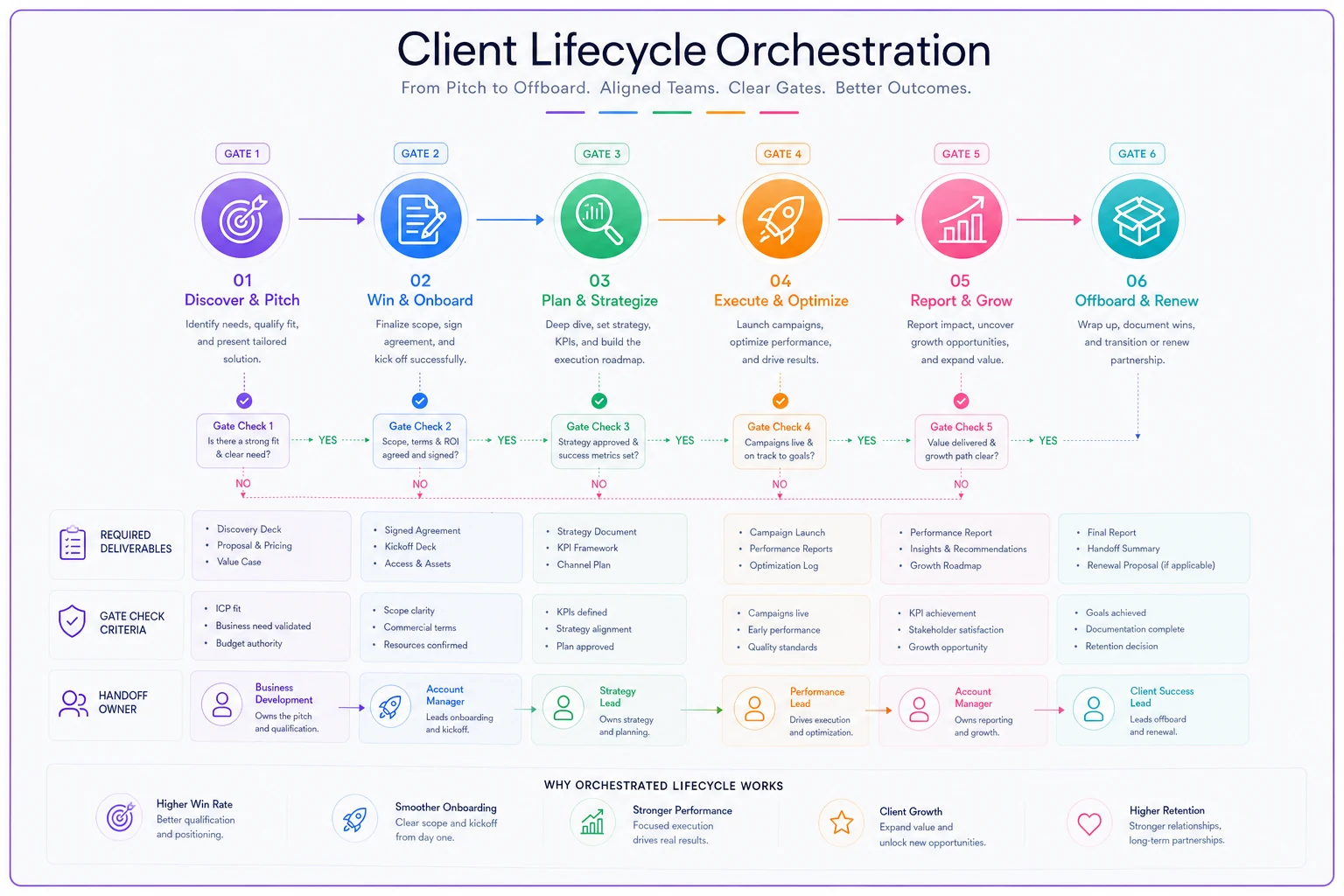
The diagram reinforces that a stage transition must be actively cleared by the named owner before the client advances.
A worked walkthrough of one stage transition
The renewal transition is the one agencies handle worst, so it's worth making the gate idea concrete.
Say a client is on a 12-month retainer ending in March. In an unorchestrated agency, someone remembers in late February that renewal is coming, scrambles to pull together a results summary, and has an awkward "so, are we continuing?" call two weeks before the contract lapses.
In an orchestrated model, the renewal gate triggers at the 90-day mark—early December. Here's what that kicks off:
-
Risk scoring. The account owner assigns a renewal risk score based on real signals: engagement on calls, deliverable satisfaction, results versus the goals set at onboarding, and any billing friction. This ties directly to the momentum built in your post-launch optimization roadmap—if you captured early wins and documented them, the value story is already half written.
-
Value narrative assembly. A results recap gets drafted showing what was promised at onboarding versus what was delivered. Not raw dashboards—the actual story.
-
Capacity confirmation. Delivery confirms whether the account can be serviced at current or expanded scope next term. No renewing into a team that's already overloaded.
-
Commercial prep. Sales and finance align on pricing, any changes, and payment terms before the conversation, not during it.
-
The renewal conversation. A confident, prepared discussion happening with 60+ days of runway to address any issues surfaced by the risk score.
The difference in outcome is meaningful. You're not scrambling for a renewal at the eleventh hour—you're managing it as a planned event with time to fix problems if they surface.
The offboard stage almost nobody designs
Every agency has an onboarding process. Almost none have a real offboard process. That's a mistake, because offboarding does two things that directly affect future revenue: it protects you legally and operationally, and it captures knowledge and goodwill you'd otherwise lose entirely.
A proper offboard gate should require:
-
Access and credential revocation documented and verified—no lingering admin access to a former client's ad accounts or analytics
-
Data handling per policy—deletion or export handled according to contractual and legal obligations, with evidence retained
-
Financial closeout—final invoices sent, no open balances, deposits reconciled
-
Knowledge capture—a written account summary so that if the client ever returns (more do than you'd expect), you're not starting from scratch
-
Case study or testimonial capture—done while results are fresh and the relationship is still warm, even if the client is leaving on neutral terms
-
Exit interview—a short, honest conversation about why they're leaving, fed back into your process. Churn reasons are some of the cheapest product research you'll ever get
A clean offboard turns an ending into an asset. A messy one turns it into risk and a lost referral.
Knowledge capture: the rule that makes the whole thing survive turnover
Everything above collapses if the knowledge lives in individual heads. The most underrated part of a lifecycle model is this: knowledge capture is a deliverable at every stage, not an afterthought.
Each stage produces a durable artifact—the signed scope, the onboarding record, monthly health notes, the renewal narrative, the offboard summary. When an account owner leaves, their replacement inherits a documented account, not a folder of scattered files and a vague handover email.
Agencies that survive team turnover without churning clients are the ones where any account can be picked up by someone new and understood in an afternoon. That's only possible when knowledge capture is tied to stage transitions themselves, so it happens as a byproduct of normal work rather than a separate task everyone quietly skips when things get busy.
Where tooling actually fits (and where it doesn't)
You don't need software to define this model—you need clarity on stages, gates, deliverables, and owners first. Buying a tool before you've designed the process just gives you an expensive place to store confusion.
That said, once the model exists, the manual overhead of running it is real. Tracking renewal triggers, confirming gates are cleared, making sure billing fires when a milestone ships, ensuring the offboard checklist actually gets completed—this is exactly the kind of coordination that eats hours and gets skipped when everyone's slammed. AI-assisted operational platforms help here by automatically surfacing the right stage checks, flagging when a gate hasn't been cleared before a client advanced, and keeping deliverable records and handoff notes centralized so nothing depends on someone's memory. The value isn't automation for its own sake—it's that the gates actually get enforced instead of quietly bypassed.
But the tool serves the model. Not the other way around.
When this level of orchestration makes sense—and when it doesn't
When it makes sense: You're past roughly 12–15 people, running multiple accounts across separate delivery teams, and the founder can no longer be the connective tissue. If you've had unexplained churn, renewal surprises, or billing that consistently lags delivery, you're already paying the cost of not having this.
When it's overkill: You're a four-person shop with five clients and everyone's in every conversation. Formalizing gates and stage owners at that size adds bureaucracy you don't need yet. A lightweight version—just documenting the pitch-to-delivery handoff and the offboard—is plenty.
Who should not do this: Anyone trying to install the full model overnight across a resistant team. This gets adopted stage by stage. Start with your worst handoff—usually pitch-to-onboarding or the renewal gate—prove it reduces pain, then expand. Rolling out all five gates at once just produces a beautiful document nobody follows.
A short real scenario
A performance agency around 22 people, roughly $2.4M in revenue, was losing clients faster than they could explain. Retention hovered somewhere around 60% annually, and renewals kept catching them off guard—accounts they thought were solid would quietly decide not to continue.
They didn't overhaul everything. They implemented two gates: a structured pitch-to-onboarding handoff with a completion checklist, and a 90-day renewal gate with risk scoring. Within about two quarters, the renewal surprises mostly stopped—not because clients suddenly loved them more, but because problems surfaced 60–90 days earlier when there was still time to act. Retention climbed into the low 70s over the following year.
Their delivery quality hadn't changed. The work was always good. What changed was that the connections between sales, delivery, and finance stopped leaking.
Pulling it together
The client journey isn't a series of independent phases owned by independent teams. It's one continuous system, and the value—or the damage—lives in the transitions between stages. Sales promises, delivery executes, finance bills, and someone eventually offboards, and every one of those handoffs is a place where accountability either transfers cleanly or gets dropped.
Designing your lifecycle with defined deliverables, real gates, named handoff owners, and knowledge capture at every stage is what separates agencies that scale smoothly from ones that grow into chaos. You don't need to build all of it at once. Pick your worst handoff, put a gate on it, and make sure someone actually owns clearing it. Then move to the next one. Closing those seams, one at a time, is the difference between a business that runs on process and one that runs on the founder remembering everything.
The client journey isn't a series of independent phases owned by independent teams. It's one continuous system, and the value—or the damage—lives in the transitions between stages. Sales promises, delivery executes, finance bills, and someone eventually offboards, and every one of those handoffs is a place where accountability either transfers cleanly or gets dropped.
Designing your lifecycle with defined deliverables, real gates, named handoff owners, and knowledge capture at every stage is what separates agencies that scale smoothly from ones that grow into chaos. You don't need to build all of it at once. Pick your worst handoff, put a gate on it, and make sure someone actually owns clearing it. Then move to the next one. Closing those seams, one at a time, is the difference between a business that runs on process and one that runs on the founder remembering everything.
Ready to elevate your agency's performance?
Join 2,000+ agencies using Digmaly to save time, boost efficiency, and deliver superior client results.