



Most agency OKR systems die quietly. They get written at a Q1 offsite, live on a nice Notion page for about three weeks, then get abandoned the moment someone's biggest client threatens to churn and everyone drops the "strategic goals" to go fight fires.
The problem isn't the OKRs themselves. It's that the gap between a company objective like "become the retention leader in our niche" and what an account manager actually does on Tuesday at 2pm is enormous. Nobody builds the connective tissue. So the OKRs float at the top, the account KPIs grind away at the bottom, and the two never really touch.
If you've ever asked "why aren't we hitting our goals?" while every individual dashboard looked green, you've met this gap. Everyone's busy, everyone's shipping, and the agency still isn't moving in the direction leadership picked. That disconnect is almost always a cascading failure, not an effort failure.
This isn't a list of OKR tips. The goal here is to show how objectives, account-level KPIs, governance cadences, tooling, and compensation actually link together so outcomes become predictable instead of hopeful.
Why the cascade breaks (and it's usually the same spot)
Leadership sets objectives that are directional and qualitative. Accounts run on metrics that are tactical and quantitative. The translation layer between them is missing, so people improvise.
An objective like "drive measurable client outcomes that reduce churn" sounds clear until you try to cascade it. Does that mean the paid search team should optimize for ROAS? Should the account lead push for a bigger retainer? Should the strategist run more QBRs? Three people read the same objective and build three unrelated plans. None of them are wrong, but none of them add up to the objective either.
The cascade typically breaks at the account-team boundary. The company OKR flows fine down to the department head. The department head translates it into a department OKR. Then it hits 25 individual accounts, each with its own client, its own contract scope, its own health status — and the clean logic collapses. A struggling account and a thriving account cannot both chase the same key result the same way.
That's the core insight most OKR frameworks miss for agencies specifically: your delivery unit is the account, and accounts aren't uniform. You can't cascade like a product company where every team ships into the same roadmap. You have to cascade into a portfolio of very different situations.
The cascade that actually holds: objective → portfolio theme → account KPI
Instead of forcing every account to chase the same number, the cascade that works introduces a middle layer: portfolio themes.
Eliminate marketing chaos with streamlined campaign control.
Digmaly lets you plan, execute, and track every campaign effortlessly.
- Unified campaign management
- Real-time client reporting
- Collaborative team workflows
No credit card required
A portfolio theme is how a company objective expresses itself across a group of accounts with similar characteristics. You segment accounts, then translate the objective differently for each segment.
Here's how the three-layer flow works in practice. Each level gets progressively more concrete and closer to what someone can actually do this week.
Company Objective ↓ Portfolio Theme (per account segment) ↓ Account KPI (owned by account team) ↓ Individual Contribution (tasks + weekly rituals)
-
Company objective — the directional goal. Example
"Build a reputation for retention so we can raise prices by renewal time."
-
Portfolio theme — how that objective applies to a segment of accounts. Growth accounts, at-risk accounts, and mature accounts each get a different theme derived from the same objective.
-
Account KPI — the measurable target the account team owns this quarter, chosen because it moves the theme.
So the same retention objective cascades like this:
-
At-risk accounts → theme
"stabilize and rebuild trust" → KPI: lift health score above threshold, two clean QBRs delivered, zero missed SLAs this quarter.
-
Growth accounts → theme
"expand footprint with proof" → KPI: one documented case-study-worthy result, one upsell conversation booked.
-
Mature/stable accounts → theme
"protect margin and renew early" → KPI: renewal secured 60+ days before term, scope creep kept under control.
None of those account KPIs are "reduce churn." They're the inputs that produce the objective. That's the difference between a system that actually cascades and one that just restates the same vague goal at every level.
The mistake almost everyone makes is cascading the outcome (churn, revenue, NPS) all the way down to teams who can only influence inputs. You end up holding an account manager accountable for a lagging number they can't directly move in 90 days. Cascade inputs down, roll outcomes up.
Here's a quick visual that summarizes the flow across objective, portfolio theme, account KPI, and individual contribution.
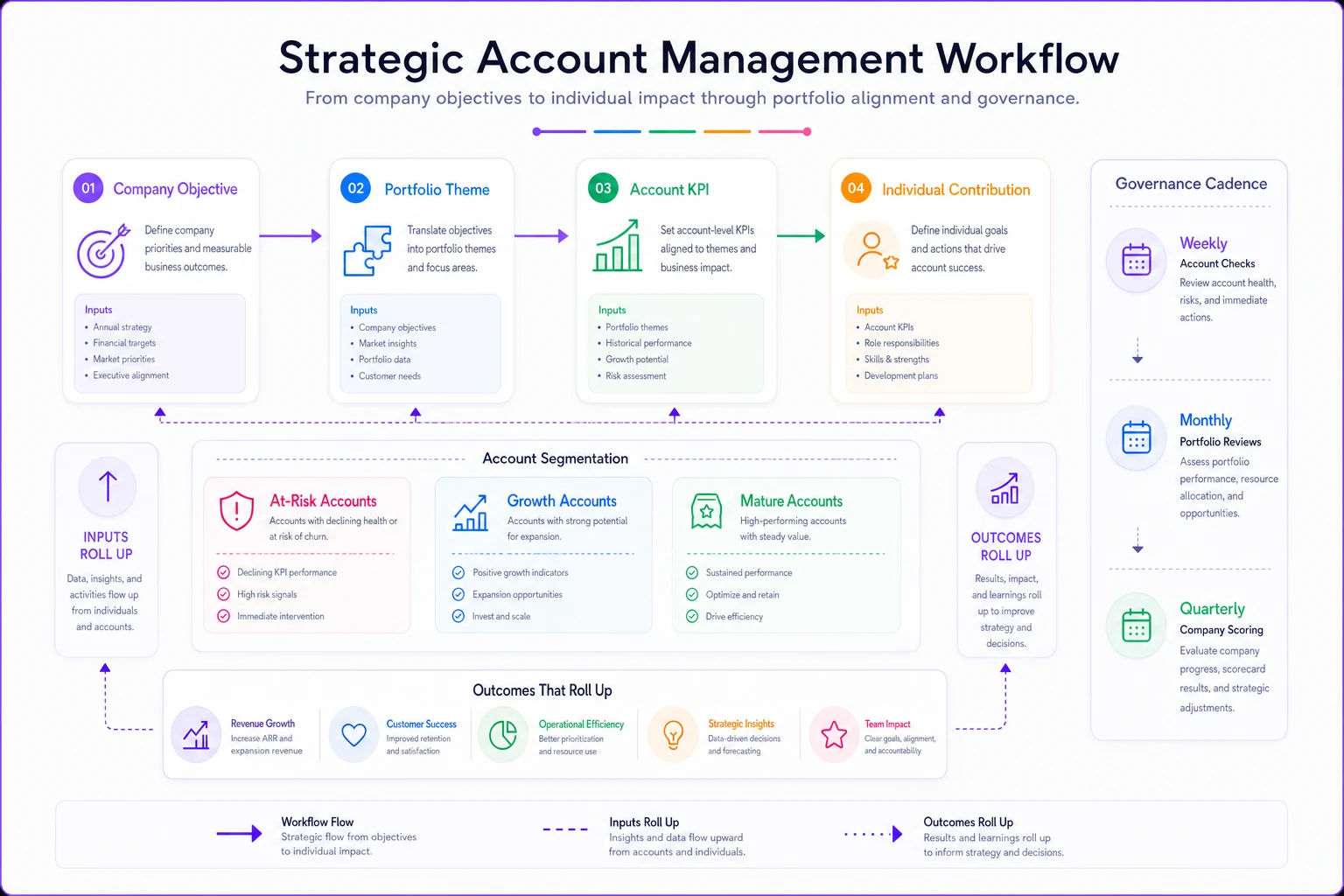
Broken down:
What each layer should actually own
There's a useful way to think about ownership at each layer. As you move down the cascade, the time horizon shrinks and the degree of direct control increases. Leadership owns slow, uncontrollable outcomes. Account teams own fast, controllable inputs. If you've flipped that — holding leadership accountable for weekly metrics or teams accountable for annual outcomes — the system fights itself.
The table below lays out the ownership, time horizon, measurement, and review cadence for each layer.
| Layer | Owns | Time horizon | Measured by | Reviewed |
|---|---|---|---|---|
| Company objective | Direction + the "why" | Annual, revisited quarterly | Lagging outcomes (churn, margin, revenue) | Quarterly |
| Portfolio theme | Segment strategy | Quarterly | Mix of leading + lagging | Monthly |
| Account KPI | Deliverable inputs | Quarterly, tracked weekly | Leading indicators the team controls | Weekly / bi-weekly |
| Individual contribution | Tasks + rituals | Weekly | Completion + quality | In 1:1s |
One thing worth flagging: agencies love to assign the same KPI to both the account lead and the strategist. Shared ownership of a number usually means nobody owns it. Pick one accountable person per KPI, even if three people contribute.
Governance: the cadence is the system
OKRs don't fail in the writing. They fail in the weeks between reviews, when everyone's heads-down and nobody's checking whether the inputs are actually producing the outcome. The cadence is what keeps the cascade alive.
A cadence that holds up across a growing agency looks roughly like this:
-
Weekly, account level — account team checks leading KPIs. Are we on pace? What's blocked? This is a 15-minute status, not a meeting. It catches drift while it's still cheap to fix.
-
Monthly, portfolio level — department heads review themes. Which segments are tracking, which aren't, what needs reallocation? This is where you move resources between accounts, which weekly reviews can't see.
-
Quarterly, company level — leadership scores objectives, retires what's done, resets themes. This is also where comp-linked results get confirmed.
The monthly portfolio review is the one most agencies skip, and it's probably the most valuable. Weekly reviews are too zoomed-in to see the portfolio. Quarterly reviews are too late to fix anything. The monthly rhythm is where you notice that your at-risk segment is sliding while your growth segment is crushing it — and you move a senior person before a renewal gets lost.
A governance habit worth adopting: every review answers "what's the confidence level?" not just "what's the number?" A KPI at 60% of target with high confidence to land is healthier than one at 85% that's stalled. Confidence calls surface problems a raw percentage hides.
For a deeper framework on which metrics belong at leadership reviews versus account reviews, the agency operational scorecard breaks down the leadership metrics that predict scale rather than just describe it.
Tooling: keep it boring, keep it connected
Agencies tend to overcomplicate this. They buy a dedicated OKR platform, fill it in once, and never look at it again because it's disconnected from where work actually lives. The OKR tool becomes a second source of truth that contradicts the real dashboards.
The practical stack has three jobs, and you can probably fill them with tools you already own:
-
A planning layer — where objectives, themes, and KPIs are written and owned. A structured doc or lightweight OKR tool is fine. The main requirement is that each KPI has one owner and a target.
-
A measurement layer — where account KPIs get read from live data, not manually typed in. If your numbers are being copy-pasted by hand into the OKR tool every Friday, the system will rot within a quarter. Automated pulls from your reporting stack are what keep the numbers trustworthy.
-
A review layer — the recurring meeting structure and the dashboard everyone looks at during governance. This is where confidence calls and reallocation decisions get logged.
Automate KPI pulls from your reporting stack first — measurement drift breaks governance faster than any process gap.
The connection between these layers matters more than any single tool. A common failure: the planning layer says "ROAS above 3.0" but the measurement layer calculates ROAS differently than the client-facing report does. Now you have three numbers for the same KPI and governance meetings turn into reconciliation arguments. KPI definitions have to stay consistent across the OKR system and client reporting — that's a governance rule, not a tooling one.
If reactive, disconnected dashboards are your current reality, this piece on ending reactive dashboards covers the move toward governed, narrative-driven reporting — and the same KPI-governance discipline is what makes an OKR cascade trustworthy.
Linking compensation without poisoning the system
This is where most agencies either chicken out entirely or go too hard and break behavior.
Comp-linkage done wrong turns account KPIs into numbers people game. Tie a bonus purely to ROAS and watch people quietly cut branded terms, awareness work, anything that doesn't juice the measured metric this quarter. Tie it purely to retention and watch people over-service unprofitable accounts to avoid churn on their watch. Every single-metric comp link produces a predictable distortion.
The templates that hold up share a few principles:
-
Weight toward inputs the person controls, not outcomes they influence. An account lead's comp should lean on the KPIs they own — clean delivery, early renewals, health-score movement — not the company-level churn number.
-
Use a blended scorecard, not a single trigger. Three to four weighted components make gaming harder because you can't tank one area to spike another.
-
Cap the downside, gate the upside. A quality gate — no SLA breaches, no client escalations — that must be cleared before any OKR bonus pays out. This stops people from hitting numbers by burning clients.
A simple comp-linkage structure for an account lead might look like this. The order matters — the quality gate is listed last but it functions as a prerequisite, not just another weighted component.
-
40% — account KPI attainment (the input metrics they own this quarter)
-
25% — portfolio theme contribution (did their accounts move the segment goal)
-
20% — delivery quality gate (SLA, escalations, governance participation)
-
15% — one qualitative leadership-scored component (judgment, teamwork, process improvement)
The quality gate as a gate, not just a weight, is the important part. If someone clears their numbers but breached SLA three times and burned a client relationship, the gate caps the payout regardless of the other scores. That single rule prevents most of the bad behavior that comp-linked OKRs usually create.
A real scenario
A mid-sized paid media agency — roughly 30 people, somewhere around 40 active accounts — had quarterly OKRs that nobody could connect to daily work. Leadership wanted to lift net revenue retention. Account teams had no idea what that meant for them, so they kept doing what they always did.
They introduced the three-layer cascade. Accounts got segmented into at-risk, stable, and growth. Each segment got its own theme and account KPIs built from inputs teams actually controlled — early renewal conversations, health-score recovery, documented wins. Governance shifted to weekly account checks, monthly portfolio reviews, quarterly company scoring. Comp got a blended scorecard with a hard quality gate.
The first quarter was messy. In the second quarter, the monthly portfolio review caught two at-risk accounts sliding early enough to reassign a senior strategist before renewal — both stayed. Over about three quarters, net revenue retention moved from the low 90s into the high 90s. Maybe more telling, leadership stopped being surprised at quarter-end. The numbers at the top finally matched what the account teams had been reporting all along, because everyone was now reading from the same definitions.
Nothing heroic happened. It was just the cascade finally holding together instead of leaking at the account boundary.
When this makes sense — and when it doesn't
This makes sense when you're past the point where one person can hold the whole agency in their head. Usually that's somewhere north of 15–20 people and enough accounts that leadership can't personally track each one. At that scale, the cascade and governance cadence replace the founder's intuition.
This is a bad idea when you're a 5-person shop with 8 accounts. You don't need a three-layer OKR cascade — you need a weekly conversation. Bolting heavy governance onto a tiny team adds ceremony without adding clarity, and people will resent it.
Who should not do this yet: agencies whose KPI definitions aren't stable. If your ROAS, retention, or health-score calculations are still being argued about account by account, fix the measurement discipline first. An OKR cascade built on numbers people don't trust just moves the arguments into the governance meeting. Get your definitions consistent, then cascade.
The thing to remember
A working agency OKR system isn't a document. It's a chain: company objectives translate into portfolio themes, themes translate into account KPIs the team actually controls, governance cadences keep the chain honest between quarters, and compensation reinforces the right inputs without rewarding people for gaming the outputs.
Break any link and the whole thing reverts to the default — green dashboards everywhere and a company that isn't really going anywhere. Keep the links connected, review on a real cadence, and the agency starts moving in the direction you actually picked, predictably, quarter after quarter. That predictability is the entire point.
A working agency OKR system isn't a document. It's a chain: company objectives translate into portfolio themes, themes translate into account KPIs the team actually controls, governance cadences keep the chain honest between quarters, and compensation reinforces the right inputs without rewarding people for gaming the outputs.
Ready to elevate your agency's performance?
Join 2,000+ agencies using Digmaly to save time, boost efficiency, and deliver superior client results.