


Most agencies think they have an incident problem. What they usually have is a handoff problem wrapped inside an incident.
The tracking pixel breaks at 9:14 a.m. Someone in Slack notices conversions dropped. A junior analyst spends 40 minutes confirming it's real. An account lead panics and calls the client before anyone understands what happened. By the time the fix ships, three people have three different versions of the story, the client is furious, and nobody wrote down a single thing that could later justify not issuing an SLA credit.
That's the real cost. Not the outage itself — the fumbled chain between detecting it, proving what happened, communicating it, fixing it, and closing the commercial loop. Agency incident management lives or dies in that chain, and almost every agency handles each link as a separate ad-hoc scramble instead of one connected lifecycle.
This post is about the lifecycle. How detection feeds an evidence bundle, how that bundle drives client comms and your root cause analysis, and how the RCA gates your SLA remediation so you don't hand out credits you didn't owe — or worse, get exposed on ones you did. When these pieces connect properly, mean time to resolution (MTTR) drops and, more importantly, so does the commercial and reputational fallout that outlasts the actual outage.
The lifecycle nobody actually runs end to end
Here's the sequence a mature agency incident process moves through:
Detection → Evidence bundle → Client comms → RCA → SLA remediation gating → Billing-ready artifacts.
Sounds obvious written out. In practice, agencies run maybe two or three of these well and improvise the rest. The improvised links are where trust and margin leak.
Here's where each stage typically breaks.
Detection: the alert exists, the ownership doesn't
Detection is rarely the technical failure point — most teams have some alerting on spend, conversions, or pixel fires. The failure is that detection produces noise nobody owns. An alert fires, it lands in a channel with 60 people, and everyone assumes someone else is handling it.
The pattern that shows up constantly: the first 20–45 minutes of an incident are spent deciding whether it's actually an incident. That ambiguity is pure MTTR waste. A real detection layer doesn't just fire — it assigns severity and an owner in the same motion. If your alerting can't say "this is a Sev-2, it's assigned to the ad ops on-call, and the clock started at 9:14," you don't have detection. You have a smoke alarm with no fire department.
If you're still figuring out what actually deserves an alert versus background noise, the triage logic in our automated anomaly investigation playbook is what feeds a clean signal into this whole lifecycle. Bad detection poisons everything downstream.
The evidence bundle: the step everyone skips and later regrets
This is the most underrated stage, and it's the one that separates agencies that survive disputes from agencies that eat costs they never should have eaten.
The evidence bundle is a snapshot of what was true at the moment things broke. Screenshots, spend curves, conversion timelines, pixel status, change logs, who touched what and when. The problem is that this evidence is most available in the first hour — exactly when everyone is too busy firefighting to capture it. Two days later, when the client disputes the impact or you need to prove the outage was Meta's fault and not yours, the evidence is gone. Platform dashboards have re-baselined. Nobody remembers the exact timestamps.
What a usable evidence bundle contains:
-
Timestamped detection record (when it fired, who acknowledged it)
-
Before/during/after metric snapshots (not links — actual captured values)
-
Change log for the affected accounts in the 72 hours prior
-
Platform-side status or error confirmation, if applicable
-
The comms sent to the client, with send times
-
The fix applied and deploy time
The real insight: your evidence bundle is simultaneously your RCA input, your client-comms proof, and your billing dispute artifact. One capture, three jobs. Agencies that treat evidence capture as a compliance chore miss that it's the single asset that protects them commercially.
Make evidence capture a required first-15-minutes step and automate timestamped screenshots where possible.
Client comms: the message that either buys goodwill or manufactures a lawsuit
Agencies get client comms during incidents backwards. They either go silent — hoping to fix it before the client notices — or they over-share raw panic ("we think the pixel broke, we're not sure, we'll update you").
Both erode trust. Silence reads as incompetence when the client eventually finds out. Raw panic reads as chaos.
The pattern that works is staged, factual, and paced:
-
Acknowledgment (fast, low-detail)
"We've identified an issue affecting conversion tracking on your account, we're actively investigating, next update by [time]."
-
Status update (scoped)
what's confirmed, what's being ruled out, expected impact window.
-
Resolution notice
what was fixed, when, and confirmation metrics are recovering.
-
Post-incident summary
the RCA-lite, delivered when you actually understand it — not before.
The mistake that comes up most often: agencies jump straight to explaining cause during step one, before RCA is done. Then that "cause" turns out to be wrong, they walk it back, and now the client trusts nothing. Communicate status early. Communicate cause only after RCA.
RCA: stop writing fiction
Root cause analysis in most agencies is a paragraph written from memory a week later to close a ticket. That's not RCA, that's a book report.
Real RCA reconstructs the timeline from the evidence bundle — which is exactly why the bundle matters. If you captured timestamps and change logs, RCA practically writes itself: "Change X deployed at 08:52, conversion drop began at 09:04, correlation confirmed, rollback at 09:47, recovery confirmed at 10:15." If you didn't capture anything, RCA becomes guesswork, and guesswork is what you'll be arguing about when the SLA credit conversation starts.
A tight RCA answers three things and nothing more:
-
What actually happened (timeline, from evidence)
-
Why it happened (the real root, not the symptom)
-
What prevents recurrence (a concrete, owned action — not "be more careful")
The recurrence action is where agencies consistently fake it. "We'll double-check pixels going forward" is not a control. "We added a pixel-fire monitor with a 15-minute alert threshold on all Sev-2 accounts" is.
SLA remediation gating: the part that protects your margin
Here's the connection almost nobody makes: your RCA should gate your SLA remediation, not the other way around.
Eliminate marketing chaos with streamlined campaign control.
Digmaly lets you plan, execute, and track every campaign effortlessly.
- Unified campaign management
- Real-time client reporting
- Collaborative team workflows
No credit card required
In most agencies the sequence is emotional. Client's upset → account lead promises a credit to calm them down → finance finds out later and eats it. The credit gets issued before anyone knows whether the incident even breached the SLA, whether it was the agency's fault, or what the contractual remedy actually is.
Gating flips this. No credit gets committed until:
-
The RCA confirms fault and impact
-
The impact is measured against the actual SLA terms (was there a breach or just a bad day?)
-
The remedy is calculated against contract language, not vibes
This is where a real credit workflow matters. If your team is calculating credits ad hoc, you're either overpaying to keep the peace or underpaying and creating disputes. The structured approach in our SLA credit calculation and enforcement workflow shows how to tie the credit to measured breach severity so the number is defensible on both sides.
The gate does two things at once: it stops reflexive over-crediting, and it makes the credits you do issue land as fair and evidence-backed rather than negotiated. Clients argue less with a credit that comes attached to a timeline and a number they can actually verify.
A quick comparison of ungated vs gated remediation
| Dimension | Ungated (reactive) | Gated (RCA-driven) |
|---|---|---|
| When credit is decided | During the panic, verbally | After RCA confirms fault + impact |
| Basis for the number | Whatever calms the client | Contract terms × measured impact |
| Evidence attached | None | Full evidence bundle + timeline |
| Dispute frequency | High — client feels it's arbitrary | Low — number is verifiable |
| Margin impact | Unpredictable, often over-issued | Controlled and forecastable |
| Repeat exposure | Same incident, same argument | Recurrence control documented |
The ungated column is where agencies quietly bleed 2–4% of a client's monthly retainer per incident in unnecessary goodwill credits — and still lose the account six months later because the underlying fault kept recurring with no real fix in place.
Billing-ready artifacts: closing the commercial loop
The last stage turns a survived incident into a clean commercial record. Billing-ready artifacts are the paperwork that lets finance, the client, and — if it ever comes to it — a contract dispute all reference the same facts.
At minimum, an incident should produce:
-
The final RCA document
-
The evidence bundle it was built from
-
The SLA breach determination (breach / no breach, with the math)
-
The credit or remediation applied, tied to that determination
-
A recurrence-control record
When these exist as structured artifacts rather than scattered Slack threads and half-remembered calls, two things happen. Disputes get short — you send the packet, the conversation ends. And renewals get easier, because you can show a client "here's every incident this year, here's how each was handled, here's the trend." That transparency is one of the strongest retention tools an agency has. Clients don't leave agencies that own their mistakes with receipts.
A real scenario
A mid-sized performance agency, roughly 30 people, managing about $1.4M in monthly ad spend across around 40 accounts. Their incident process was: whoever noticed it, Slacked it; whoever was free, fixed it; the account lead smoothed it over with the client.
Their MTTR on tracking and spend incidents was averaging somewhere around 5–6 hours, mostly because the first two hours were just confusion about severity and ownership. Worse, they were issuing SLA credits on roughly two-thirds of incidents — many of which, when they looked closely, weren't actually SLA breaches at all. Just clients who complained loudly enough.
They rebuilt around the lifecycle. Detection now auto-assigns severity and an owner. Evidence capture became a required first-15-minutes step. Comms moved to the staged template. RCA gated every credit decision.
Within about two quarters, MTTR dropped to roughly 2 hours on the same incident types — almost all of the savings came from killing the "is this even an incident?" ambiguity. Credit issuance fell by more than half, not because they got stingy, but because the gate revealed how many "breaches" weren't. Client escalations to leadership dropped noticeably, because clients were getting paced, factual updates instead of silence followed by panic. One account they'd expected to churn actually expanded, and the account lead credited the incident transparency directly.
When this level of rigor makes sense — and when it doesn't
When it makes sense:
-
You're managing enough spend that a tracking outage has real revenue impact
-
You have SLAs with credit clauses (or clients keep asking for them)
-
Incidents are recurring and eating senior team hours
-
You've eaten credit costs you couldn't clearly justify
When it's overkill:
-
You're a five-person shop with a handful of clients and everyone already knows what's happening in real time. Formal evidence bundles for a team that fits in one Slack huddle is bureaucracy for its own sake.
-
Your incidents are genuinely rare and low-impact. Don't build a fire department for a candle.
Who should be careful adopting this: agencies that will implement the templates but not the ownership model. A perfect evidence-bundle template with no one accountable for filling it out is worse than nothing — it creates the illusion of process. The structure only works if severity, ownership, and the RCA gate have real owners.
One caution as you automate parts of this: incident detection and remediation are exactly the kind of high-stakes workflows where automation without guardrails creates new incidents. Before you wire up auto-alerts or auto-remediation, the guardrails and rollback thinking in our guide on AI governance for campaign automation will keep your incident tooling from becoming an incident source.
How the pieces actually connect
Step back and the whole thing is one data object moving through stages.
Detection creates the incident record and starts the clock. Evidence capture attaches proof to that record while it's still fresh. Client comms pulls status from that record so the account lead isn't inventing anything. RCA reconstructs the timeline from the attached evidence. The SLA gate reads the RCA to decide the remedy. Billing artifacts are just the finished record, exported.
The reason agencies struggle isn't that any single stage is hard. It's that they store each stage in a different place — detection in a monitoring tool, evidence in someone's screenshots folder, comms in email, RCA in a doc, credits in a spreadsheet, billing in the finance system. Nothing references anything else, so every stage rebuilds context from scratch. That rebuild is your MTTR.
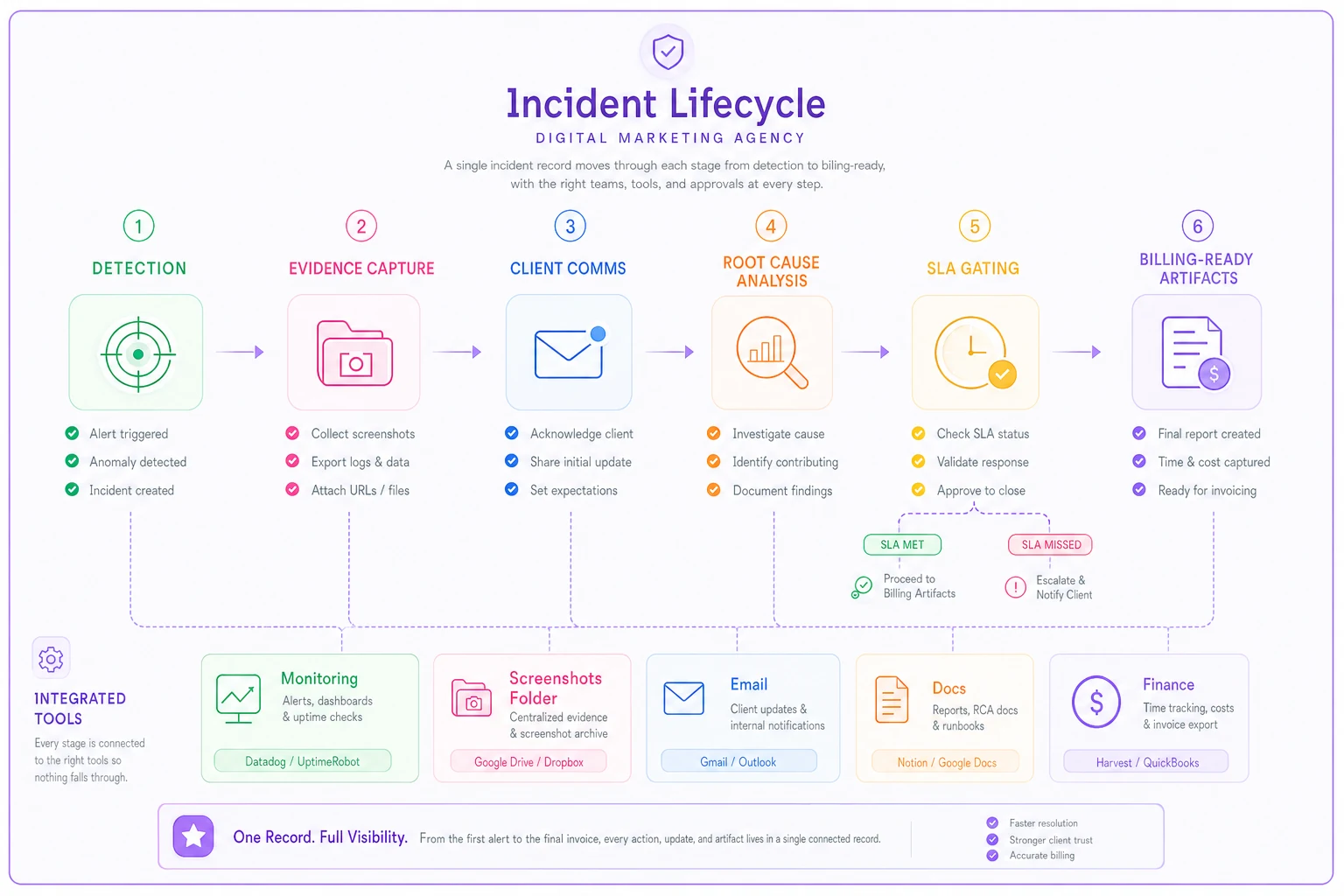
Visualize the incident as a single record flowing between tools and teams.
Whether you run this in a dedicated incident platform, a shared workspace, or a well-disciplined ticketing setup matters less than the principle: one record, moving through stages, carrying its evidence with it. The agencies with the lowest MTTR and the cleanest client relationships aren't the ones with the fanciest tooling. They're the ones where an incident is a single connected object instead of six disconnected scrambles.
Get the lifecycle wired together and outages stop being existential. They become routine — logged, proven, communicated, resolved, and closed, with the commercial side handled the same way every time. That predictability is what clients actually pay for, and it's what keeps them from leaving the next time something breaks. Because something always breaks. The agencies that hold onto accounts are just the ones that made breaking boring.
Ready to elevate your agency's performance?
Join 2,000+ agencies using Digmaly to save time, boost efficiency, and deliver superior client results.