

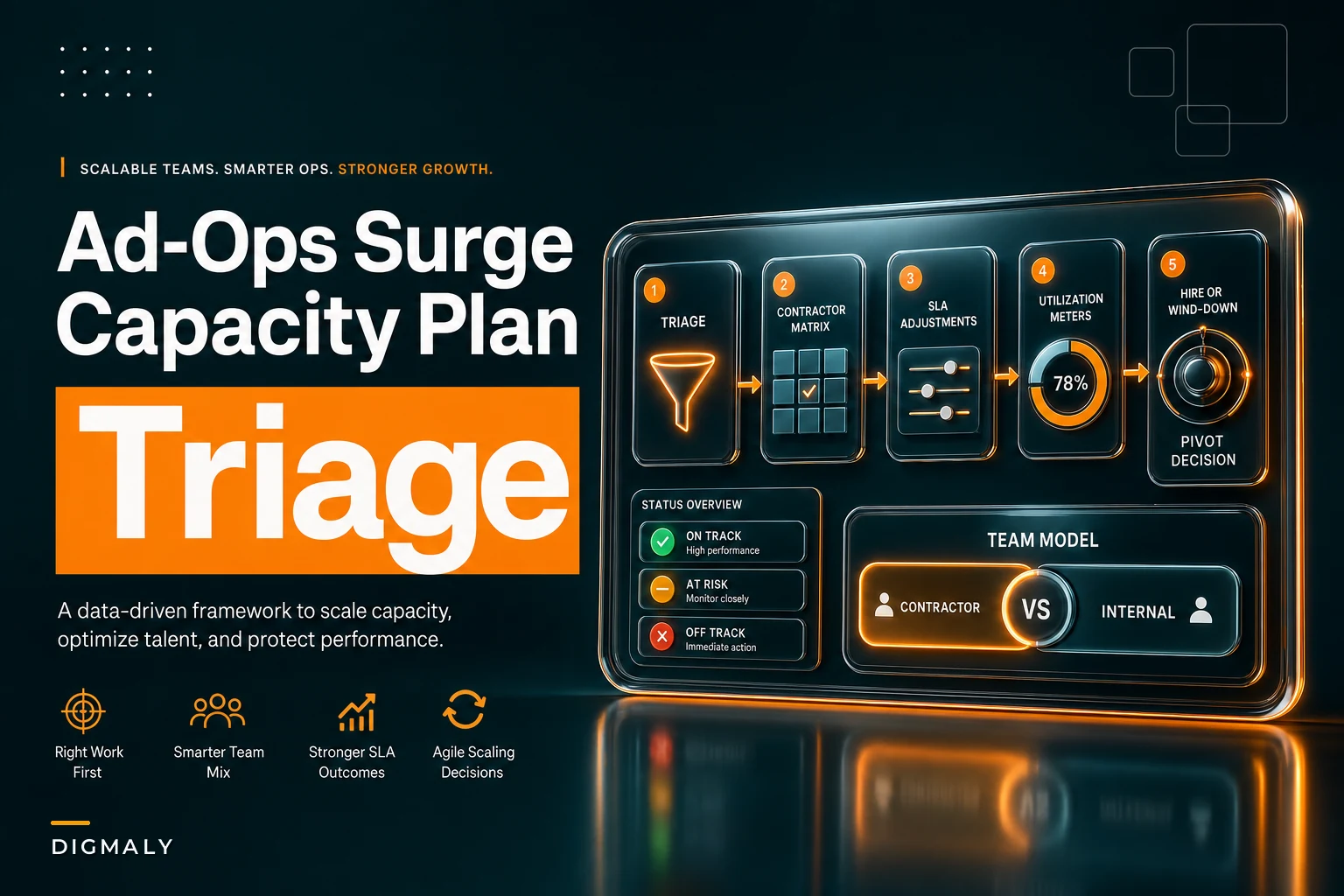

Winning is dangerous. Not in the dramatic sense — in the operational one. A client approves a budget jump from $40k to $120k three days before a product launch. A pitch you'd half-forgotten comes back with a signed contract and a "can you start Monday?" A current account suddenly wants three new markets live by end of quarter. All good news. All ways agencies quietly break.
Quality doesn't collapse during the hard months. It collapses during the good ones. When demand spikes faster than your team can absorb it, the first casualties are invisible: QA passes get skipped, naming conventions slip, pacing checks get eyeballed instead of verified, and the senior buyer who should be optimizing is instead building 40 ad sets by hand at 9pm.
This is a playbook for that specific moment. Not general scaling advice — the actual decisions you make in the 72 hours after a surge lands, and the 60 days that follow to make sure it stops being a fire drill.
What a surge actually looks like inside the ops
"We got busy" is useless for planning. A surge is any demand event that pushes a team or pod above its sustainable utilization line for more than a week. In practice, it shows up as one of four shapes:
-
A net-new account that lands faster than your standard onboarding runway allows
-
A budget expansion on an existing account — often 2–3x — that multiplies ad sets, placements, and reporting load without adding a single new logo
-
A scope creep spike where several accounts all ask for "one more thing" in the same two-week window
-
A seasonal collision where multiple clients' peak periods overlap and your reserve capacity gets eaten from both ends
These feel different from normal busy periods because each one has a different right answer. A budget expansion rarely needs a new full-time hire — it needs reprioritization and maybe a temporary contractor for the grunt build work. A net-new enterprise account might actually justify a headcount decision. Treating all four the same is the first mistake, and it's the one that leads agencies to either panic-hire or burn people out.
Without a surge plan, the default is the worst option: absorb it with existing people, say yes to everything, and hope. That hope costs you.
The real cost of winging it
The damage from an unmanaged surge doesn't land where you'd expect. Clients rarely notice the chaos directly — they notice the symptoms a few weeks later.
Eliminate marketing chaos with streamlined campaign control.
Digmaly lets you plan, execute, and track every campaign effortlessly.
- Unified campaign management
- Real-time client reporting
- Collaborative team workflows
No credit card required
A typical pattern: a pod of three buyers runs comfortably at around 75–80% utilization across eight accounts. A new account lands that should've had its own dedicated resource but instead gets wedged into the existing pod. Within two weeks everyone's at 100%+. The senior buyer stops doing optimization reviews because she's doing builds. Creative refresh cycles stretch from weekly to "whenever." Two accounts that were performing fine start to drift because nobody's watching the pacing closely.
By week four, one of those drifting accounts has overspent its monthly budget by roughly 18% with weaker results, and the client is asking pointed questions. Now you're not just understaffed — you're understaffed and firefighting a trust problem on an account that was healthy a month ago.
The math is brutal. The incremental revenue from the new account might be $8k–$10k in monthly fees. The at-risk account it quietly destabilized might be worth $6k. You "won," but you traded one relationship's stability for another's, plus your team's goodwill on top.
Triage rules: decide what gets protected first
The most important move in the first 48 hours is triage — deciding, deliberately, what gets your best attention and what gets a reduced-but-honest level of service temporarily. Most agencies do this by accident, protecting whoever shouts loudest. Do it on purpose instead.
-
Revenue and strategic weight — is this a flagship account, a reference client, or a renewal-at-risk relationship?
-
Volatility — how quickly does this account degrade without active management? A lead-gen campaign with tight pacing degrades fast; an always-on brand campaign tolerates a few days of reduced touch.
-
Change exposure — is anything actively in flight right now (a launch, a migration, a test) where neglect causes real harm?
Score each account low/medium/high across those three and you get a clear tiering:
| Triage tier | Criteria | Service level during surge |
|---|---|---|
| Protect | High revenue/strategic + high volatility or active change | Full service, no cuts, assign your steadiest person |
| Maintain | Medium weight, stable, nothing in flight | Core tasks only — pacing checks, no net-new experiments |
| Hold | Low volatility, tolerant, no active changes | Honest reduced touch, communicated proactively |
The uncomfortable part is the "Hold" tier. The instinct is to protect everyone equally, but spreading a stressed team evenly across all accounts means everyone gets a degraded version of you. Better to protect your critical accounts fully and tell your tolerant clients, honestly, that you're pausing non-essential work for two weeks. Most reasonable clients prefer a heads-up over silent decay.
Preserve a simple template for the 'Hold' notification to speed communications and keep expectations clear.
One rule that saves relationships: never let an account silently drop a tier. If a client moves to "Hold," someone sends a short note setting expectations. Reduced service a client knows about is an inconvenience. Reduced service they discover on their own is a breach of trust.
Contractor vs. reprioritize: the decision matrix
Once you've triaged, you need to answer the resourcing question. Broadly you have three levers: reprioritize existing work, bring in a contractor, or trigger a hire. The hiring question deserves its own rigor — if you haven't already built out the logic for when a spike justifies permanent headcount, why capacity formulas, hiring scorecards and profitability triggers should drive your agency operational playbook is worth reading before you post a job.
For the short-term surge itself, the choice is usually between reprioritizing and contracting:
| Factor | Reprioritize internally | Bring in a contractor |
|---|---|---|
| Surge duration | Under ~3 weeks | 3 weeks to a few months |
| Work type | Strategic, judgment-heavy, client-facing | Standardized builds, QA, reporting assembly |
| Account sensitivity | High-touch flagship work | Lower-risk, well-documented accounts |
| Team headroom | Someone genuinely has 10–15% slack | Everyone is already near capacity |
| Onboarding cost | Zero | 1–2 weeks of ramp before productive |
The pattern most agencies miss: contractors are great for the build and reporting layer, terrible for the judgment and relationship layer. The worst thing you can do is hand a contractor a sensitive flagship account because that's where the pressure is highest. Use the contractor to take over standardized work on your "Maintain" and "Hold" accounts, which frees your senior people to concentrate on what actually needs them.
A quick reality check on reprioritizing: it only works if someone actually has slack. "Reprioritize" too often means "pile more on people who are already full and call it a decision." If your whole pod is at 90%+, reprioritization isn't a lever — it's wishful thinking, and you should be reaching for the contractor or hiring conversation instead.
When a contractor is the wrong call
Skip the contractor if the surge is genuinely short — a one-week crunch where onboarding eats the entire window. Skip it if the work is too client-specific to hand off safely, or if nobody has the bandwidth to brief and review the contractor's output. An unmanaged contractor on sensitive work doesn't add capacity. It adds QA burden and risk.
SLA adjustments: protect the promise you can actually keep
Surges put your SLAs under direct strain, and the instinct is to quietly miss them and hope nobody notices. The better play is to proactively, temporarily adjust the SLAs you can't hold — in writing, for the specific accounts affected.
In practice this means having pre-drafted "surge mode" SLA terms ready to go. A report that normally lands in 24 hours might shift to 48; a creative refresh request that's normally 3 days becomes 5. The key is that these changes are explicit, time-boxed, and communicated — not silent degradation.
For your "Protect" tier, SLAs don't move at all. That's the whole point of the tiering. The honesty here is what preserves trust. A client who gets told "during this two-week push, standard reports shift to 48-hour turnaround, and here's the end date" respects the professionalism. A client who just notices things getting slower assumes you're slipping.
Keep a simple log of which SLAs were adjusted, for whom, and for how long. When the surge ends, reverse every adjustment on a specific date and confirm it in writing. SLAs that quietly stay "adjusted" after the surge is over are how your service standard permanently erodes, one crisis at a time.
The 30/60-day stabilization plan
Triage and contractors handle the first two weeks. But a surge that keeps going stops being a surge and becomes your new baseline — and baselines need structure, not firefighting. A lot of agencies survive the initial spike, exhale, and never actually stabilize, so the next surge hits them just as unprepared.
Days 1–7 (the surge window):
-
Run triage and tier every affected account
-
Make the contractor-vs-reprioritize call per the matrix
-
Issue temporary SLA adjustments in writing to affected clients
-
Assign a single surge owner — one person accountable for the whole situation, not a committee
Days 8–30 (absorb and assess):
-
Track actual utilization daily, not by feel — if the pod is sustaining above ~85%, the surge isn't temporary
-
Document everything the contractor touches so the work is transferable
-
Measure whether the "Hold" tier accounts are actually holding or quietly degrading
-
Decide by day 30
is this a spike that will recede, or a permanent step-up in volume?
Days 31–60 (stabilize or hire):
-
If volume is receding, wind down the contractor and reverse SLAs on a set date
-
If volume is the new normal, trigger the hiring decision using your real capacity and profitability numbers
-
Rebuild reserve capacity — a pod running at 100% has zero buffer for the next surge, which is a liability
-
Run a short retro
what warning signs did you miss, and what tripwire would've caught this earlier?
The hinge point is the day-30 decision. The data to make it well is simple, but you have to actually capture it: sustained utilization, the margin on the new work, and whether service quality held across the board. If utilization stayed high and the new revenue carries healthy margin and quality held, that's a hire. If any of those three is shaky, you don't have a hiring case — you have a scoping or pricing problem to fix first.
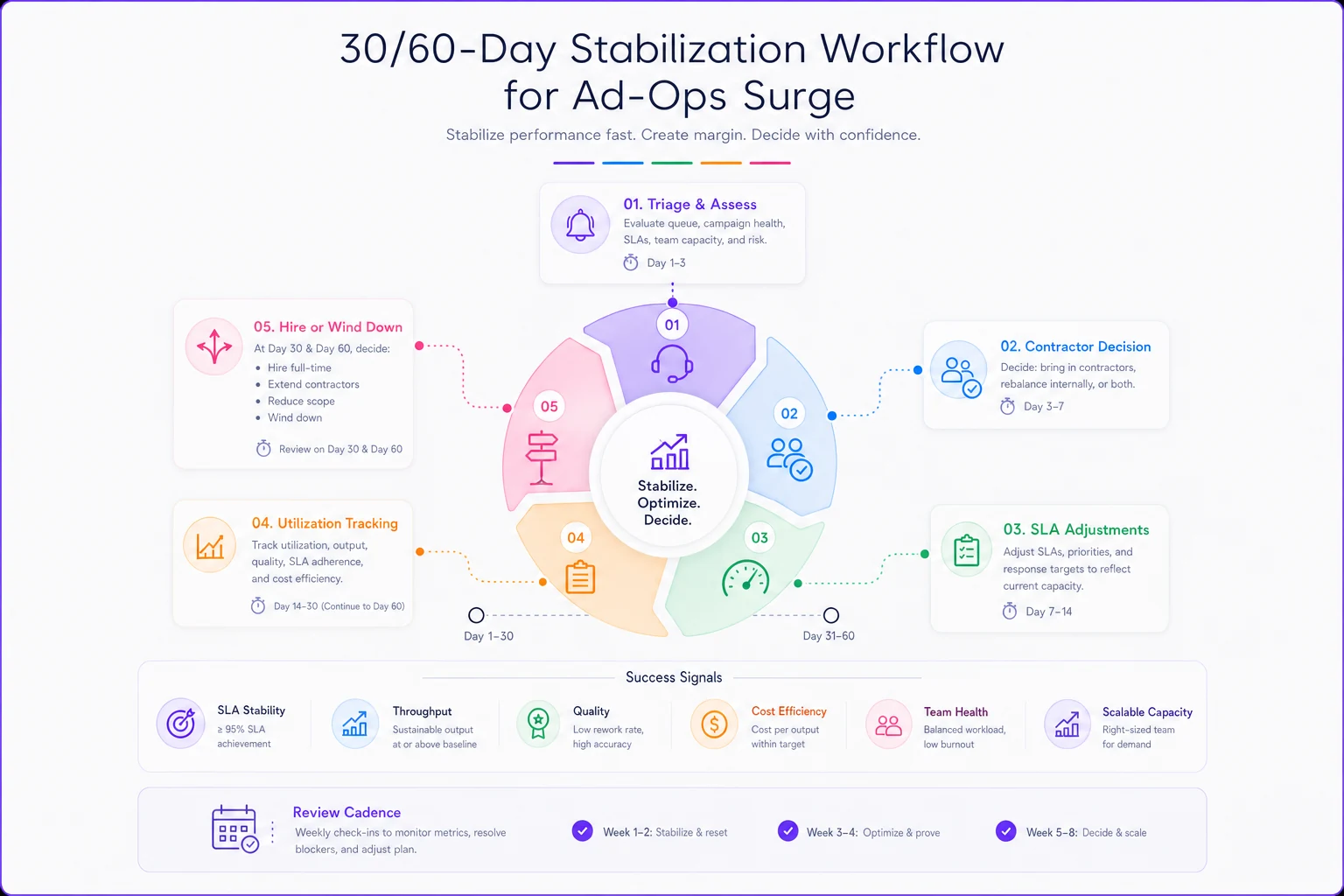
Here's a visual of the stabilization workflow.
Hiring triggers worth defining before you need them
The reason surges cause panic hires is that nobody set the trigger in advance, so the decision gets made emotionally in the middle of a crunch. Define these numbers when you're calm:
-
Sustained utilization threshold — a pod sitting above 85% for more than 30 consecutive days
-
Revenue-per-head floor — the point where new volume clearly supports an additional salary with margin to spare
-
Quality-slip signal — a measurable uptick in missed SLAs, QA catches, or pacing errors across the pod
-
Reserve depletion — when you've had zero surge buffer for an extended stretch
When two or more of these fire together, you're not reacting to a surge anymore — you're responding to structural growth, and that's when a hire is justified. The difference between a panic hire and a confident one is whether you defined the trigger before the pressure hit.
A real scenario
A mid-sized performance agency, around 14 people, ran paid social and search for roughly 20 e-commerce and lead-gen clients. One of their mid-tier clients landed outside funding and jumped monthly spend from about $35k to $110k, with two weeks' notice before their biggest launch of the year.
The pod handling that account was already at roughly 80% utilization. The old approach would've been to absorb it — and in a previous surge, that's exactly what happened, which had quietly cost them an unrelated account that overspent while nobody was watching.
This time they ran the playbook. They tiered their accounts: the expanding client and two other flagships went to Protect, four stable always-on accounts went to Maintain, and three low-volatility accounts moved to Hold with a heads-up email. They brought in a contractor — not for the flagship, but to take over standardized build and reporting work on the Maintain tier, freeing the senior buyer to focus entirely on the launch. They shifted report turnaround on the Hold accounts from 24 to 48 hours for a defined three-week window.
The launch landed clean. No account overspent. The two Hold-tier clients who got the heads-up didn't blink. By day 30, utilization data showed the expanded spend was sticking, margin was healthy, and the sustained-utilization and revenue-per-head triggers had both fired — so they made a confident hire instead of a panicked one and wound the contractor down over the following two weeks. The messy part wasn't eliminated, but it stopped being a crisis.
Where this connects to the rest of your ops
A surge plan doesn't live in isolation — it's a pressure test for whether your underlying workflows can bend without breaking. If your builds, QA, and reporting are already chaotic on a normal week, a surge just amplifies that chaos. The groundwork in the operational campaign orchestration framework to turn chaotic launches into predictable, on-time campaigns is what makes a surge survivable in the first place, because standardized, well-documented work is the only kind a contractor can safely pick up on short notice.
This is also where having your capacity, utilization, and SLA data in one place stops being a nice-to-have. The day-30 decision — recede or hire — is only as good as the numbers behind it. If you're reconstructing utilization from memory and scattered spreadsheets mid-surge, you'll decide badly. Agencies that keep this data in a single operational view make the call faster and with far less drama.
The point
An ad ops surge capacity plan isn't about being able to say yes to everything. It's about knowing, in advance, exactly which levers you'll pull when a win lands harder than expected — what gets protected, what gets a contractor, which SLAs flex, and when a spike earns a real hire. The agencies that handle sudden wins well aren't the ones with infinite capacity. They're the ones who decided how they'd respond before the good news showed up.
Ready to elevate your agency's performance?
Join 2,000+ agencies using Digmaly to save time, boost efficiency, and deliver superior client results.