


Most agencies plan for disruption the same way people plan for a house fire — they assume it won't happen, and if it does, they'll figure it out. The problem is that in ad ops, disruption isn't a rare catastrophic event. It's a Tuesday. A platform API goes dark mid-flight. Your lead media buyer gets food poisoning the morning a $40k launch is scheduled. A billing processor flags three client cards at once. Google decides your largest account looks suspicious and freezes spend.
None of these are extinction-level events. But stacked together, or hitting at the wrong moment, they quietly erode the one thing that actually keeps clients paying you: the feeling that someone has their hands on the wheel.
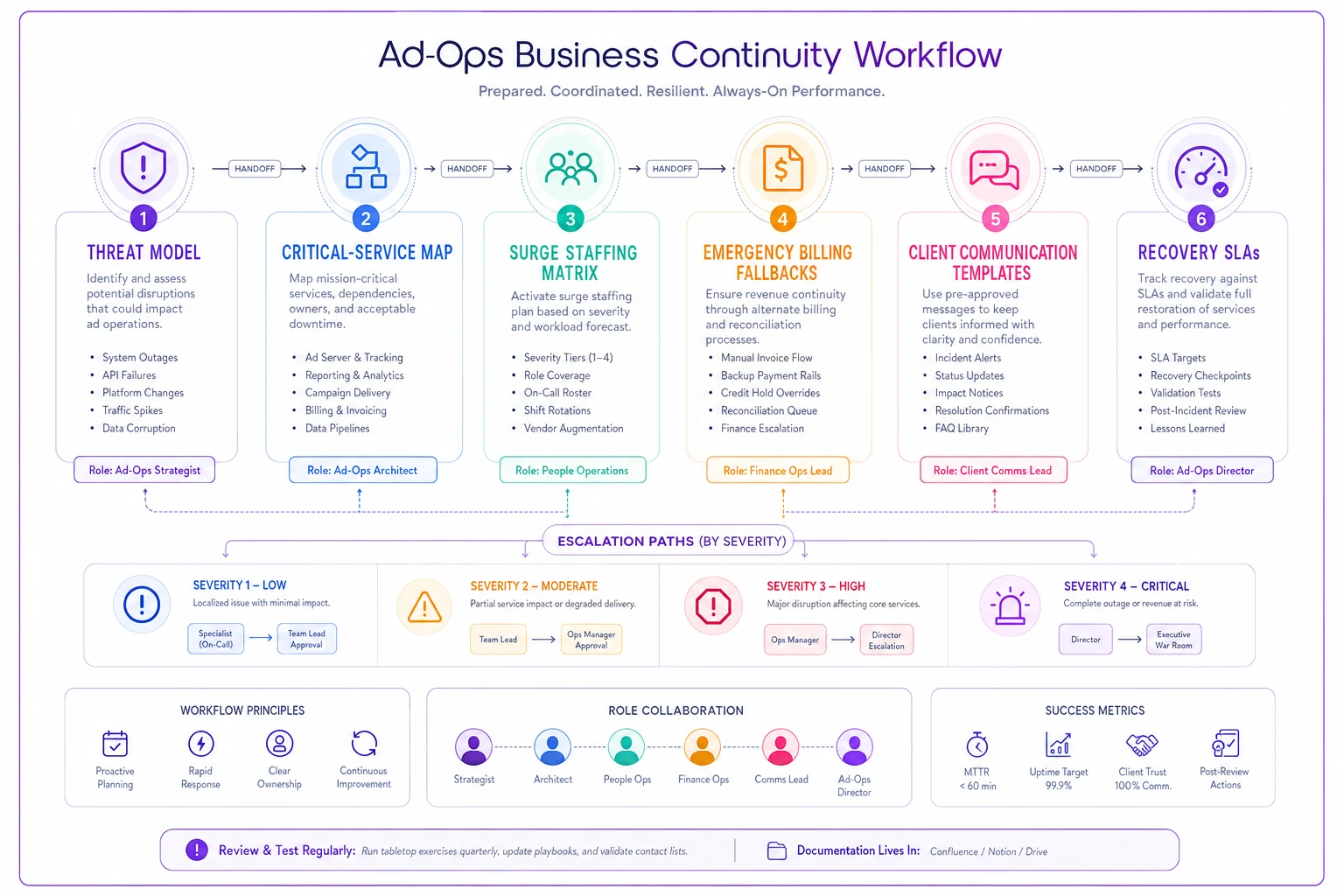
A real ad ops business continuity plan isn't a binder nobody opens. It's a set of connected systems — threat models, service maps, staffing matrices, billing fallbacks, communication templates, and recovery SLAs — that let the agency keep delivering when something breaks. The goal isn't zero disruption. That's fantasy. The goal is that disruption never turns into a client-trust event.
The pieces fail in predictable ways when they're built in isolation, so it's worth walking through how the whole thing fits together.
Why continuity breaks differently at an agency
In most businesses, continuity planning is about keeping the lights on. In ad ops, it's weirder, because your "operation" is spread across systems you don't own. You're renting access to Meta, Google, TikTok, your reporting stack, your billing processor, and a dozen pixels and server-side connectors. Half your failure points are outside your walls.
That changes the whole shape of the problem. You can't just back up a database and feel safe. A continuity plan that only covers your infrastructure misses the stuff that actually takes clients down — platform suspensions, API deprecations, attribution outages, policy changes that hit overnight.
The second thing that makes agencies fragile is knowledge concentration. In a five-to-twenty person shop, there's almost always one person who "just knows" how the Henderson account is structured, or which three clients are on legacy billing terms, or why that one pixel fires server-side through a weird workaround. When that person is out, the disruption isn't the outage — it's that nobody else can navigate it.
What you see across a lot of small agencies is that continuity doesn't fail at the moment of crisis. It fails months earlier, when the operation quietly becomes dependent on undocumented tribal knowledge and manual steps that only live in someone's head.
Start with threat modelling, but keep it boring
Threat modelling sounds like a security exercise, and agencies tend to overcomplicate it. You don't need a risk matrix with forty rows. You need an honest list of things that have actually gone wrong or realistically could, scored by how likely they are and how much damage they'd do.
Eliminate marketing chaos with streamlined campaign control.
Digmaly lets you plan, execute, and track every campaign effortlessly.
- Unified campaign management
- Real-time client reporting
- Collaborative team workflows
No credit card required
The useful version fits on one page. For each threat you want three things: what breaks, who's affected, and how fast you'd need to respond before it becomes a client problem.
| Threat | Likelihood | Client impact | Response window |
|---|---|---|---|
| Ad account suspension on a top-10 account | Medium | Spend halts, client panics | Hours, not days |
| Lead buyer unavailable during launch week | Medium-high | Launch slips, QA gaps | Same day |
| Reporting/attribution pipeline outage | Medium | Dashboards go dark, reviews stall | 1–2 days |
| Billing processor declines batch | Low-medium | Cash flow + client friction | 2–3 days |
| Platform API deprecation | Medium | Automation and pacing break | Known in advance, often ignored |
| Multiple clients churn-signal at once | Low | Revenue shock | Weeks |
Keep the threat model to one page and focus on things that have actually happened or are realistically likely.
The insight most agencies miss here: the scariest-sounding threats aren't always the ones that hurt most. A full platform outage affects everyone equally and clients tend to be forgiving because "it's Meta's fault." The quieter killer is a single top account getting suspended while everything else runs fine — because that client feels singled out, and your response speed is the entire story. If you don't have a tight process for that, it's worth reading through a proper ad account suspension runbook before you need one.
Critical-service mapping: know what actually can't stop
Not every service an agency delivers is equally urgent during a disruption. This is where most continuity plans go sideways — they treat everything as critical, which means nothing gets prioritized when the team is stretched thin.
-
Tier 1 — spend and delivery. Live campaigns must keep spending correctly and within pacing. If budgets run wild or stall, you're bleeding client money in real time.
-
Tier 2 — client communication. Clients need to hear from you, even if the update is "we're on it." Silence is what breaks trust, not the problem itself.
-
Tier 3 — optimization and testing. Important, but a paused A/B test for two days costs almost nothing. This is the first thing to shelve.
-
Tier 4 — reporting and internal dashboards. Uncomfortable to lose, rarely urgent. A delayed weekly report is survivable; a frozen ad account is not.
The pattern worth noticing: agencies instinctively protect reporting during a crisis because it feels visible to clients. But clients don't care about a late dashboard if their campaigns are healthy. They care enormously about a late dashboard if they suspect something's wrong. So reporting isn't inherently critical — it becomes critical only when Tier 1 is already in trouble. Mapping forces you to see that relationship clearly.
This mapping also depends heavily on how you've structured your offering in the first place. If your service tiers and SLAs aren't tied to capacity, your continuity map will constantly fight your commercial model. Agencies that have thought through service packaging and billing-linked capacity tend to find critical-service mapping almost falls out naturally, because they already know which clients are paying for what level of responsiveness.
Surge staffing matrices: who covers whom
The single-point-of-failure problem is solvable, but not with vague promises that "everyone can pitch in." Under pressure, "everyone's responsibility" becomes nobody's. You need an explicit matrix that says, for each critical account and each critical function, who's primary and who's backup.
-
Account / function — the thing that needs covering.
-
Primary owner — who normally runs it.
-
Trained backup — someone who has actually done the work, not just read about it.
-
Emergency escalation — the senior person who makes judgment calls when backups are stuck.
-
Cross-training status — honest flag
green (ready), yellow (partial), red (no real backup).
The red flags are the whole point. The matrix isn't valuable because it assigns backups — it's valuable because it shows you where you have none. Then cross-training becomes a scheduled activity instead of a someday-maybe.
A scaling note worth flagging: at under ten people, your matrix will be ugly and that's okay. You simply can't have deep backups for everything. The trick at that size is making sure at least documentation exists where live backups don't, so a competent person could navigate the account cold. As you cross fifteen to twenty people, the matrix shifts from "who can cover" to "how do we prevent any single account from ever having only one trained person again." That becomes a hiring and onboarding policy, not a crisis plan.
Emergency billing adjustments
Billing is the part of continuity planning that agencies almost always forget, and then it bites them exactly when they're already stressed.
Two scenarios come up constantly. First: a disruption on your side means a client didn't get the service level they paid for. If a campaign sat stalled for three days because of a suspension you were slow to appeal, charging full freight that month invites a fight. Having a pre-agreed framework — service credits, partial adjustments, whatever — means you can offer the right thing immediately instead of negotiating under duress.
Decide your billing-adjustment rules while calm, not during the incident. When something breaks, the temptation is to improvise a goodwill gesture that's either too generous (you eat margin you didn't need to) or too stingy (the client stews). A simple pre-defined ladder — "stalled 24–48 hrs = X, 48–72 hrs = Y, over 72 hrs = Z plus a call" — turns an emotional decision into an administrative one.
A real example: a small performance shop managing around $300k–$350k in monthly spend across roughly 18 clients had one account suspended for four days during a holiday push. No billing framework existed. The founder panicked and refunded the entire month's management fee — close to $4k — to keep the client calm. A pre-set credit ladder would've justified a credit closer to $1,200, kept the relationship intact, and saved most of that margin. The client didn't need a full refund. They needed a fast, confident response and a fair adjustment. The over-correction came purely from not having decided any of this in advance.
Client-communication templates that don't sound canned
During a disruption, your team is busy fixing things. That's exactly when communication slips — because writing a careful client message feels like a distraction from the actual firefighting. So it gets delayed, then rushed, and then it reads like a hostage note.
Pre-written templates solve this, but only if they're built right. The mistake is making them sound like legal disclaimers. A good continuity template has three jobs: acknowledge the issue in plain language, show you understand the impact on their business, and give a specific next-update time.
-
Platform outage (not our fault) brief, factual, "here's what we're doing on our end while it's down."
-
Account suspension / spend halt reassuring, action-focused, clear on appeal timeline.
-
Our-side error honest, accountable, no excessive groveling, paired with the fix and any billing adjustment.
-
Delayed reporting / data issue low-drama, with the key numbers verbally if the dashboard's down.
-
All-clear / resolution confirms it's fixed, summarizes what happened, states what's changed to prevent recurrence.
One underrated detail: the resolution message matters more than the crisis message for retention. Clients remember how a problem ended. A thoughtful "here's what happened and here's what we changed" note after the fact does more for trust than the fastest firefight. Most agencies send the panic email and then go silent once it's fixed, which wastes the recovery entirely.
Recovery SLAs: define "back to normal" before you need it
The final connective tissue is recovery SLAs — your internal commitments for how fast each type of disruption gets resolved or escalated. These aren't the client-facing SLAs you sell. They're the operational targets that tell your team when "we're handling it" needs to become "this is now an escalation."
-
Spend/pacing anomaly detected and triaged within 1 hour, escalated if unresolved in 4.
-
Account suspension appeal filed same business day, client notified within 2 hours.
-
Reporting outage interim manual numbers to any client with a scheduled review within 24 hours.
-
Billing failure fallback invoicing initiated within one business day.
-
Key-person absence during launch backup activated within the same day, scope adjusted if needed.
Recovery SLAs only work if the staffing matrix, service map, and templates already exist. The SLA says "notify the client within two hours" — but that promise is empty unless there's a template ready and a person assigned to send it. This is why continuity planning fails when it's done piecemeal. Each component leans on the others. A beautiful threat model with no staffing backup is theater. A staffing matrix with no recovery clock is just a list of names.
When a heavy continuity plan actually makes sense — and when it doesn't
When it makes sense: You're past ten people, you have a handful of accounts that each represent a meaningful chunk of revenue, and you've already had at least one disruption that scared you. At that point the cost of a bad incident — a lost flagship client, a public billing fight — dwarfs the effort of documenting this stuff.
When it's overkill: You're a three-person shop with ten small, roughly equal clients and strong personal relationships. A full matrix and template library is more structure than your operation can absorb. What you need instead is basic documentation and a single honest conversation about what happens if one of you is out for a week.
Who should NOT do this yet: Agencies still figuring out their core delivery process. If your normal, non-crisis operations are chaotic, continuity planning is premature. You can't build a reliable recovery system on top of an unreliable baseline. Stabilize the everyday workflow first; the continuity layer sits on top of it.
A quick real scenario
A boutique paid-social agency — seven people, around $220k monthly managed spend, 14 clients — kept hitting the same wall. Their most senior buyer managed their three largest accounts almost single-handedly. When she took a planned ten-day vacation, two things went wrong in the same week: a pacing issue on one account quietly overspent by roughly $6k before anyone caught it, and a second account's reporting broke right before a client review that nobody else knew how to pull manually.
Nothing about the crisis was exotic. The problem was pure concentration — one person, no documented structure, no clear backup, no recovery clock. The overspend alone wiped out a chunk of that month's margin, and the reporting miss cost them a near-renewal client who started quietly shopping around.
Afterward they did the unglamorous work: a one-page threat model, a service map ranking what couldn't stop, a staffing matrix that flagged four accounts as single-point red, and five communication templates. Nothing fancy. The next time that buyer was out — and the next platform hiccup hit — the overspend got caught inside an hour and the client with the scheduled review got interim numbers before they even asked. No heroics. Just a system doing what one stressed person used to improvise.
Bringing it together
Continuity in ad ops isn't a document you write once. It's the sum of small, connected systems — knowing your threats, knowing what can't stop, knowing who covers whom, knowing how you'll bill and communicate and recover. Each one is modest on its own. Together they're the difference between a disruption that clients barely notice and one that quietly starts a churn cycle.
Most agencies build none of this until a bad week forces the issue. The ones that build it earlier aren't necessarily more disciplined — they've usually just already lived through the week you're trying to avoid. The one-page versions of everything above can be drafted in an afternoon, and they'll earn their keep the first time something breaks at exactly the wrong moment.
Most agencies build none of this until a bad week forces the issue. The ones that build it earlier aren't necessarily more disciplined — they've usually just already lived through the week you're trying to avoid. The one-page versions of everything above can be drafted in an afternoon, and they'll earn their keep the first time something breaks at exactly the wrong moment.
Ready to elevate your agency's performance?
Join 2,000+ agencies using Digmaly to save time, boost efficiency, and deliver superior client results.