

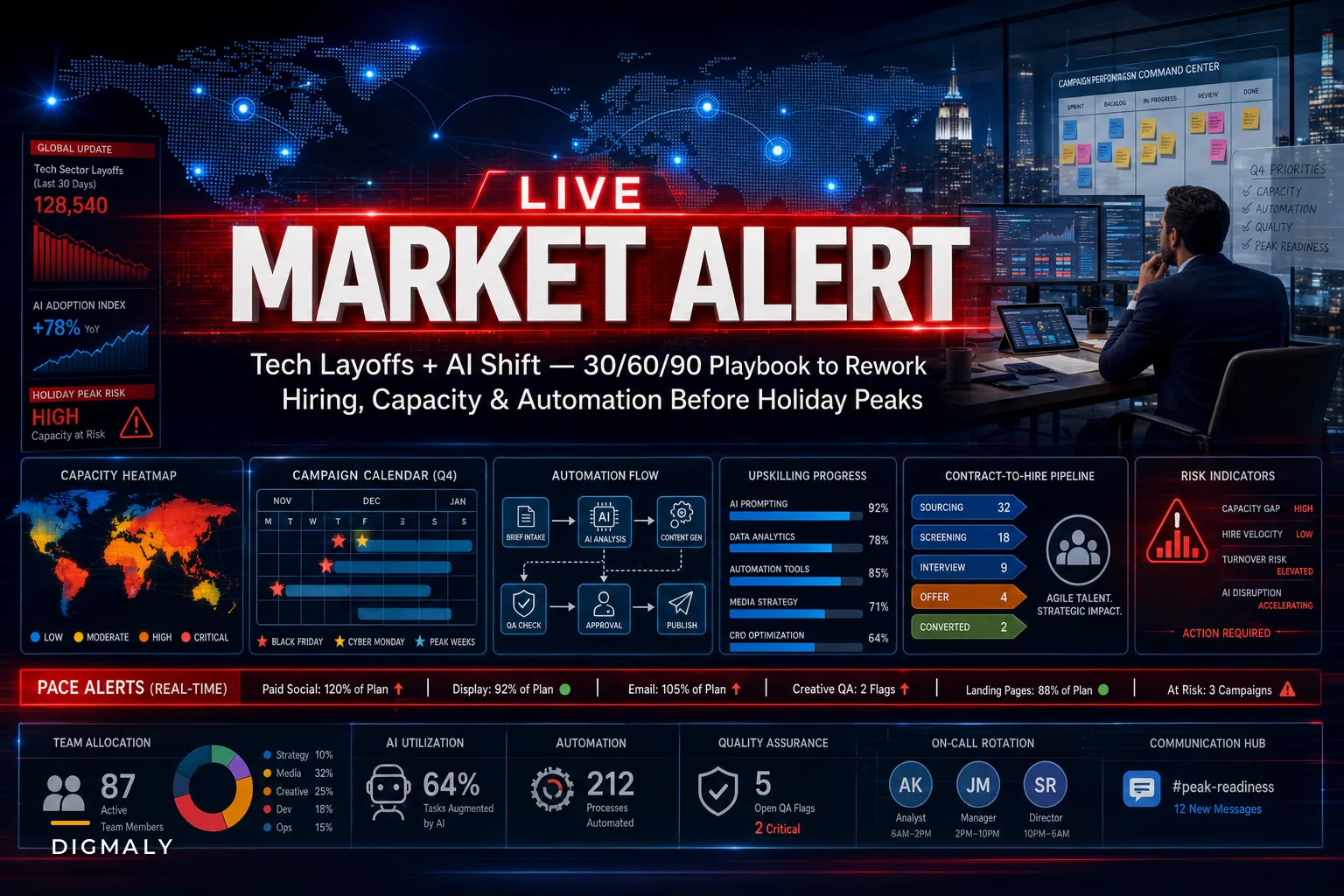

The headlines this week landed at an awkward moment for agencies. Amazon trimmed more roles inside its devices unit after a stretch of product launches, part of a wider pattern where big employers are reallocating headcount and budgets toward AI and efficiency. Reuters framed the Amazon move as another sign of companies restructuring teams even after shipping new products — which tells you this isn't about failing product lines. It's about where money is flowing next.
Most agencies read this as a hiring opportunity. Bigger pool, experienced candidates, suddenly affordable. That's partly true. But hitting this in late October, right before holiday peak, makes it a trap if you treat it like a normal talent cycle. You don't have a leisurely two-quarter hiring problem. You have a delivery-stability problem to solve in 90 days, while client-side teams churn, budgets wobble, and your own people start getting recruiter DMs from the same companies doing the cutting.
The agencies that handle layoff season well don't just hire cheaper talent. They re-architect capacity so a single departure — theirs or a client's — doesn't blow up a seasonal campaign. The sequencing matters more than people think.
The real problem isn't talent supply. It's exposure.
Most people get excited about a flooded talent market and miss the other direction this cuts. The same wave putting senior media buyers on the market is also thinning out your clients' marketing departments. When an advertiser loses the one internal person who approves creative, owns the ad account, or signs off on budget, your campaign doesn't just slow down — it stalls with no clear owner on the other side.
Client-side layoffs create three immediate problems:
-
Approval bottlenecks — the person who signed off on spend is gone, and nobody knows who inherited the authority
-
Budget freezes — new finance leadership reviews every line item, and your retainer sits in the "discretionary" pile
-
Knowledge loss — the one stakeholder who understood why a campaign was structured a certain way walks out with that context
So before posting a single job opening, map your client exposure. For each account, write down: Who approves spend? Who approves creative? Who owns the ad accounts and pixels? If any of those is a single named person with no backup, that account is fragile heading into peak — regardless of how strong your internal team is.
A quick exposure scan looks like this:
| Account | Single-point approver? | Budget at risk if they leave | Backup contact known? | Peak dependency |
|---|---|---|---|---|
| Client A (retail) | Yes — CMO only | ~$90k Nov–Dec | No | High |
| Client B (DTC) | No — 2 approvers | Low | Yes | High |
| Client C (B2B) | Yes — marketing mgr | ~$25k | Partial | Medium |
The accounts with a "Yes / No / High" row are the ones generating 11pm emergency calls in December. Those get your attention first.
The 30/60/90 sequence
Splitting this into phases isn't a framework for its own sake — it's because you genuinely can't fix hiring, capacity, and automation simultaneously without breaking current delivery. Each phase has one dominant job.
Eliminate marketing chaos with streamlined campaign control.
Digmaly lets you plan, execute, and track every campaign effortlessly.
- Unified campaign management
- Real-time client reporting
- Collaborative team workflows
No credit card required
Here's a quick visual workflow for the 30/60/90 sequence.
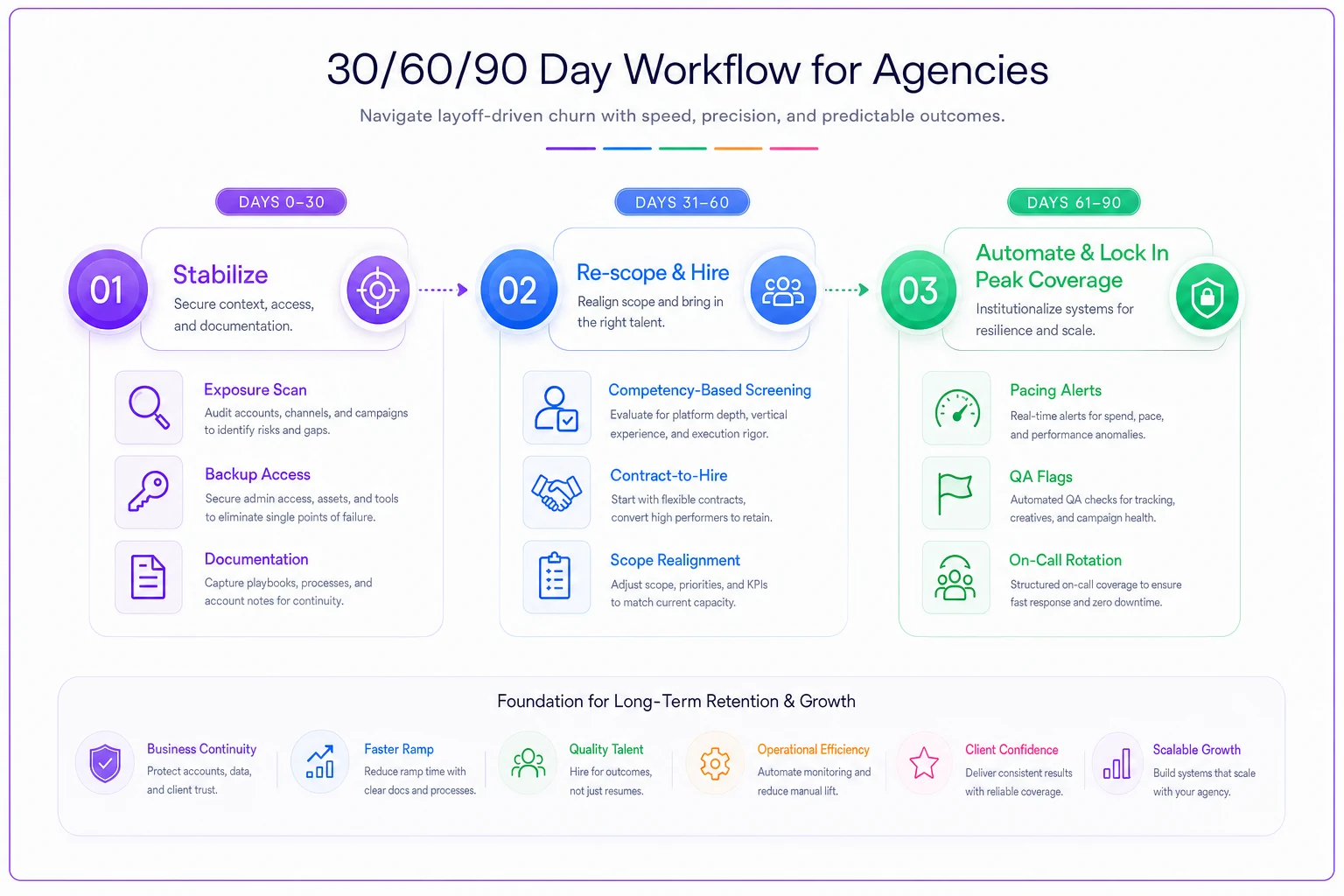
Days 0–30: Stabilize and reduce single points of failure
-
Run the client exposure scan above and flag fragile accounts.
-
Secure backup access on every ad account, analytics property, and billing profile — before a client contact disappears and you lose admin rights entirely. Boring, highest-ROI thing you can do this month.
-
Document the "why" behind your top accounts. Not just the setup — the reasoning. If your lead strategist got poached tomorrow, could someone else explain why Client A runs a specific bidding structure?
-
Identify your own flight risks. The people most likely to get recruited are usually your best. Have the retention conversation now, not after they've accepted something.
-
Freeze non-critical scope changes until peak is over. Layoff season is the worst time to redesign a reporting stack or migrate platforms.
Churn exposes undocumented knowledge. Agencies that survive leadership turnover without client fallout are the ones where process lives in a system, not in someone's head.
Days 31–60: Re-scope capacity and hire deliberately
Now you look outward. But hiring in a layoff market requires more discipline, not less — because the resumes look amazing and the real question (can this person perform under your workflow, with your tools, on your timeline) doesn't show up on paper.
A senior media buyer from a large tech company who got cut may be genuinely excellent and completely unprepared for the scrappy, multi-client reality of agency life. The context-switching alone is an adjustment — six accounts, six brand voices, six approval chains in a single afternoon. That's a different job than owning one brand's entire paid media strategy.
This is where structured evaluation beats gut instinct. Rather than hiring on brand-name pedigree, screen against the actual competencies the role requires. Building out a media buyer competency matrix and training curriculum lets you rank candidates on what actually matters — platform depth, QA discipline, pacing judgment, speed to ramp — rather than where they last worked. It also shortens ramp time, which matters a lot when you're hiring in October for December delivery.
A few capacity moves worth making in this phase:
-
Prefer contract-to-hire over full-time for peak. Coverage without committing to post-holiday headcount you may not need come January.
-
Backfill at the junior level, free up seniors for client-facing work. The layoff market has solid mid-level talent that can absorb execution tasks.
-
Recalculate capacity with churn baked in. If your model assumes everyone stays through December, it's already wrong. One departure shouldn't push accounts past their service limits.
Days 61–90: Automate the brittle parts and lock in peak coverage
By this point, fragile accounts are protected and new hires are ramping. The final phase is about making delivery less dependent on any single person being online — which is the whole point, given this whole situation started with sudden departures.
The areas worth automating first are the ones that quietly break when someone's out: budget pacing checks, naming-convention enforcement, anomaly flags, reporting assembly. These are the tasks that, when a person quits mid-week or goes dark, nobody notices until a client does.
AI-assisted operational workflows earn their keep here — not as a replacement for buyers, but as a safety net. Automated pacing alerts catch an overspend before a junior hire would. Automated QA flags a broken pixel on a Saturday when the team's offline. The goal isn't running campaigns on autopilot. It's making sure a thin, churning team doesn't miss the obvious during the busiest weeks of the year.
A realistic peak-coverage checklist for the final stretch:
-
[ ] Pacing alerts live on every account with meaningful holiday spend
-
[ ] On-call rotation defined for Black Friday / Cyber Monday weekend
-
[ ] Automated daily spend/performance snapshot going to account leads
-
[ ] Reserve creative approved and queued in case of fatigue mid-peak
-
[ ] Rollback plan documented for any automated bid rule
-
[ ] Every key account has a named backup owner, internally and client-side
Prioritize automated pacing alerts on accounts you've flagged as high dependency first.
The goal isn't running campaigns on autopilot. It's making sure a thin, churning team doesn't miss the obvious during the busiest weeks of the year.
A realistic scenario
Consider a 14-person agency running paid media for roughly nine mid-market retail and DTC clients. Two things hit the same month: their most senior buyer took an in-house offer, and one client's marketing director — the sole budget approver on an ~$80k holiday campaign — got laid off.
Without any of this planning, that combination is a disaster. Nobody internally knew the departed buyer's account logic, and nobody at the client could approve the November budget release. That exact pattern, in past cycles, has cost agencies two to three weeks of stalled spend during the highest-converting window — low five figures in lost client performance and a very uncomfortable renewal conversation.
Running the 30/60/90 changes the outcome. Backup admin access was already secured and account reasoning documented in month one. When the buyer left, a mid-level teammate picked up the accounts in a few days. When the client approver disappeared, there was already a secondary contact flagged and the client's finance lead looped in directly. The campaign launched roughly on schedule. Not perfectly — there was still scramble — but the difference between "a rough week" and "a lost season" came down to work done 60 days earlier.
When this playbook is overkill — and when it's not enough
When to go lighter: Small shop, two or three long-tenured clients, stable relationships. Focus on the day 0–30 access and documentation work and skip the aggressive hiring phase. Adding contract staff you don't actually need just drains margin.
When you need to go harder: If a large share of revenue sits with enterprise clients whose internal teams are actively being restructured, the exposure scan isn't a one-time task — it's a weekly check through year-end. One wrong assumption about who holds budget authority can swing a quarter.
Who should not treat the talent flood as a growth signal: Agencies already stretched thin on management capacity. Hiring three experienced media buyers sounds great until you realize nobody has bandwidth to onboard them. Unmanaged senior hires during peak often create more chaos — they make changes without context, and the fragile accounts get more fragile.
The thread running through all of this
Layoff cycles feel like a people event. Operationally, they're a resilience test. The agencies that get rattled are the ones where knowledge, access, and approval authority all live in individual heads — theirs and their clients'. The ones that stay steady have built delivery that survives a departure.
You can't control when the next round of cuts lands or which of your client contacts gets caught in it. What you can control is whether a single exit takes a campaign down with it. Spend the next 90 days reducing those single points of failure, hire against real competencies rather than resume shine, and automate the brittle checks that break when someone's out. Do that, and the churn around you becomes something you can absorb — maybe even hire into — instead of something that eats your holiday quarter.
Ready to elevate your agency's performance?
Join 2,000+ agencies using Digmaly to save time, boost efficiency, and deliver superior client results.