

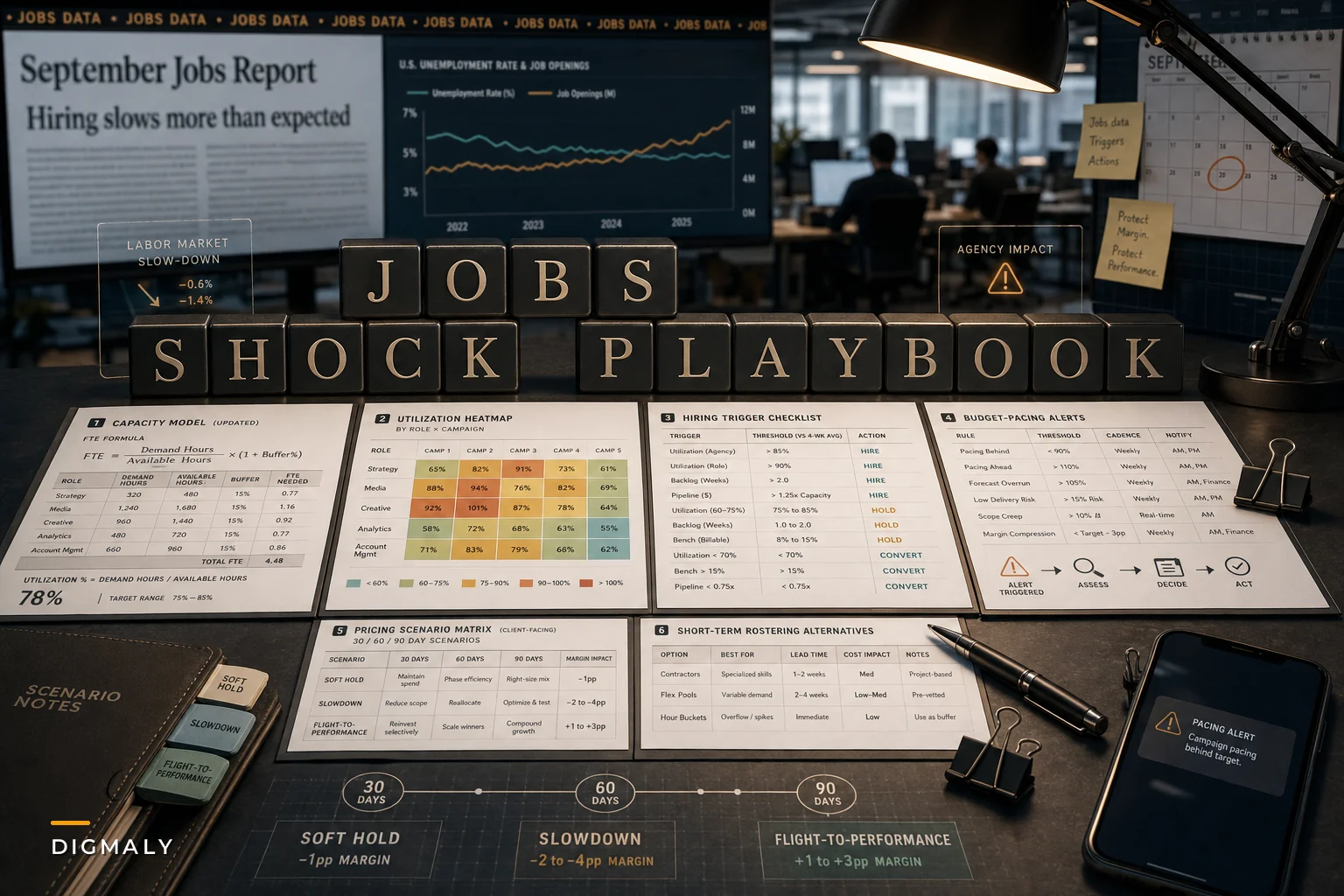

The September numbers landed harder than most agency owners expected. Nonfarm payrolls rose just 29,000, and unemployment ticked up to around 4.2% — a softer print than almost anyone had penciled in. Reuters covered the sharp slowdown in job growth the morning the BLS report dropped, and the immediate reaction across marketing-heavy businesses was predictable: budget reviews moved up, Q1 planning got more conservative, and a few clients started asking quiet questions about scope.
What most agency owners miss, though, is where the softness actually hits first. The pipeline worry is real but slow-moving. What breaks within weeks — not quarters — is your agency capacity planning. You built your staffing plan, your utilization targets, and your hiring roadmap on demand assumptions that were formed three to six months ago. When the macro signal shifts, those assumptions age overnight. You're either carrying payroll you can't bill against, or scrambling to cover accounts you over-promised.
This isn't a "cut costs and hunker down" piece. It's a reconfiguration playbook — how to re-run your capacity model, decide what to do about open roles, and reset client pacing and pricing conversations before the softness actually reaches your revenue.
Why the capacity side reacts before the revenue side
Agencies tend to watch the wrong lagging indicator after a macro shock. Everyone stares at new business. But new business was already going to be lumpy — a soft month there is normal noise. The real exposure is on the delivery side, and it moves faster.
Think about the chain of events. A client's internal finance team sees the same headlines you do. They don't cancel. What they do is slow down approvals, push a campaign launch from November to January, trim a test budget, or "pause to reassess." None of that shows up as churn. It shows up as utilization drift — your team is technically staffed on the account, but the billable work thins out. You're paying for capacity that's suddenly idling.
And then some accounts get more demanding when budgets tighten, because clients need every dollar to perform and they lean on you harder for optimization and reporting. So you end up with this weird split: half your book goes quiet, half gets heavier, and your blended utilization number hides both problems because they cancel each other out on paper.
That's the trap. A single blended utilization figure is useless in a shifting market. You need to see it account by account, and you need to see it this week, not in next month's financials.
The first move: re-run your capacity model with three demand scenarios
Before touching a single hiring decision, rebuild your forecast around three cases. Not one "revised" number — three, because you genuinely don't know yet which way client budgets break, and committing to a single revised forecast is how agencies overcorrect.
Eliminate marketing chaos with streamlined campaign control.
Digmaly lets you plan, execute, and track every campaign effortlessly.
- Unified campaign management
- Real-time client reporting
- Collaborative team workflows
No credit card required
| Scenario | Demand assumption | Utilization target | Hiring posture |
|---|---|---|---|
| Soft hold | 1–2 clients pause or trim ~15–20% of scope | Protect current, accept ~5pt dip | Freeze new reqs, keep backfills |
| Broad slowdown | 30–40% of book reduces spend or delays launches | Deliberately run leaner, 70–75% | Freeze all, reassign bench |
| Flight-to-performance | Clients consolidate budgets into fewer, higher-performing agencies | Push toward 85%+ on retained accounts | Hire selectively for senior optimization roles |
The flight-to-performance column is the one agencies forget. A softer labor market doesn't automatically shrink your business — it often concentrates spend. CNBC's breakdown of the September report pointed to uneven weakness across sectors, which is exactly the kind of environment where some clients get hit and others barely feel it. If you freeze hiring across the board, you can't absorb the budget that consolidates toward you from a competitor who panicked.
Here's a simple workflow to re-run your capacity model across three scenarios.
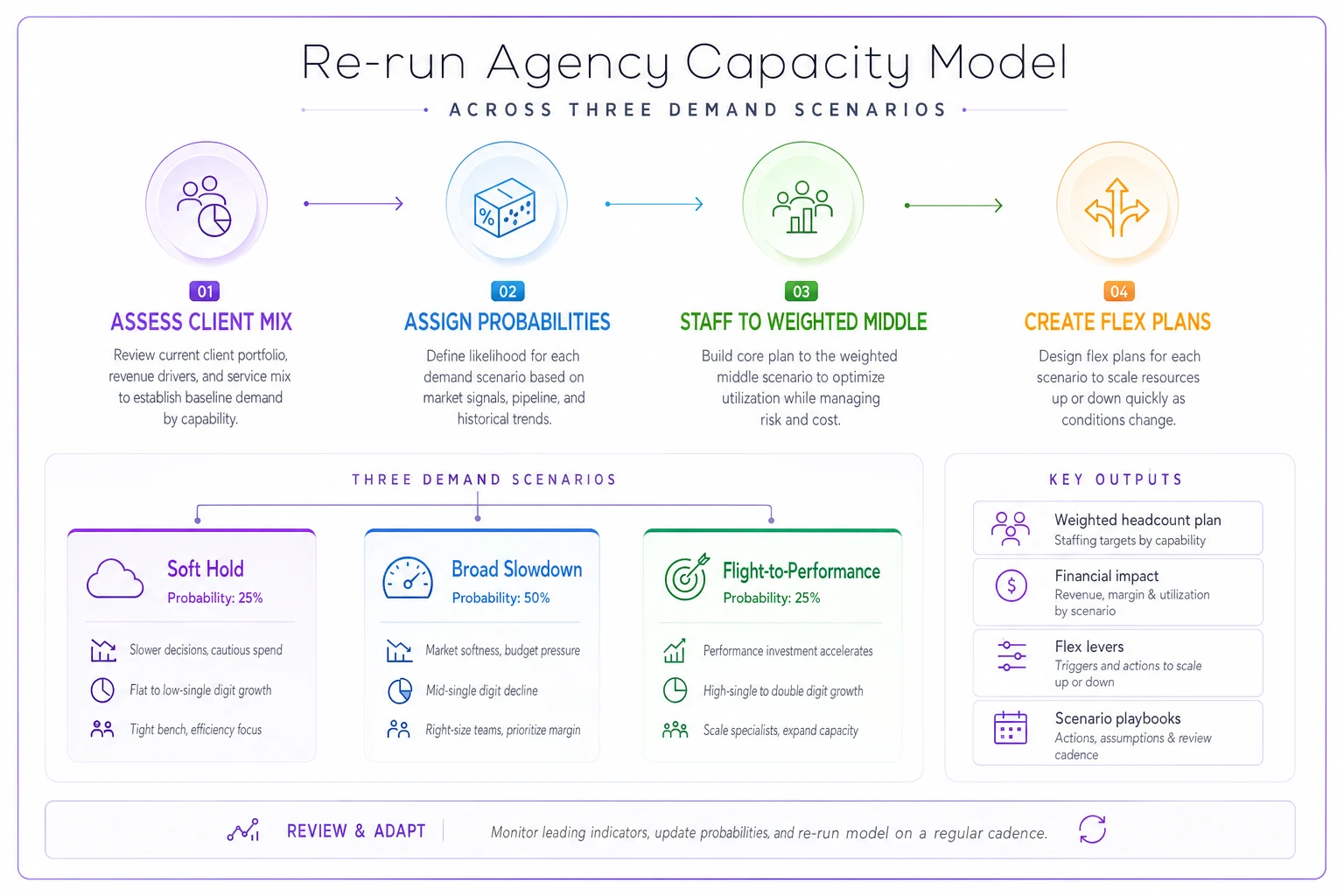
Run all three scenarios. Assign a rough probability to each based on what you actually know about your specific client mix — not the national headline. Staff to the weighted middle, with a clear plan for how you'd flex in either direction.
Rethinking the open reqs: freeze, reprioritize, or convert
Most agencies respond to a scare with a blanket hiring freeze. That's the blunt instrument, and it costs you later. A smarter move is sorting every open role into one of three buckets.
-
Freeze outright. Speculative roles you opened on the assumption of growth that hasn't materialized yet — junior generalist hires, "we'll probably need another account manager soon" roles. These wait.
-
Convert to contract or fractional. Roles tied to specific client work that might soften. Instead of a full-time hire, bring in contract capacity you can scale down without severance or morale damage. A fractional senior strategist at 15–20 hours a week often covers the gap at a fraction of the committed cost.
-
Accelerate. Senior, performance-critical roles — the people who protect retention on your best accounts. A softer labor market means better candidates are available and wage pressure eases. CNBC noted slower wage growth alongside the weaker payrolls, which quietly improves your leverage on senior hires you actually need.
Convert client-tied open roles to contract or fractional capacity to maintain flexibility without severance risk.
The mistake is treating all open roles as one decision. They aren't. The question isn't "should we hire right now" — it's "which specific roles protect revenue versus which ones were bets on growth that haven't landed yet." Your hiring scorecard should already separate those. If it doesn't, that's the gap this moment just exposed. The logic behind tying hiring triggers to profitability and capacity signals — rather than gut feel — is something we walked through in detail in why capacity formulas and hiring scorecards should drive your operational playbook, and it's exactly the framework that makes a moment like this manageable instead of panicked.
Tightening client pacing before anyone overspends
When client budgets get nervous, two pacing problems show up at once, pulling in opposite directions.
The first is underspend from indecision. A client delays approving next month's budget, campaigns coast on stale allocations, pacing falls behind, and you end the month having spent 80% of plan. Performance looks soft purely because of the approval delay, and now you're in an awkward QBR explaining a shortfall that was entirely on their end.
The second is overspend from compensation. Teams, sensing budgets might get cut, quietly front-load spend to lock in results before anyone pulls the plug. That's how you blow through a monthly cap by day 20 and hand the client a reason to be angry during the exact window when they're already anxious about money.
Both are failures of the same thing: nobody's watching pacing against a scenario-adjusted target. Your thresholds were set for a stable-budget environment. In a nervous market you want tighter bands and faster alerts — flag any account drifting more than roughly 10% off daily pace instead of waiting for a weekly roll-up.
A quick pacing-review checklist for the next 30 days
-
Pull daily pace variance per account, not blended
-
Flag accounts where approvals are stalling (underspend risk) separately from overspend risk
-
Reset alert thresholds tighter for the next two monthly cycles
-
Identify which accounts have hard caps vs. flexible budgets — treat them differently
-
Pre-write the "your approval is pending and pacing is slipping" client note so it goes out fast
-
Note which clients historically front-load; watch those for early overspend
The goal isn't just catching overspend; it's catching underspend-from-indecision early enough to nudge the client for a decision before the month is lost.
When to open the pricing and scope conversation (and when not to)
This is the part agencies dread, and they usually time it wrong — they wait until a client asks for a cut, which puts you on defense. The better move is being proactive, but selectively.
When it makes sense to open the conversation: Accounts where you're already running over your scoped hours. A softer market is actually decent cover for an honest "here's what we're delivering versus what's scoped, let's align" conversation, because the client is thinking about efficiency anyway. Framed as "let's make sure every dollar is working," a scope reset lands very differently than a straight price increase.
When it's a bad idea: Your anchor accounts that are performing well and aren't complaining. Don't manufacture a pricing conversation out of macro anxiety on an account that's healthy — you'll create instability where there was none.
Who should absolutely not do this right now: Agencies without clean utilization and profitability data per account. If you can't walk into the conversation with a precise picture of hours delivered, margin, and performance, you'll negotiate blind and probably concede too much. Get your numbers straight before you open anyone's contract.
The underlying principle: pricing conversations go well when they're grounded in delivered value and real capacity data, and badly when they're reactions to fear. The macro news is context, not an argument.
A real scenario: the 14-person performance shop
Consider a mid-sized performance agency — around 14 people, mostly paid media and creative, with a book of roughly 20 clients. Going into October they had two open reqs: a mid-level media buyer and a senior growth strategist. Blended utilization looked fine at about 78%.
When they broke it out by account, the picture changed. Four accounts had quietly dropped to around 50% of scoped activity because launches got pushed. Three accounts had crept past scope because those clients were leaning hard on optimization. The healthy middle was masking both.
What they did: froze the media buyer req, converted that need into a contract buyer at roughly 20 hours a week, and accelerated the senior strategist hire — because the three over-scope accounts were their most valuable and at risk of being under-served. They tightened pacing alerts on the four quiet accounts and got approval decisions moving within about ten days instead of letting the month drift.
The outcome wasn't dramatic. They avoided roughly $6k–$8k a month in committed payroll they'd have been idling, kept their three heaviest accounts from slipping, and went into the next quarter with a flex plan instead of a panic. No layoffs, no client surprises. That's what handling it well actually looks like — unglamorous and quiet.
The deeper problem this exposed
A jobs report doesn't create agency capacity problems. It reveals ones that were already there. Agencies that struggle in a soft month are almost always running on blended numbers, gut-feel hiring, and pacing reviews that happen too late to act on. The macro shift just removes the slack that was hiding all of it.
The agencies that adjust smoothly have the opposite setup: per-account visibility, hiring decisions tied to defined profitability triggers rather than optimism, and pacing alerts fast enough to catch drift in days. When the signal changes, they re-weight their scenarios and move. They're not predicting the economy — they just built an operation that can flex without drama.
Treat the September print as a stress test, not a crisis. Re-run your model in three scenarios. Sort your open roles instead of freezing everything. Tighten pacing on the accounts most likely to drift in either direction. Have the scope conversations where they're honestly warranted, and skip the ones driven by fear. If the softness deepens, you'll be ready. If it doesn't — and the labor market often surprises in both directions — you've lost nothing but a few hours of planning, and you've got a sharper operation than you started with.
Ready to elevate your agency's performance?
Join 2,000+ agencies using Digmaly to save time, boost efficiency, and deliver superior client results.