

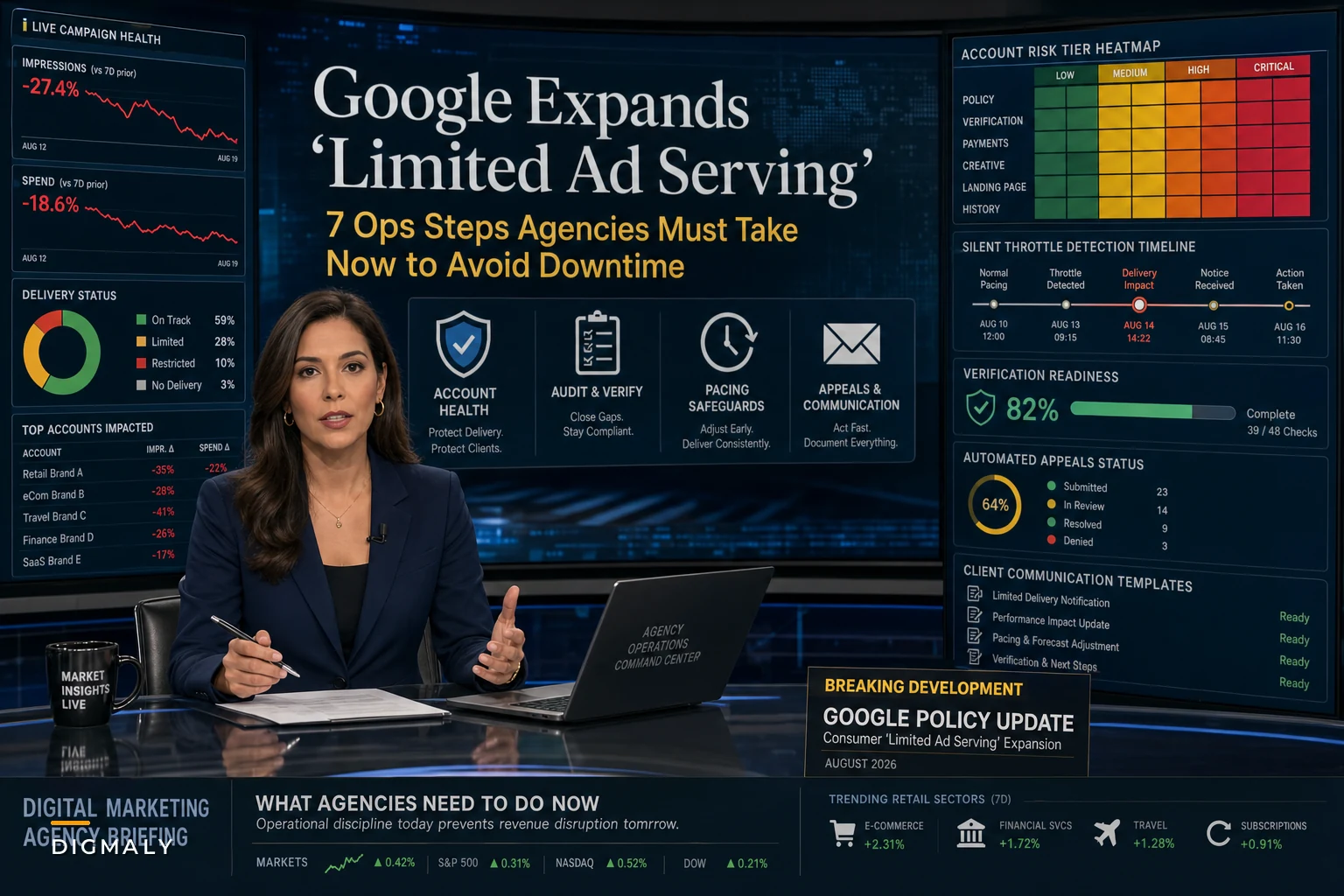

The old mental model for staying live on Google Ads was pretty straightforward: keep your ads policy-compliant, fix disapprovals fast, and delivery holds steady. That model just cracked.
Google's updated Limited Ad Serving policy, posted August 5, 2026, moves the throttling decision up a level — from the ad to the account. Instead of disapproving individual assets, Google will now cap impressions for advertisers it flags as "unqualified" based on trust signals: business verification status, account age and history, user reports, and overall policy track record. The rollout starts this month across Search, YouTube, Gmail, Discover, and the Play Store, with full expansion completing by 2028.
For a single in-house team running one account, that's an annoyance you fix once. For an agency managing 40, 80, or 200 client accounts, it's a structural problem. Delivery risk now has nothing to do with campaign quality and everything to do with account standing — something most agency dashboards don't even track.
What changes when throttling moves to the account layer
The important detail buried in the policy is the mechanism. Under the old regime, a bad ad got disapproved, you saw a red flag in the UI, and you knew what to fix. Limited Ad Serving doesn't work like that. When an account gets flagged, impressions get quietly reduced — sometimes to a trickle — while everything in the campaign view looks technically "eligible."
That's the part that catches teams off guard. There's no disapproval to react to. You just see delivery soften. As Search Engine Land noted in its reporting on the expansion, this applies across all Ads surfaces — meaning the same trust signal can suppress a client simultaneously on Search and YouTube even though the creative and targeting are completely different.
The operational trap is that most agencies detect problems through performance anomalies, not standing anomalies. If a client's leads drop 30% on a Tuesday, the first hypotheses are usually budget, bid strategy, or seasonality. "Google downgraded the account's trust status" isn't even on the whiteboard. By the time someone connects the dots, you've burned a week and a client's patience.
The real exposure: your portfolio's weakest verification links
Trust signals accrue at the account and business-entity level — and agencies tend to have a long tail of accounts with sloppy standing they've never had a reason to clean up.
Eliminate marketing chaos with streamlined campaign control.
Digmaly lets you plan, execute, and track every campaign effortlessly.
- Unified campaign management
- Real-time client reporting
- Collaborative team workflows
No credit card required
Think about which accounts in your book are most vulnerable:
-
Accounts you inherited mid-flight where you never completed advertiser verification because "it was already running"
-
Accounts tied to a client business whose legal name, website domain, and billing entity don't line up cleanly
-
Newer client accounts with thin history and a couple of past policy strikes from before you took over
-
Accounts where the client changed their landing page domain but never re-verified
None of those cause problems under an ad-level system. All of them become live delivery risks under an account-level trust system. The accounts that get throttled first are almost never your flagship clients with clean multi-year histories — they're the messy handoffs sitting quietly in the corner of your MCC.
Start audits with inherited or recently migrated accounts — they're the most likely weak links.
That's the deeper issue this policy exposes: agencies have been managing campaigns without managing account health as a first-class asset. Verification, entity consistency, and standing history were treated as one-time onboarding chores, not ongoing monitored conditions.
7 immediate ops steps to prevent downtime
Below is the sequence worth prioritizing if the rollout hits your portfolio this quarter. Order matters — the first three are about not getting caught blind, the rest are about staying qualified.
This workflow shows the steps you should run through when an alert fires.
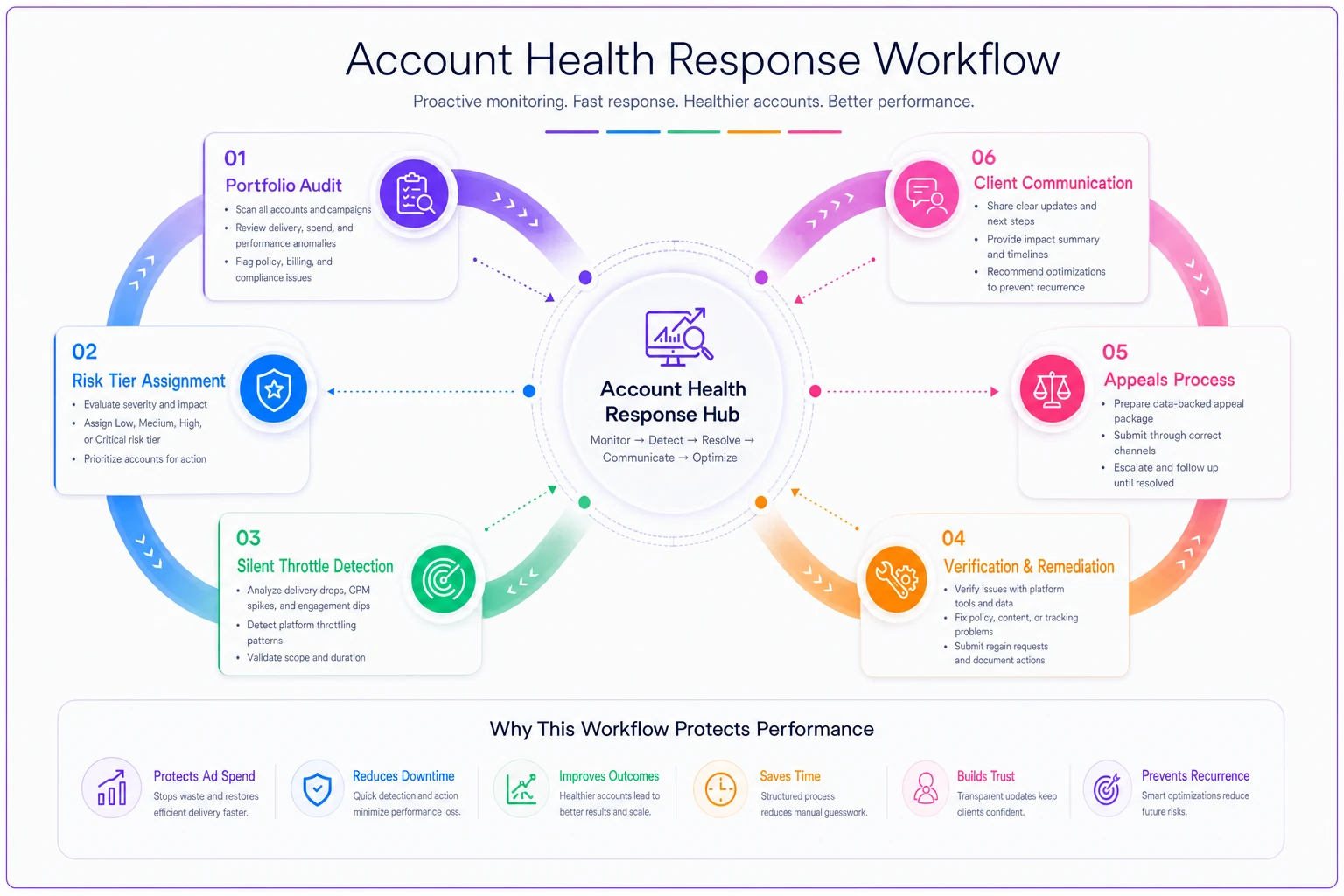
A quick visual of the response workflow.
1. Run a portfolio-wide verification audit this week
Pull every account in your MCC and log its current verification and standing status. You're looking for anything that isn't fully verified: incomplete advertiser identity verification, business verification gaps, or mismatches between the verified entity and the account's billing or domain.
Don't do this in your head. Build a simple sheet:
| Client account | Advertiser verified? | Business entity matches domain? | Prior policy strikes | Account age | Risk tier |
|---|---|---|---|---|---|
| Client A (flagship) | Yes | Yes | 0 | 4 yrs | Low |
| Client B (inherited) | Partial | No — domain changed | 1 | 14 mo | High |
| Client C (new) | No | Yes | 0 | 3 mo | Medium |
The "risk tier" column is the whole point. It tells you where to spend the next two weeks. Everything else in the audit is just context that gets you there.
2. Build a delivery-gap alert that watches for *silent* throttling
Because Limited Ad Serving doesn't produce a disapproval, you need to detect it through the symptom: impressions falling below expected range while campaigns remain eligible and budget-unconstrained.
A workable rule: flag any campaign where impressions drop more than roughly 40% week-over-week while the campaign is still marked eligible and hasn't hit its budget cap. That combination — eligible but under-delivering with budget headroom — is your early-warning fingerprint for account-level throttling.
Set this to check daily, not weekly. A week of delay on a client's primary lead channel is enough to trigger a "why are we down 50%" email that nobody wants to be on the receiving end of.
3. Stand up a fast verification and appeals workflow before you need it
When an account does get limited, speed of response matters, and the worst time to figure out your process is mid-incident. The triage, evidence-gathering, and client-communication structure in our ad account suspension runbook maps almost one-to-one onto Limited Ad Serving response — identify the trigger, gather documentation, submit a clean appeal, keep the client informed with a script rather than a panic email.
One adjustment worth noting: for Limited Ad Serving specifically, your "evidence" is usually verification completeness and entity consistency, not proving a specific ad was compliant. Different trigger, same discipline.
4. Reconcile entity, domain, and billing details across every account
This is the unglamorous work that actually moves trust signals. For each account, confirm the verified business name matches the domain registration and the billing entity. Where a client rebranded, moved domains, or restructured legally, get the verification updated to reflect current reality.
A typical mismatch looks like this: client's LLC is "Northgate Home Services LLC," the site is on northgatehvac.com, and billing runs through a parent holding company. All three being different is exactly the kind of inconsistency that quietly erodes trust standing over time — and nobody catches it because nothing visibly breaks.
5. Revise pacing and forecasting to assume delivery is *not* guaranteed
Most pacing logic assumes that if budget exists, impressions will follow. That assumption is now conditional. For higher-risk accounts, build a buffer into forecasts — don't promise a client full spend delivery on an account that's one trust flag away from a cap.
Practically, this means adding a delivery-confidence note to at-risk accounts in your internal forecasts and not front-loading aggressive budget increases on accounts you haven't verified. Ramping spend hard on an unverified, thin-history account is now a way to invite scrutiny rather than results.
6. Tighten landing-page and branding consistency checks
Trust signals extend past the account into where the ad sends people. Sudden landing-page domain changes, brand-name inconsistencies between the ad and destination, or thin-looking pages all feed the "unqualified" assessment.
Before any client domain migration, treat re-verification as part of the migration checklist — not something you get to after delivery softens.
7. Prep client communication *before* the first incident
Clients will notice delivery dips whether or not you explain them.
A short, plain proactive note — "Google is rolling out an account-level delivery policy through 2028; we've audited your account and here's your standing" — turns a future panic conversation into a moment where you look like the competent one in the room. Draft that note now, not when something breaks.
A realistic scenario: the inherited HVAC account
An agency managing paid media for a regional home-services company takes over an account that's been running fine — somewhere in the $18k–$22k monthly Search spend range, steady lead flow, nobody thinking twice about it.
The account was never fully re-verified after the handoff. The client also switched from a .net to a .com domain eight months in without updating verification. Under the old system, none of that mattered. Under account-level trust throttling, it's a stack of weak signals sitting there waiting.
When something like this gets limited, the visible symptom is a slow bleed — impressions down 35–45% over a couple of weeks, lead volume sagging, no disapproval anywhere to explain it. The agency that already ran a verification audit catches it in the "eligible but under-delivering" alert and fixes standing in days. The agency without that monitoring spends a week chasing bid strategies and answering an increasingly annoyed client, then loses the retainer over a problem that had nothing to do with campaign skill.
Same policy, same account type. The difference was entirely operational readiness.
When to treat an account as high-priority — and when to leave it alone
Not every account needs the full treatment. Over-auditing clean, long-history flagship accounts wastes time you should spend on the risky tail.
Prioritize immediately when:
-
The account was inherited and never fully re-verified
-
Entity name, domain, and billing don't align
-
There's any prior policy strike history
-
The account is under roughly 18 months old with thin spend history
-
A domain migration happened without re-verification
Lower urgency when:
-
The account has multi-year clean history and completed verification
-
Entity, domain, and billing all match
-
No policy issues on record
The mistake to avoid is applying uniform effort across the whole portfolio. Trust risk is concentrated, not evenly distributed — spend your time accordingly.
The underlying shift agencies need to internalize
The bigger lesson isn't really about one Google policy update. Platform-level trust is becoming an account asset you have to actively maintain, the same way you already maintain conversion tracking or campaign naming conventions. Platforms are moving decisions upstream — away from "is this ad okay" and toward "should this advertiser be delivering at all" — and that changes what agencies are actually responsible for monitoring.
The teams that come out of the 2026–2028 rollout in good shape won't be the ones with the cleverest bid strategies. They'll be the ones who treated account standing as a monitored, documented condition across their whole book — who knew which accounts were exposed before Google flagged anything, and had a response workflow ready instead of a scramble. Get the audit done, wire up a silent-throttling alert, and make verification a recurring operational check rather than a one-time onboarding box.
That's the difference between a policy footnote and a client-losing outage.
Ready to elevate your agency's performance?
Join 2,000+ agencies using Digmaly to save time, boost efficiency, and deliver superior client results.