

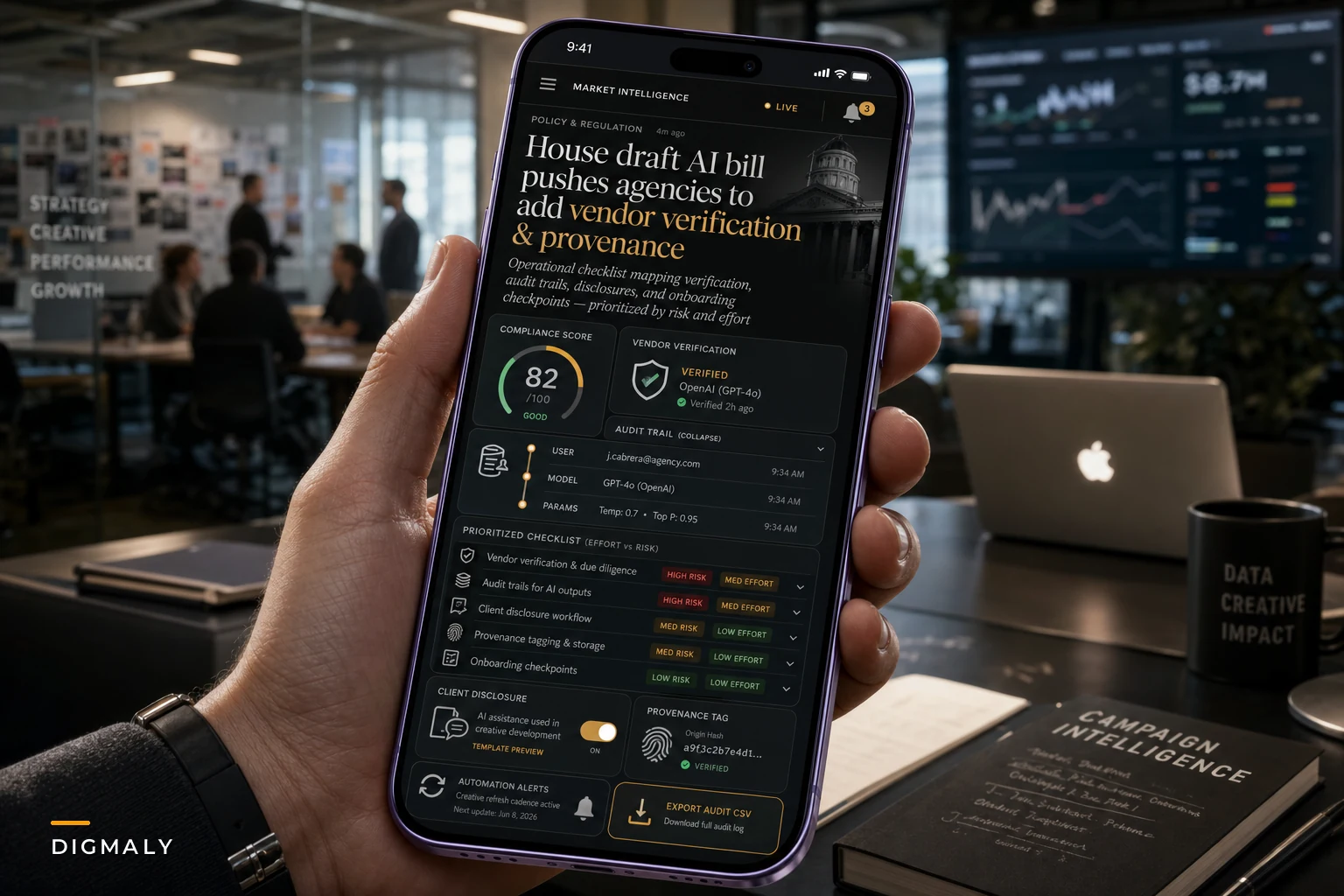

Last week, Representatives Jay Obernolte and Lori Trahan dropped a bipartisan discussion draft that's about to make your creative workflows a lot more complicated. The Great American AI Act proposes federal requirements that would force agencies to verify, audit, and document every AI tool touching their creative production.
If you're using Claude for copy variations, MidJourney for concept mockups, or ChatGPT for audience persona development, you're facing disclosure requirements, vendor verification mandates, and audit trails that your current workflows can't handle.
The three-year federal preemption window means you have maybe 18 months before these requirements become real operational headaches. Most agencies have zero infrastructure to track which creative assets used AI assistance, let alone prove vendor compliance or maintain audit logs for client work from two years ago.
Why agencies are uniquely exposed to AI compliance risk
Marketing agencies sit at an uncomfortable intersection when it comes to AI compliance for marketing agencies. You're not just using AI tools internally—you're creating client-facing materials that carry legal weight in regulated industries.
A pharma client's Facebook campaign copy generated with AI assistance? That needs documentation. Financial services display ads with AI-enhanced imagery? Those require audit trails. Even basic social content for retail clients becomes a compliance liability when you can't prove which tools touched it.
-
15-20 different creative tools across teams
-
Freelancers using personal AI accounts
-
Junior creatives experimenting with new AI platforms weekly
-
No central tracking of what's AI-generated versus human-created
One agency discovered their creative team was using 47 different AI tools. Nobody knew which client deliverables contained AI-generated elements. Their creative director couldn't tell them which version of GPT wrote their latest campaign headlines.
The draft bill's requirement for "transparency and independent verification for frontier models" means you'll need vendor compliance certificates for every tool. Good luck getting that from the Discord bot your designers found for background removal.
The hidden workflow bombs in your creative process
Your current creative workflow probably looks something like this: strategist develops brief, creative team produces concepts, rounds of revisions happen, final assets get approved. Simple enough.
Eliminate marketing chaos with streamlined campaign control.
Digmaly lets you plan, execute, and track every campaign effortlessly.
- Unified campaign management
- Real-time client reporting
- Collaborative team workflows
No credit card required
Now add AI compliance requirements to each step. Your strategist's audience insights from ChatGPT need provenance metadata. The copywriter's 50 headline variations need individual generation logs. Those MidJourney concept boards require model version documentation.
Asset handoffs become compliance nightmares When your designer passes concepts to the production team, they need to include which AI tools assisted, what prompts were used, and verification that those tools meet federal standards. Your current "here's the Figma link" handoff doesn't cut it.
Client approvals need new disclaimers Every creative presentation now needs AI usage disclosure. Not just "we used AI" but specifically which models, for what purpose, with what human oversight. Try explaining to your automotive client why their tagline was technically co-written by GPT-4.
Creative refresh cycles lose their speed Remember those quick copy tests you run? Each variation now needs documentation. Your automated creative fatigue alerts become useless when refreshing creative means updating compliance records, getting new vendor verifications, and maintaining audit trails for every iteration.
The operational reality gets worse. Agencies typically run multiple tools and informal processes that aren't designed to capture the provenance and verification data the draft bill demands.
Building compliance into creative operations without killing productivity
The agencies that survive this transition will build compliance into their operational DNA, not bolt it on as an afterthought.
Start with tool consolidation. You can't manage compliance across 47 random AI platforms. Pick your core creative AI stack—maybe one for copy, one for images, one for data analysis. Get vendor agreements that include compliance commitments. Create approved tool lists that teams actually follow.
Next, redesign your creative brief templates. Add fields for:
-
Permitted AI assistance levels
-
Required human oversight checkpoints
-
Client-specific AI restrictions
-
Documentation requirements by asset type
One agency restructured their entire creative process around "AI checkpoints"—specific moments where tool usage gets documented before work continues. Their brief kickoff includes AI tool selection. Concept development requires prompt documentation. Final production triggers compliance review.
Add AI-tool usage custom fields to your existing project management templates so documentation happens as part of normal task updates.
The smart move: integrate compliance tracking into your existing project management. Don't create a separate compliance system that everyone ignores. If you're using Monday or Asana, add custom fields for AI tool usage. Make it part of the natural workflow, not an extra step.
This diagram shows where AI compliance checkpoints fit into each stage of creative production.
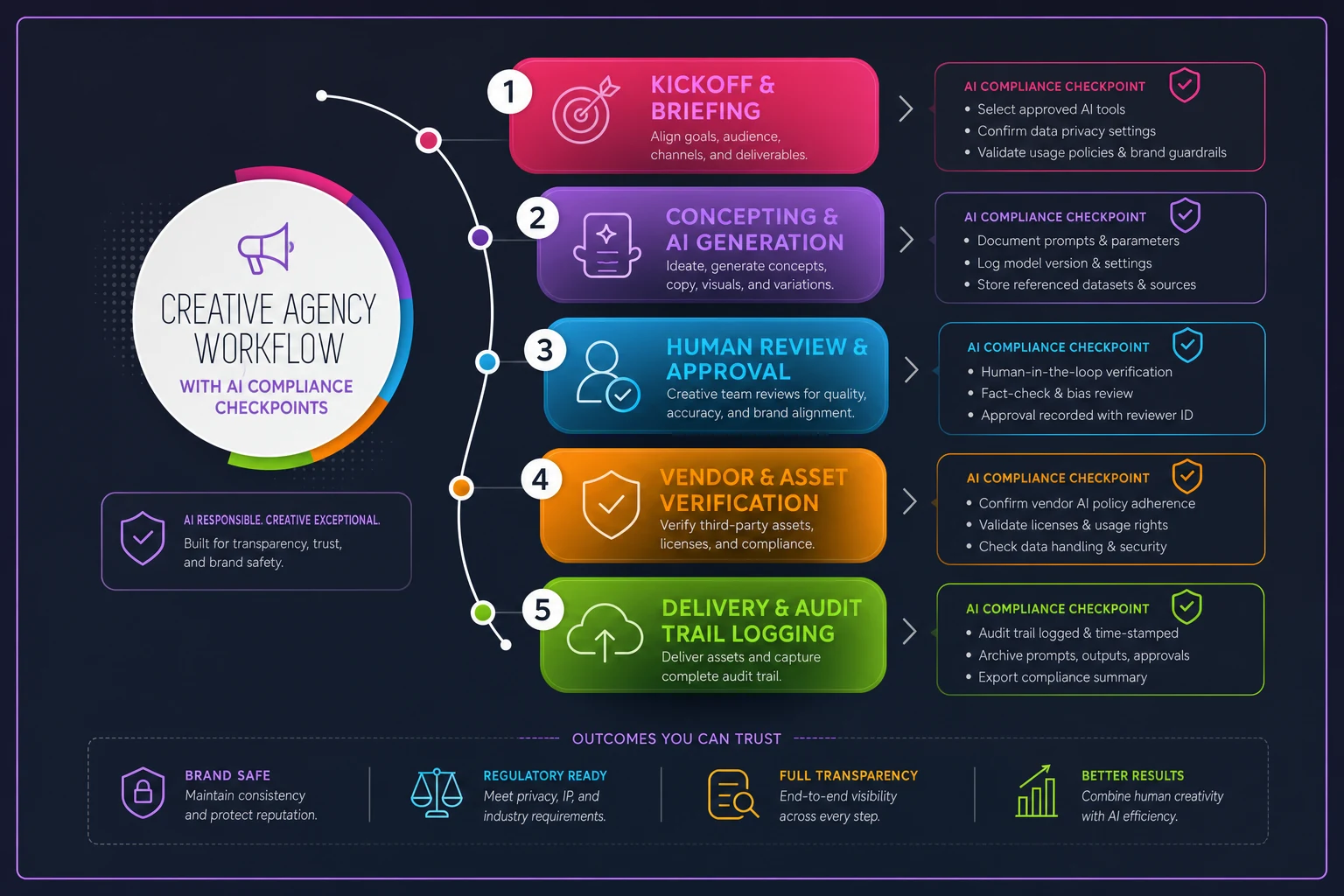
If compliance is embedded in the workflow, creatives don't need to become auditors; the system captures the necessary metadata.
The vendor management crisis nobody's preparing for
According to Reuters' coverage of the bill, the proposed Center for AI Standards and Innovation would establish verification requirements for AI model providers. That means every AI vendor you use needs to prove compliance.
Your current vendor onboarding probably involves a credit card and an email address. Under the new framework, you'll need:
Verification documentation
-
Model training data sources
-
Bias testing results
-
Security audit reports
-
Compliance certifications
Ongoing monitoring requirements
-
Quarterly compliance updates
-
Model version change notifications
-
Incident reporting procedures
-
Third-party audit results
Contractual protections
-
Indemnification for non-compliance
-
Data usage restrictions
-
Client work ownership clarity
-
Liability allocation for AI errors
One agency spent three months trying to get compliance documentation from their AI copywriting platform. The vendor didn't have it. They had to rebuild their entire copy production workflow around a different tool that could provide proper documentation.
Creating audit trails that actually work
The audit trail requirements will kill agencies that rely on informal creative processes. You need to track:
| Asset Stage | Required Documentation | Current Reality | Compliance Gap |
|---|---|---|---|
| Ideation | AI tools used, prompts, human input | Screenshots in Slack | No permanent record |
| Concept Development | Model versions, generation parameters | "Used MidJourney" | Missing technical details |
| Copy Creation | Source text, editing history, approval chain | Google Docs versions | No AI attribution |
| Production | Tool chain, processing steps, quality checks | Designer knowledge | Undocumented workflow |
| Client Delivery | Full AI disclosure, compliance certs | Creative brief | Insufficient detail |
Building these audit trails means operational changes at every level. Your creatives need to document their process, not just their output. Project managers need to verify documentation before moving to the next phase. Account managers need to understand compliance enough to explain it to clients.
Most agencies will try to fake this with spreadsheets. They'll create elaborate tracking documents that nobody updates. Two years later, when audit time comes, they'll have no real documentation for 80% of their creative work.
Real scenario: How one agency's AI transformation became a compliance disaster
A performance marketing agency in Austin went all-in on AI creative generation in early 2024. They cut their creative production time by 70%, scaled from 12 to 45 clients, and their founders were speaking at conferences about AI transformation.
By late 2025, they had:
-
Audit every creative asset from the past two years
-
Rebuild their entire creative workflow with compliance checkpoints
-
Renegotiate vendor agreements with AI platforms
-
Update all client contracts with AI disclosure terms
-
Hire a compliance operations manager
-
Implement AI-powered operational software to track and verify every creative element
The cost? Around $340,000 in direct expenses, plus lost productivity during the transition. They kept their clients, but barely.
When AI compliance actually helps your agency operations
Proper AI compliance for marketing agencies can actually improve your operations. The documentation requirements force you to fix problems you've been ignoring.
Tracking AI tool usage reveals redundant subscriptions. One agency discovered they were paying for seven different AI copywriting tools across teams—about $3,400 monthly in duplicate capabilities. Consolidation saved them $38,000 annually.
Audit trails create institutional knowledge. When your best creative director leaves, their AI prompts and workflows stay. New team members can see exactly how successful campaigns were built. The compliance documentation becomes your operational playbook.
Client trust increases with transparency. Sophisticated clients actually appreciate knowing how you're using AI. It shows operational maturity. Several agencies report winning pitches specifically because they could demonstrate AI governance while competitors couldn't.
The operational software advantage in compliance management
Manual compliance tracking breaks at scale. When you're producing hundreds of creative variants weekly, spreadsheet tracking becomes impossible. You need systems that automatically capture AI usage metadata, maintain audit trails, and generate compliance reports.
AI-powered operational software designed for agency workflows can embed compliance tracking into creative production. Instead of asking creatives to fill out forms, the system captures:
-
Which tools touched each asset
-
Generation parameters and prompts
-
Human review checkpoints
-
Approval chains and modifications
-
Client-specific compliance requirements
The platform approach also solves the vendor management problem. Instead of negotiating with dozens of AI tool providers, you work with one operational software vendor who handles downstream compliance. They maintain the vendor relationships, aggregate the compliance documentation, and provide unified reporting.
Agencies using integrated operational platforms report 40% less time on compliance tasks compared to manual tracking. That's time returned to actual creative work.
Building your 90-day compliance readiness plan
You can't wait for final regulations to start preparing. The agencies that move now will have workflows ready when requirements hit.
Days 1-30: Discovery and documentation
-
Audit all AI tools currently in use
-
Map which clients have AI-sensitive requirements
-
Document current creative workflows
-
Identify compliance gaps in vendor agreements
Days 31-60: Process design and tool selection
-
Design compliance checkpoints for creative workflows
-
Select and consolidate approved AI tools
-
Negotiate vendor compliance agreements
-
Update creative brief templates with AI fields
Days 61-90: Implementation and training
-
Roll out new workflows with pilot teams
-
Train creatives on documentation requirements
-
Implement operational software for tracking
-
Update client contracts with AI clauses
Don't try to solve everything at once. Start with your highest-risk clients (healthcare, finance, pharma) and your most AI-dependent workflows (copy generation, image creation). Build compliance muscles gradually.
Beyond compliance: The competitive advantage of AI governance
Agencies that nail AI compliance for marketing agencies will have a massive advantage over those that don't. When clients start asking about AI governance—and they will—you'll have answers backed by documentation, not promises backed by panic.
Your operational maturity becomes a selling point. While competitors scramble to explain their AI usage, you're showing prospects your governance dashboard. You're demonstrating audit trails. You're providing compliance certificates with proposals.
The agencies still running creative like it's 2023—no documentation, random tools, informal processes—won't survive the compliance era. They'll lose regulated clients first, then risk-averse ones, then anyone who cares about intellectual property clarity.
Smart agencies are already building AI governance into their service offerings. They're charging for compliance management. They're winning enterprise clients who need documented AI controls. They're turning a regulatory requirement into a revenue stream.
The Great American AI Act draft isn't just another compliance requirement—it's forcing agencies to professionalize operations that have been intentionally chaotic for decades. Creative processes that thrived on flexibility now need structure. Tool experimentation now needs governance. Fast iteration now needs documentation.
For agencies already struggling with operational maturity, this feels impossible. But for those willing to rebuild their creative operations with compliance in mind, it's an opportunity to finally fix the broken workflows everyone pretends are fine.
The next 18 months will separate agencies into two camps: those who built real operational infrastructure for AI governance, and those who hoped the requirements would go away. The choice you make now determines which camp you'll be in when the auditors come calling.
Start with one client, one workflow, one proper audit trail. Build from there. Because whether this exact bill passes or not, AI governance requirements are coming to marketing agencies. The only question is whether you'll be ready when they arrive.
Ready to elevate your agency's performance?
Join 2,000+ agencies using Digmaly to save time, boost efficiency, and deliver superior client results.