


The decision itself is the easy part. Most agency teams can look at a client, eyeball their revenue and data setup, and roughly guess whether they should lean on media mix modelling, run holdouts, or trust data-driven attribution. Where things fall apart is the week after you make that call — when someone has to build the data pipeline, define a conversion window, get consent right, and prove to a skeptical client that the number you're reporting means anything.
This is that week. If you've already worked through the media-mix decision framework for agencies, think of this as the operational layer underneath it. We're not re-litigating which method to pick. We're getting into the actual work of operationalizing whichever one you landed on — specifically for mid-market e-commerce merchants in the $5M–$50M GMV range, where budgets are big enough to matter but data teams are usually one overworked analyst and a Shopify export.
Who this is for: agency teams who've promised a client "measurement" and now have to deliver something defensible. Not a theory. A working setup.
First, match the method to reality (not to what sounds impressive)
Before any engineering happens, you need an honest read on two axes: client size and data maturity. These don't move together. Plenty of $30M merchants have garbage data hygiene, and some $6M DTC brands have a clean warehouse because the founder came from an engineering background.
Here's the practical mapping for mid-market:
| Client profile | Monthly ad spend | Data maturity | Primary method | Why |
|---|---|---|---|---|
| Small mid-market | ~$30k–$80k | Low (pixel + platform reports only) | Data-driven attribution + light holdouts | Not enough spend volume for stable MMM; DDA gives directional signal fast |
| Growing mid-market | ~$80k–$250k | Medium (warehouse exists, tagging inconsistent) | Holdouts as primary, DDA as day-to-day | Enough traffic to power geo/audience holdouts with acceptable MDE |
| Upper mid-market | ~$250k+ | Medium-high (clean warehouse, server-side events) | MMM + holdouts to calibrate | Multi-channel spend and seasonality make MMM worth the modelling cost |
The mistake that comes up constantly: an agency sells MMM to a $40k/month client because it sounds sophisticated. Three months in, the model can't separate channel effects because there isn't enough variation in spend. Confidence intervals are wider than the client's entire paid social budget. That's not a measurement program — that's an expensive shrug.
When MMM actually makes sense: the client spends across at least four or five channels, has 18+ months of history, and has meaningful spend fluctuation to learn from. Below that, you're modelling noise.
When holdouts are the right call: you can carve out a clean control group — geographic regions, audience segments, or time-based windows — and conversion volume is high enough to detect a realistic lift.
When DDA is enough: early-stage mid-market where the client mostly needs to stop wasting money on obviously bad placements, and "directionally correct, updated daily" beats "rigorous, updated quarterly."
The starter checklist: what to build before you report a single number
This is the part everyone skips and then regrets. Whatever method you chose, the underlying data plumbing is largely the same. Run this in order — the sequencing matters because each step depends on the one before it.
Eliminate marketing chaos with streamlined campaign control.
Digmaly lets you plan, execute, and track every campaign effortlessly.
- Unified campaign management
- Real-time client reporting
- Collaborative team workflows
No credit card required
-
Tagging audit. Crawl every conversion-relevant page and event. Document what's firing, what's double-firing, and what's silently broken. In practice, roughly a third of mid-market merchants have at least one purchase event firing twice on the thank-you page — usually a leftover GTM tag nobody removed after a theme migration. Find it now, not during reconciliation.
-
Server-side events. Move purchase and high-value events server-side (Conversions API, server-side GTM, whatever the stack supports). Browser-only tracking is losing you 15–30% of signal on iOS traffic. This isn't optional for anything measurement-grade.
-
Canonical order ID. Pick one order identifier that exists in every system — the platform, the payment processor, the warehouse, the ad platforms. This single field is the spine of your entire dedupe and calibration workflow. If Shopify calls it
orderidand your CAPI payload sendstransactionidwith a different value, stop and fix it. Everything downstream breaks otherwise. -
Dedupe rules. Define exactly how a conversion counts once. The typical rule set: dedupe on canonical order ID first, then on a hashed email + timestamp window as a fallback for events missing the ID. Write down the precedence order. Ambiguity here is where "the platform says 400 sales, the warehouse says 372" arguments come from.
-
Data warehouse schema. You need a normalized place for events to land. Minimum viable schema below.
-
Conversion windows & LTV definitions. Agree on the click and view windows in writing with the client (7-day click / 1-day view is a common baseline, but match it to their actual purchase cycle). Then define whether you're optimizing to first-order value or contribution-margin LTV. A supplements brand with a 60% repeat rate should not be measured on first-order ROAS — you'll under-invest in channels that drive loyal buyers.
-
Consent & privacy wiring. Consent mode signals need to flow through to your server-side layer. If a user declines, that has to be respected all the way down the pipe, not just in the cookie banner.
-
Measurement health monitoring. A daily check that events are flowing, volumes are within expected bands, and nothing's silently dropped. A broken tag discovered three weeks later invalidates three weeks of holdout data.
Treat canonical order ID mismatch as a blocker for any modelling or holdout that relies on deduped conversions.
Minimum warehouse schema for e-commerce measurement
orders
-
canonicalorderid(PK) -
order_timestamp -
customeridhashed -
gross_revenue -
contribution_margin -
isfirstorder(boolean) -
region/geo_code
events
-
event_id(PK) -
canonicalorderid(FK, nullable for non-purchase events)` -
event_type -
event_timestamp -
source(browser / server) -
consent_status
ad_spend
-
date -
channel -
campaign_id -
spend -
impressions,clicks
touchpoints
-
touchpoint_id(PK) -
customeridhashed -
channel -
touchpoint_timestamp -
campaign_id
The consent_status field on events is the one people forget, and it's the one that makes your privacy posture defensible later. If regulators or the client's legal team ask how declined-consent users are handled, you point at the field and the filter logic.
Sizing holdouts without a statistics PhD
Here's the rule-of-thumb calculator we use so account managers can size a test before promising anything.
You need three inputs: baseline conversion rate, the minimum detectable effect (MDE) you care about, and your test/control split.
The quick approximation for sample size per group:
> n ≈ 16 × p × (1 − p) / (MDE)²
where p is your baseline conversion rate and MDE is the absolute lift you want to detect (expressed as a proportion). The 16 bakes in roughly 80% power at 95% confidence — good enough for operational decisions.
Worked example. A merchant converts at 2.5% (p = 0.025). You want to detect a 10% relative lift — that's a move from 2.5% to 2.75%, so absolute MDE = 0.0025.
n ≈ 16 × 0.025 × 0.975 / (0.0025)² n ≈ 16 × 0.024375 / 0.00000625 n ≈ 0.39 / 0.00000625 n ≈ 62,400 per group
So you need roughly 62k sessions in each of test and control. If the client does 250k sessions/month, that's very runnable — a couple weeks. If they do 40k sessions/month, a 10% MDE means a multi-month test, and you should either accept detecting only larger effects (a 20% lift needs around four times fewer sessions) or use geo-based holdouts instead.
The honest issue here: most agencies promise clients they'll "prove" small lifts they mathematically cannot detect at their traffic level. Run the number first. If the MDE required for a runnable test is 25%, tell the client upfront — "we can detect big wins and big failures, not fine-tuning" — and set expectations before the invoice, not after.
Recommended holdout designs for mid-market
-
Geo holdouts are usually the cleanest for this segment. Hold back spend in a matched set of DMAs or regions. Works well when the client ships nationally and has enough regional order volume. Watch for spillover in adjacent markets.
-
Audience/PSA holdouts on paid social — serve a public-service or unrelated ad to the control group. Good for isolating a single channel's incremental effect.
-
Time-based holdouts (on/off periods) are the weakest because seasonality and trend contaminate them. Only use when geo and audience splits aren't feasible, and always pair with a comparison against modelled expectations.
For most $80k–$250k/month merchants, a geo holdout on the largest channel run for a full purchase cycle plus two weeks is the pragmatic default.
The calibration workflow: making three methods agree
This is where measurement programs earn their keep — reconciling MMM, DDA, and holdout results into one story instead of three contradictory dashboards. The point of holdouts isn't just to measure one channel; it's to calibrate your always-on methods.
In plain terms: run your holdout on Meta. It tells you the true incremental ROAS for that channel over the test window — call it 2.1x. Meanwhile your DDA model has been claiming Meta delivers 3.4x, and your MMM estimated 1.8x. Now you have an anchor. The holdout is your ground truth.
The diagram below shows the calibration workflow and how the holdout anchors ongoing reporting.
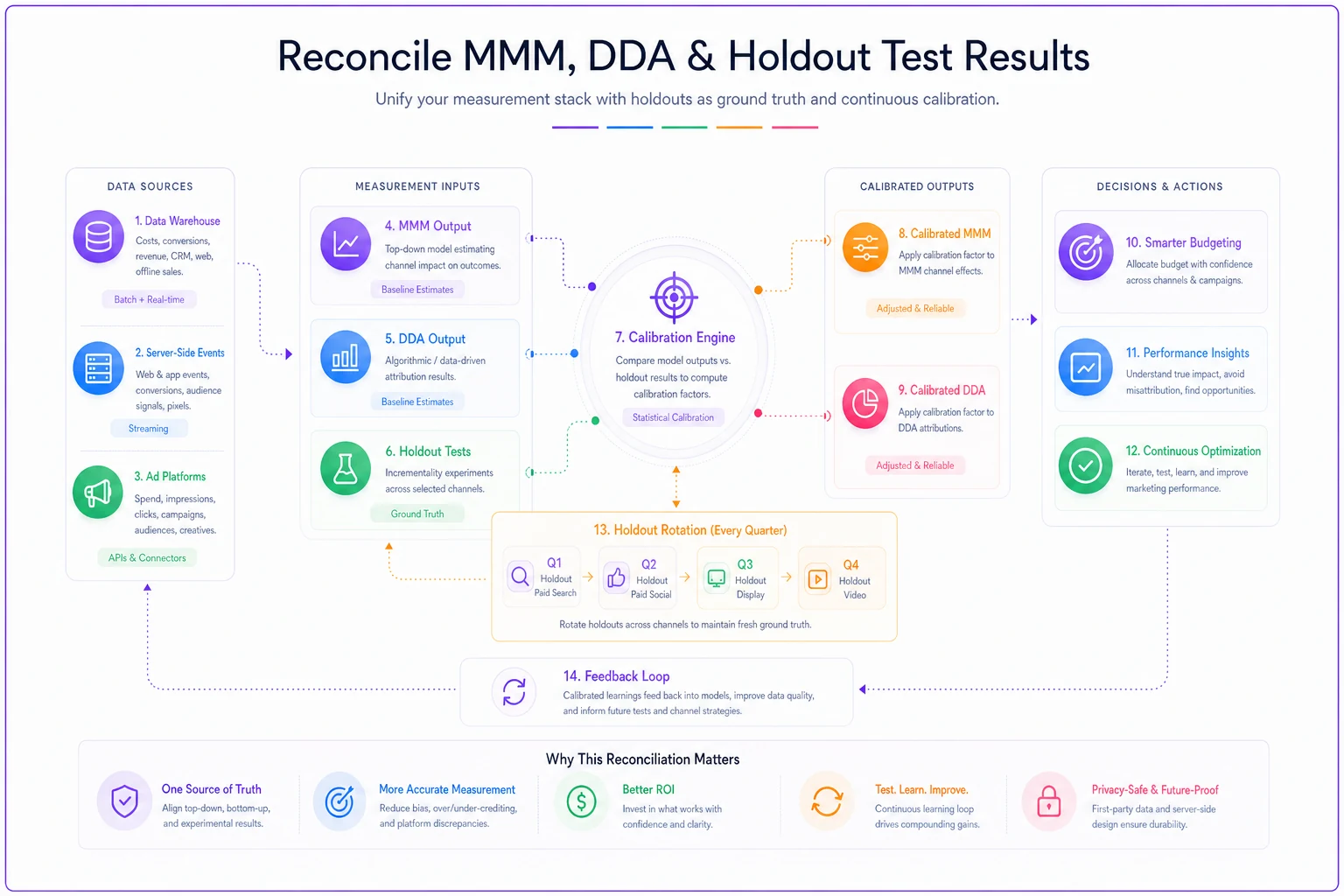
You then compute a calibration factor — the ratio between what the always-on method claimed and what the holdout proved. If DDA said 3.4x and truth was 2.1x, DDA is overcrediting Meta by roughly 62%. Apply that correction to DDA's ongoing Meta numbers until your next holdout. MMM undercredited, so it gets adjusted up.
The pattern worth internalizing: DDA almost always overcredits channels running retargeting (they intercept purchases that would've happened anyway), and MMM tends to undercredit fast-moving performance channels because it smooths over short bursts. Holdouts arbitrate. Run a rotating holdout on a different channel each quarter and over a year you've calibrated your whole mix against reality.
Document the calibration factors and their expiry dates. A calibration from Q1 shouldn't quietly govern Q4 reporting after the creative and audience have completely changed.
Privacy & consent: the actionable version
Operationally, here's what a measurement team actually has to do:
-
Consent mode wired end-to-end. Declined consent must suppress server-side event forwarding, not just client-side pixels. Verify with a test purchase in decline state and confirm nothing lands in
ad_spend-linked destinations. -
Hash all PII before it hits the warehouse. Emails and phone numbers get hashed at ingestion. Raw PII should never sit in your
eventsortouchpointstables. -
Regional consent logic. EU/UK traffic defaults to opt-out until consent; US traffic follows the client's stated policy. Bake the region check into the pipeline.
-
A deletion path keyed to
customeridhashed. When a deletion request comes in, you need to purge that customer across all tables using one key. If you can't do it in one query, your schema isn't request-ready.
A written record of your conversion windows and dedupe rules. When numbers get challenged — and they will — this document ends the argument.
RACI governance: who signs off on what
Measurement programs rot when nobody owns them. A conversion window quietly changes, someone edits a tag, and two months later the client asks why performance "dropped." Assign these roles at kickoff.
| Task | Responsible | Accountable | Consulted | Informed |
|---|---|---|---|---|
| Tagging audit & fixes | Analytics engineer | Measurement lead | Client dev | Account manager |
| Warehouse schema | Data engineer | Measurement lead | — | Analytics team |
| Conversion window / LTV definition | Measurement lead | Account director | Client marketing lead | Whole pod |
| Holdout design & sizing | Measurement lead | Account director | Media buyer | Client |
| Calibration & reconciliation | Analyst | Measurement lead | Media buyer | Account manager |
| Consent / privacy wiring | Data engineer | Compliance owner | Legal | Measurement lead |
| Measurement health monitoring | Analytics engineer | Measurement lead | — | Account manager |
| Client-facing number sign-off | Account director | Account director | Measurement lead | Client |
The one row people fight over is client-facing number sign-off. It has to sit with one person who understands both the method's limitations and the client relationship. If your media buyer is publishing platform-reported ROAS to the client while your analyst is calibrating a different number in the warehouse, you've got two truths and one very confused client.
Measurement health monitoring — the part that keeps it honest
A holdout is only valid if the tracking held for its entire duration. So the boring daily checks matter more than the fancy modelling:
-
Event volume within expected daily bands (flag anything ±30% from trailing average).
-
Server-side and browser event counts in expected proportion — a sudden collapse in server events means CAPI broke.
-
Dedupe rate stable. A jump in duplicate rate signals a new tag firing somewhere.
-
Consent-status distribution stable. A cliff usually means a consent banner change on the client's site.
-
Canonical order ID join rate above ~98%. Below that, orders are falling out of your spine and every downstream number is suspect.
Lightweight automation genuinely earns its place here — running these checks continuously and alerting the pod the day something drifts, rather than discovering a three-week gap during quarterly reconciliation. The modelling can be quarterly; the health monitoring has to be daily, and nobody wants to run those queries by hand every morning.
A quick real scenario
A home-goods DTC brand, roughly $18M GMV, came in convinced they needed MMM because a previous agency had name-dropped it. Spend was around $140k/month, mostly Meta and Google, with a messy pixel setup and no warehouse. MMM was the wrong first move — not enough channels, and the data wasn't clean enough to trust the inputs.
The actual path: fix the tagging (two duplicate purchase events found on the thank-you page), stand up server-side events, build the minimal schema, and run a geo holdout on Meta. DDA had been reporting Meta at 3.1x. The holdout came back around 2.0x incremental. That overcredit had been quietly justifying budget that wasn't driving new demand.
They shifted roughly $18k–$22k/month from Meta prospecting into Google non-brand and a small YouTube test. Blended contribution margin improved noticeably over the next two quarters — not a hockey-stick miracle, just money that had been leaking into overcredited retargeting now doing real work. MMM came later, once there was enough clean history to make it worth building.
The lesson isn't "MMM bad." It's that the sequence — clean data, then holdouts to establish truth, then modelling — consistently beats reaching for the most sophisticated-sounding tool on day one.
Where to start Monday morning
Pick your method using the size-and-maturity table, but don't let that decision block the plumbing. The tagging audit, server-side events, canonical order ID, and warehouse schema are prerequisites regardless of which method wins. Build those first.
Then size your holdout honestly with the rule-of-thumb calculator before you promise the client anything. Use holdouts to calibrate whatever always-on method you run day to day. Assign the RACI roles at kickoff so nobody's editing conversion windows without oversight.
Measurement for mid-market e-commerce isn't about having the fanciest model. It's about having numbers you can defend when the client's CFO asks a hard question — and a pipeline clean enough that the answer is the same one you gave last month.
Ready to elevate your agency's performance?
Join 2,000+ agencies using Digmaly to save time, boost efficiency, and deliver superior client results.