



The FTC opened public comment this month on a policy that could force businesses to disclose when they use a person's data to set an individual price or offer. Reuters reported the agency is weighing whether companies must clearly tell consumers when personalized pricing is in play, and Fortune framed it as a response to how much consumer surveillance tech now makes individualized pricing trivially easy.
What most agency people miss: they assume this is their client's retail problem. But if you're running dynamic offer logic, segmented discount codes, first-time-visitor promos, or audience-based landing page swaps, you're already touching personalized pricing whether you call it that or not. When disclosure enforcement lands, the client is going to look at you — the agency that built the funnel — and ask what data fed those offers and where the paper trail is.
Most agencies won't have a clean answer. That's the real exposure.
Start with the audit, because you can't disclose what you can't find
Before anything else, you need to know where personalized pricing actually lives in your accounts. The problem is it rarely lives in one place. It's scattered across ad platform audience rules, landing page personalization scripts, email/SMS segmentation, and sometimes a CRO tool nobody remembers installing.
Personalization typically gets built incrementally. Someone adds a returning-visitor discount in Q1. Someone else layers in a geo-based offer in Q3. A year later there are six overlapping rules and no single document explaining which data signal triggers which price. That's fine until a regulator — or a client's lawyer — asks you to map it.
Keep a living inventory that ties each offer to its data signal and owner.
Run the audit against these categories:
-
Ad-level offers — audience segments tied to different promo creative (new vs. returning, high-LTV lookalikes, cart abandoners)
-
Landing page logic — dynamic price/offer blocks that change based on UTM, cookie, or logged-in state
-
Email/SMS pricing — segment-specific discount codes driven by behavioral or purchase-history data
-
Third-party personalization tools — CRO platforms, recommendation engines, any script that alters displayed price
-
Bidding-driven offers — value-based bidding that effectively pushes different offers to different individuals
Don't treat this as a one-page inventory. It needs to show the data input behind each offer, not just the offer itself. "Returning visitors get 10% off" isn't the compliance question. "We identify returning visitors using a first-party cookie plus hashed email match from the CRM" — that's what disclosure rules will actually care about.
The 7 operational steps, in the order that actually works
Sequence matters here. If you write client disclosures before you've mapped data flows, you'll disclose the wrong thing and have to walk it back. This is the order that holds up.
Eliminate marketing chaos with streamlined campaign control.
Digmaly lets you plan, execute, and track every campaign effortlessly.
- Unified campaign management
- Real-time client reporting
- Collaborative team workflows
No credit card required
-
Inventory every personalized-offer mechanism across ad accounts, landing pages, email, and third-party tools. One row per mechanism.
-
Trace the data lineage for each — what signal triggers it, where that signal comes from, and who owns the source system.
-
Classify by risk. Offers driven by sensitive or inferred data (health interest, financial proxy, precise location) sit at the top. Broad behavioral signals sit lower.
-
Update measurement and reporting so personalized-offer performance is flagged separately, not blended into overall ROAS.
-
Add disclosure checkpoints to creative approval and landing page QA so nothing ships without a compliance review flag.
-
Revise vendor and client contracts to assign responsibility for disclosure and clarify who controls the data feeding the pricing logic.
-
Draft client-facing communications explaining what's changing and what you need from them — legal sign-off on disclosure language, mostly.
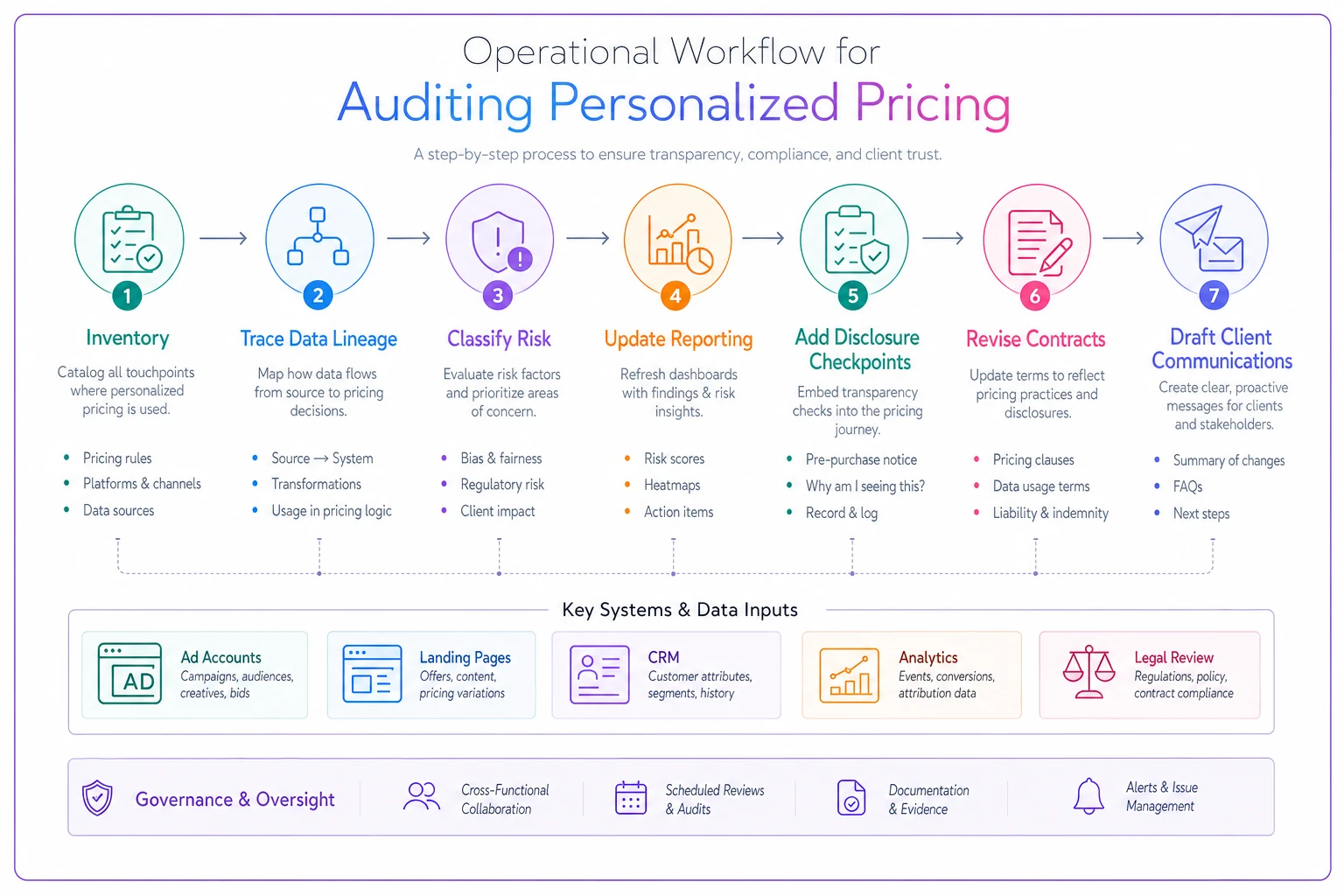
Steps 1–3 are discovery. Steps 4–7 are the operational hardening. Most agencies want to jump straight to step 7 because it feels like progress, but a disclosure email built on an incomplete inventory just creates a written record of what you didn't know.
Reporting is the part people underestimate
There's a quiet problem here. When you run personalized offers, your reporting usually buries them. A 10%-off returning-visitor promo gets absorbed into overall conversion rate and blended ROAS. Nobody breaks out "revenue attributable to individualized pricing" because there was never a reason to.
Under a disclosure regime, that changes. You'll want to answer two questions on demand: how many conversions came from a personalized offer, and what data drove the personalization. If your dashboards can't isolate that, you're rebuilding reporting under pressure instead of doing it calmly now.
A simple way to structure the split:
| Offer type | Data signal used | Disclosure needed? | Reported separately? |
|---|---|---|---|
| Sitewide promo (everyone) | None | No | Optional |
| New vs. returning discount | First-party cookie | Likely yes | Yes |
| Segment discount (purchase history) | CRM behavioral data | Yes | Yes |
| Geo-based offer | Location/IP | Depends on granularity | Yes |
| Lookalike-driven offer | Inferred/modeled data | Yes | Yes |
Worth noticing: the offers that perform best tend to be the ones highest on the disclosure-risk list. The purchase-history segment discount quietly lifting revenue is exactly the mechanism regulators are pointing at. The reporting work and the compliance work aren't separate projects — they're the same audit viewed from two angles.
Where this actually gets messy: data lineage
You can inventory offers in an afternoon. Tracing where the data came from is where agencies stall, because the honest answer is often "we're not totally sure." A discount fires on a segment built two years ago from a data source that's since been deprecated, and nobody can reconstruct the logic.
This is the underlying issue the FTC proposal exposes, and it's bigger than pricing. Agencies have been running on data plumbing they can't fully explain. Personalized pricing just makes the gap legally visible.
If you've already built proper role matrices, credential rotation, and lineage checks, this is a manageable extension of that work. If you haven't, the personalized-pricing audit is going to double as a forced data-governance project. It's worth going through the data governance framework for ad ops first, because disclosure requirements sit directly on top of clean lineage — you literally cannot disclose "we use X data to set your price" if you can't confirm which data X actually is.
The practical lineage check for each offer: name the source system, name the owner, confirm the signal is still live, and confirm you have documented consent basis for using it that way. Any offer that fails one of those four gets paused or reworked, not disclosed.
A real scenario
A mid-size ecommerce agency managing a home-goods brand had three overlapping personalized offers running: a first-purchase code, a win-back discount for lapsed customers, and a "high-value segment" early-access offer built off CRM purchase data. Combined, these were driving somewhere around a third of promo-attributed revenue — roughly $40k–$50k monthly across the account.
When they ran a disclosure audit, they found the win-back segment was built on an email list imported from a previous agency, with no documented consent record for behavioral targeting. Not a huge segment, but a real liability. They paused that offer, rebuilt the segment on properly consented first-party data over about six weeks, and added a plain-language disclosure line to the landing page.
Revenue dipped slightly during the rebuild — a few thousand dollars — then recovered once the compliant version launched. The bigger win wasn't the revenue recovery. It was that when the client's legal team asked "can you prove how these offers are targeted," the agency had a one-page lineage doc ready instead of a scramble. That's the difference between being the agency that gets renewed and the one that gets blamed.
When to move now vs. when to wait
Move now if:
-
You run purchase-history or behavioral segment discounts
-
Your clients are in regulated-adjacent verticals (finance, health, insurance)
-
You inherited data or segments from a prior agency and can't fully trace them
-
You have large accounts where a compliance issue would be an existential client-relationship risk
You can stage it if:
-
Your personalization is limited to broad, non-sensitive signals (sitewide promos, simple new-vs-returning)
-
You have small accounts with clean, recent first-party data
-
You've already done a governance pass in the last year
Who should not overreact: agencies running purely broad, undifferentiated promos with no individual data driving price. You still want the inventory on file, but you're not the target of this.
Client communication without causing panic
The temptation is to send clients a scary email about regulation. Don't. What they actually need is a short note that says: here's what we're auditing, here's what we found, here's what needs your legal team's sign-off. Frame it as you getting ahead of it on their behalf — because you are.
Agencies that handle this well treat it as an operational upgrade they're delivering, not a fire drill they're forwarding. A disclosure requirement, handled cleanly, is a reason clients trust you more, not less. Handled badly — or ignored until enforcement — it becomes the thing that shows up in the "why we left our agency" conversation.
The real takeaway isn't about personalized pricing specifically. Regulators keep making agencies prove they understand their own data. Every agency that already knows where its data comes from, who owns it, and what it's used for will absorb this proposal as routine work. Everyone else will be reverse-engineering their own funnels under a deadline. Do the audit now, while it's still optional.
Ready to elevate your agency's performance?
Join 2,000+ agencies using Digmaly to save time, boost efficiency, and deliver superior client results.