



Yesterday's Fed meeting ended exactly how most agencies expected it wouldn't. The Federal Reserve kept rates steady at 3.50%–3.75%, but the real gut punch came from their forward guidance—at least one more hike coming later this year, plus a bump in their near-term inflation outlook.
For agencies running on 15-25% margins with clients already cutting budgets, this isn't just another macro update to file away. It's an immediate operational problem that hits every corner of your business.
The domino effect nobody's talking about
Most agency owners focus on the obvious stuff—higher borrowing costs, tighter client budgets. But the real operational damage happens in places you're not watching.
Your media buyers are about to face a brutal reality. Client CFOs who were fine with $50K monthly ad spend when money was cheap are now scrutinizing every dollar. And it's not just cuts—they want the same results with 30% less spend. Your team will burn hours trying to squeeze performance from campaigns that simply don't have the fuel to run properly.
Meanwhile, your cash conversion cycle is quietly doing damage. Clients stretch payment terms from net-30 to net-45 or net-60. Your vendors still want payment on time. That gap becomes a canyon fast. Agencies around the $2M annual revenue mark typically need somewhere in the $160-170K range in working capital to operate smoothly. In this rate environment, that number jumps to $240K or more.
The talent situation gets particularly ugly. Competitors who locked in credit facilities at 4% two years ago can still afford to poach your best people. You're stuck choosing between expensive debt to retain talent or watching your A-players leave.
Step 1: Implement dynamic pricing triggers based on utilization and cash position
Forget annual pricing reviews. You need pricing that responds to operational reality on a rolling basis.
Eliminate marketing chaos with streamlined campaign control.
Digmaly lets you plan, execute, and track every campaign effortlessly.
- Unified campaign management
- Real-time client reporting
- Collaborative team workflows
No credit card required
-
Team utilization rates
-
Days sales outstanding (DSO)
-
Gross margin by client
When utilization drops below 75% for two consecutive weeks, that's your signal to raise prices on new proposals by 10-15%. Sounds counterintuitive? It's not. Lower utilization usually means you're over-servicing existing clients. Higher prices either improve margins or naturally filter out unprofitable work.
Track your DSO. When it crosses 45 days, add a 2% monthly finance charge to all new contracts. Automatic, non-negotiable. Clients who balk at finance charges are telling you they plan to pay late.
One agency I worked with implemented this system and saw something unexpected—close rate went up around 8%. Clients interpreted the structured pricing as sophistication, not desperation.
Step 2: Create staged budget reduction playbooks before clients ask
Clients will cut budgets. Not if—when. The agencies that come out okay have already mapped out exactly how they'll handle 10%, 25%, and 40% budget cuts for each client.
For a 10% cut, you're looking at channel consolidation. Drop the experimental TikTok campaigns and double down on proven Google Ads performance. Your playbook should specify which channels get cut first, which campaigns merge, and how you communicate the shift.
At 25%, you need service-level adjustments. Maybe weekly reporting becomes bi-weekly. Maybe you sunset custom creative and shift to template-based assets. The key is having these decisions made in advance, not during a panicked client call.
The 40% cut requires fundamental restructuring—moving the client to a project-based model, bringing in junior resources, or honestly recommending they work with a smaller agency. Sometimes firing yourself is the most profitable decision you can make.
Build these playbooks now while you're thinking clearly. Include specific email templates, meeting agendas, and transition timelines. When the cut request comes, you respond with options instead of scrambling.
Step 3: Restructure retainers with built-in elasticity and escape clauses
The traditional 12-month retainer doesn't hold up in this environment. Clients can't commit to fixed spend when their own revenue is unpredictable. But that doesn't mean abandoning recurring revenue.
Design retainers with monthly baseline fees covering roughly 60% of scope, then performance bonuses that can add another 40%. A client paying $20K monthly might have a $12K base covering core management and reporting, with up to $8K in performance incentives tied to specific KPIs.
Include bilateral escape clauses. If client ad spend drops below a threshold—say, 70% of planned—they can exit with 30 days notice. But if they consistently demand out-of-scope work (tracked and documented monthly), you get the same exit right.
Add utilization credits that roll forward. If a client uses 30 hours of their 40-hour monthly allotment, those 10 hours bank for up to 90 days. This prevents the month-end scramble to "use up" hours while giving clients flexibility around campaign launches or busy periods.
Step 4: Build a three-scenario cash flow model and stress test weekly
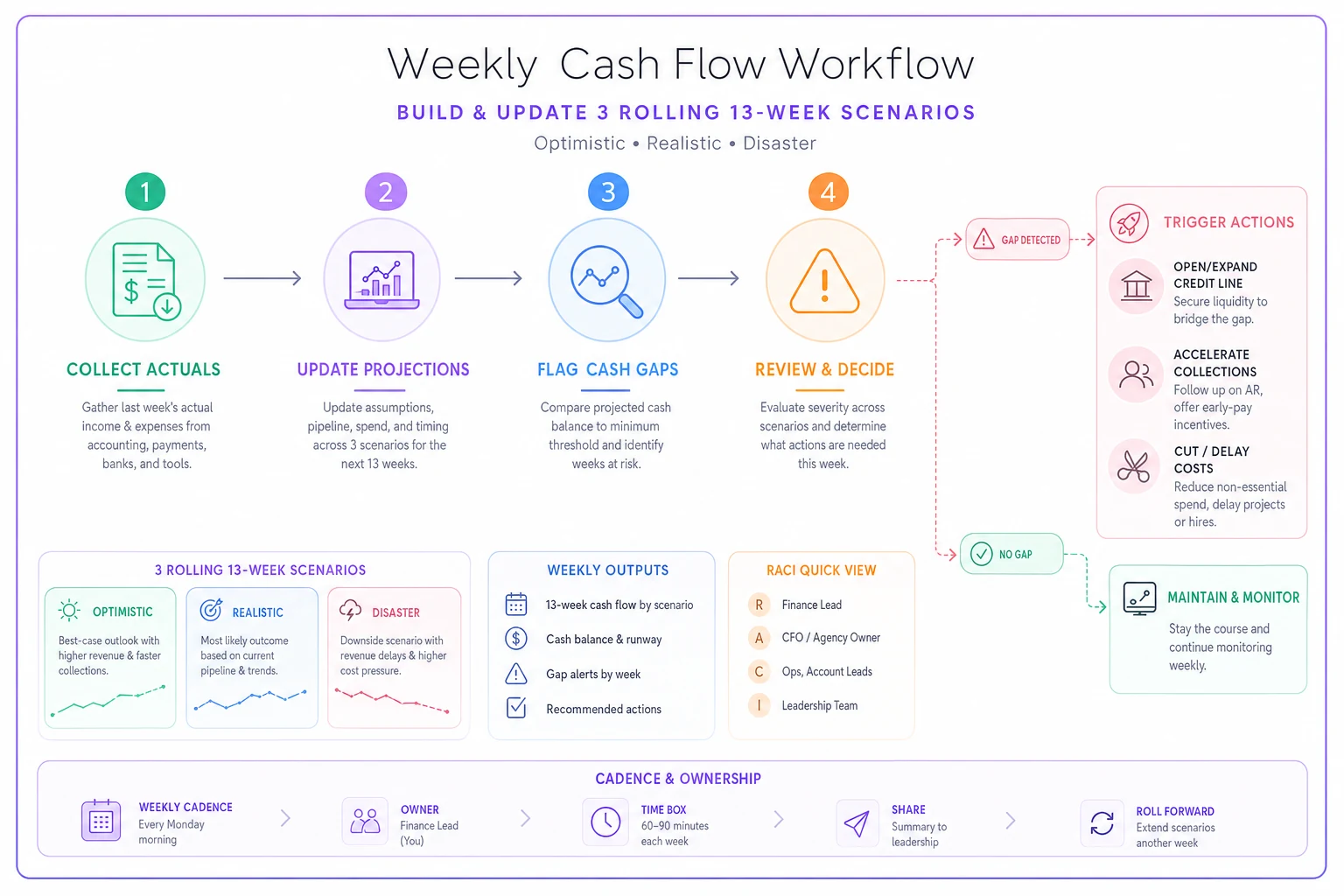
That annual budget from January? Mostly useless now. You need three rolling 13-week cash flow forecasts updated every single week.
Scenario A (Optimistic): Current clients maintain spend, 80% of pipeline closes, payments arrive on time. Best case—probably a 20% chance of happening.
Scenario B (Realistic): 15% client budget reduction, 50% pipeline close rate, payments slip by roughly 15 days on average. This should be your operating assumption.
Scenario C (Disaster): Largest client leaves, 25% cuts across the board, payments stretch to 60 days. If this scenario shows you running out of cash within 8 weeks, you need to act now.
Run these scenarios in a basic spreadsheet. Nothing fancy. Include every cash input and output—client payments, software subscriptions, that lease on the office printer. Update actuals weekly and adjust projections based on real client behavior, not optimism.
When Scenario B shows cash getting tight in week 7, you have 7 weeks to fix it. Open a credit line, accelerate collections, cut costs. But you can't fix what you don't see coming.
This visual shows the weekly workflow to update the three scenarios and trigger actions when cash tightness appears.
Run these scenarios in a basic spreadsheet. Nothing fancy. Include every cash input and output—client payments, software subscriptions, that lease on the office printer. Update actuals weekly and adjust projections based on real client behavior, not optimism.
Step 5: Shift from headcount planning to capacity elasticity
Stop thinking about hiring as adding headcount. Start thinking about buying capacity that can scale up and down with demand.
-
Core capacity (40%) Full-time employees who are untouchable
-
Flex capacity (40%) Contractors and part-timers you can scale
-
Surge capacity (20%) Overflow partners and white-label providers
For a 20-person agency, that might mean 8 full-timers, 8 reliable contractors, and relationships with a couple of overflow partners. When utilization spikes above 85%, you tap flex capacity. Above 95%, you activate surge partners.
Reuters noted that businesses broadly are rethinking fixed cost structures in this environment. CNBC's coverage confirmed the same trend—variable cost models are becoming the default, not the exception.
Price your services assuming 80% utilization of core capacity only. Everything above that is margin expansion. This model survives both feast and famine. When budgets cut, you scale down flex capacity. When demand surges, you can capture it without rushed hiring.
Document capacity triggers in a simple dashboard. Core team hits 85% for two consecutive weeks? Start bringing in flex resources. Drops below 65%? Start reducing contractor hours. Make these decisions systematic, not emotional.
Step 6: Create client profitability triage and intervention protocols
Every Monday morning, you need a ranked list of clients from most to least profitable. Not by revenue—by profit. Include fully-loaded costs: salaries, software allocations, everything.
Three buckets:
-
Green (>25% margin) Protect at all costs
-
Yellow (10-25% margin) Optimize immediately
-
Red (<10% margin) Fix or fire within 30 days
Green clients get preservation mode. Your best people, slightly over-delivered work, and longer contracts locked in before they reconsider budgets.
Yellow clients need immediate intervention. Cut unnecessary touchpoints, standardize their campaigns, suggest platform consolidation that reduces management overhead. You're doing surgery to improve margins without killing the patient.
Red clients get an ultimatum—politely delivered, but firm. Fees increase, scope decreases, or the relationship ends. One agency saved roughly $400K annually by firing their three least profitable clients. That's $400K of capacity redeployed to work that actually made money.
The intervention protocol should be automatic. Client hits yellow? The account lead has 5 days to present an optimization plan. Red? Client conversation within 72 hours.
| Bucket | Description |
|---|---|
| Green (>25% margin): | Protect at all costs |
| Yellow (10-25% margin): | Optimize immediately |
| Red (<10% margin): | Fix or fire within 30 days |
The intervention protocol should be automatic. Client hits yellow? The account lead has 5 days to present an optimization plan. Red? Client conversation within 72 hours.
The automation piece worth paying attention to
While everyone's focused on AI for creative or campaign optimization, the real operational advantage right now is automating the mundane stuff that burns hours and creates errors.
The smarter agencies are building simple operational platforms that monitor these triggers automatically. Instead of manually checking utilization rates, cash positions, and client profitability each week, you get alerts when something needs attention. Your ops manager stops being a number-cruncher and starts making actual decisions.
Budget pacing is a good example. Instead of media buyers manually checking spend rates across a dozen-plus platforms every morning, automated alerts fire when any campaign is pacing 10% over or under. That's somewhere around 45 minutes saved per buyer per day—which adds up fast across a mid-sized media team.
Same logic applies to capacity management. Rather than guessing when to bring in contractors, clear utilization triggers notify your resource manager when it's time to scale. No emotion, no delays, just a response based on what's actually happening.
Automate DSO and utilization alerts so your ops manager can act immediately.
These aren't complex AI systems. They're straightforward automations that remove human error and delayed reactions from critical decisions. An agency that might've taken three weeks to notice and respond to margin compression now catches it in three days. That gap matters a lot when cash is tight.
The hard truth about the next 18 months
The Fed's pause isn't really a pause—it's a warning. Whether rates rise once more or a few more times, the era of cheap money fueling aggressive agency growth is over. The agencies that come out the other side won't be the ones with the best creative or the smoothest pitch decks.
Survival goes to agencies with operational discipline. The ones who know their numbers cold, who can flex their cost structure without breaking, who've turned pricing and capacity into dynamic systems rather than annual discussions.
Every step here is something you can start on tomorrow morning. Not next quarter, not after your next planning session. Because your competitors are either adapting or slowly running out of runway. The Fed just drew a line in the sand.
The smartest agencies are already building the operational infrastructure to navigate this. They're not waiting for conditions to improve. They're assuming they won't and building accordingly. Your capacity formulas and profitability triggers aren't nice-to-haves anymore—they're the difference between staying open and shuttering.
The agencies that come out stronger from this rate environment will be the ones who treated operational excellence as a core competency, not an afterthought.
Ready to elevate your agency's performance?
Join 2,000+ agencies using Digmaly to save time, boost efficiency, and deliver superior client results.